



In the world of robotics, wheels are the "easy mode." They work perfectly on flat factory floors, but they fail at the "last inch" of the real world—the rugged, the uneven, and the unpredictable. To navigate these environments, we look to nature.
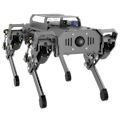
Enter the ROSpider, an 18-DOF (Degrees of Freedom) hexapod platform designed to bridge the gap between biological agility and standardized industrial manipulation. Unlike wheeled rovers, a hexapod doesn't just "roll" over a surface; it interacts with it. By integrating OpenClaw compatibility, the ROSpider moves beyond being a simple mobile base to becoming a versatile robot capable of precise 3D interaction.
Unlock the Full Potential of ROSpider: Check out our comprehensive ROSpider documentation.Hardware Synergy: 18 Servos Meet RISC-V/ARM Power
To achieve lifelike movement, the ROSpider relies on a high-torque actuation stack. It features eighteen 35KG high-voltage bus servos. Why high voltage? Because 18 joints moving simultaneously draw massive current; high-voltage systems ensure that the torque remains consistent even during complex "crouch-and-reach" maneuvers.
One of the most unique features of this platform is its OpenClaw compatibility. In the maker community, hardware fragmentation is a major hurdle. By adhering to the OpenClaw standard, the ROSpider allows developers to swap end-effectors—from grippers to specialized tools—without having to recalculate the entire 6-DOF mechanical arm’s Inverse Kinematics (IK) logic from scratch.
In wheeled robotics, SLAM (Simultaneous Localization and Mapping) is relatively straightforward. But with a hexapod, the "body" naturally oscillates as it cycles through its tripod gait. This creates "motion ghosting" in your LiDAR data.
1.Why TOF LiDAR?
We opted for TOF (Time-of-Flight) LiDAR for the ROSpider. Unlike traditional triangulation LiDAR, TOF sensors measure the phase shift of light, resulting in higher sampling frequencies and better performance in sunlit or high-contrast environments.
2. The Secret Sauce: IMU-Gait Compensation
The true technical "meat" of this system is the IMU-LiDAR Fusion. Inside the ROS 2 stack, we utilize the onboard 6-axis IMU to track the robot's pitch, roll, and yaw in real-time. By feeding this orientation data into the robot_state_publisher, the system constantly updates the TF (Transform) Tree.
The Result: The software "subtracts" the robot's body shake from the laser scan. Even if the ROSpider is climbing over a 30° incline, the LiDAR perceives the world as a stable, level environment.
Inverse Kinematics (IK) & Gait AlgorithmsHow do you coordinate 18 joints without losing your mind? You don't code the servos; you code the Vector.
The ROSpider uses a high-order IK engine. Instead of manually setting 18 angles, you define the (X, Y, Z) coordinates for the leg tips. The ROS 2 controller then calculates the necessary angles for the "Tripod Gait" (where 3 legs support the body while 3 legs swing).
Adaptive Height Control: By fusing the IMU data with the gait algorithm, the ROSpider can detect a slope. It automatically adjusts individual leg lengths to keep the main chassis—and the mounted OpenClaw arm—perfectly level. This "active suspension" is what allows for stable 3D vision and manipulation while on the move.
From Navigation to Manipulation: The WorkflowThe ultimate power of the ROSpider is the hand-off between its "senses":
- Global Navigation: The TOF LiDAR and Nav2 stack guide the robot through a cluttered room to the general vicinity of a target.
- Local Precision: Once within 10cm, the 3D Depth Camera takes over. It generates a high-resolution point cloud of the object.
- Standardized Manipulation: Because the system is OpenClaw-compatible, the MoveIt 2 motion planning framework treats the gripper as a known entity. It plans a collision-free path for the 6-DOF arm to secure the target with millimetric precision.
We believe that advanced robotics should be accessible. The ROSpider is backed by over 2, 000 pages of technical documentation and a fully open-source GitHub repository. We’ve mapped out the full learning path—from basic motor commands to complex LLM-driven autonomous agents.


Comments