



For years, hobbyist robotics was limited to "Reactive Automation"—if a sensor detects a wall, turn left. But the industry is moving toward Embodied AI. This means giving an artificial "brain" (like ChatGPT or DeepSeek) a physical "body" that can reason about its surroundings.
ROSpider is designed specifically as a sandbox for this evolution. It isn't just a walker; it’s a multimodal agent capable of understanding the nuance behind a human command like, "Go find the red package and bring it to my desk."
High-Performance Hardware: The "Body" of the AgentTo run modern AI, you need a serious compute stack. ROSpider supports NVIDIA Jetson or Raspberry Pi 5, acting as the primary "Cerebrum" for high-level ROS 2 processing.
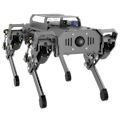
- 18-DOF Bionic Chassis: Unlike wheeled robots, the hexapod's 18 high-voltage bus servos allow it to maintain stability on uneven terrain. It can crouch, tilt, and step over obstacles, mimicking biological movement.
- Dual-Controller Sync: While the Pi 5 handles the AI, an onboard STM32 acts as the "Cerebellum, " managing microsecond-level motor synchronization to keep the gait fluid and stable.
Explore the official ROSpider tutorials to access the complete open-source code and specialized guides for LLM integration.Multimodal Perception: Seeing and Hearing in 3D
An intelligent agent is only as good as its data. ROSpider integrates three core sensing technologies:
- 3D Depth Vision: Using a structured light camera, the robot captures Point Cloud data. It doesn't just see a "flat" image; it understands the 3D volume and exact spatial coordinates of an object.
- LiDAR SLAM: The TOF LiDAR scans the environment 360°, allowing the Nav2 stack to build a high-resolution map and navigate autonomously without bumping into furniture.
- 6-Mic Array: This enables Sound Source Localization (SSL). When you call the robot, it uses "Time Difference of Arrival" (TDOA) logic to turn its head toward your voice.
This is where the magic happens. The workflow bridges the gap between a "chat" and a "physical act":
1. Intent Parsing: The robot captures your voice, converts it to text, and sends it to an LLM (Online via API or Local via Ollama).
2. Task Decomposition: The LLM breaks a vague request into sub-tasks.
- Command: "Clean up the mess."
- Logic: Find objects -> Plan path -> Navigate -> Pick up -> Drop in bin.
3. Vision-Language Alignment: The robot uses YOLO (for recognition) and the 3D camera (for positioning). It "grounds" the LLM's abstract idea of a "messy block" into a real-world coordinate (X, Y, Z).
4. Action Execution: The MoveIt 2 framework calculates the arm's trajectory, ensuring the 6-DOF gripper reaches the target without colliding with the robot’s own legs.
Developer-Centric EcosystemOne of the biggest hurdles in ROS 2 is the steep learning curve. ROSpider lowers this barrier with an Integrated Algorithm Framework. Out of the box, it supports:
- YOLO & OpenCV: For advanced visual tracking.
- MediaPipe: For gesture-based control.
- Extensive Documentation: Over 2, 000 pages of technical manuals and 100+ video lessons.
Whether you are a university researcher or a senior maker, the platform is designed to be "Open-Source First, " allowing you to swap sensors, modify gait algorithms, or deploy your own custom AI models.
ConclusionROSpider represents a move away from "pre-set paths" toward "cognitive missions." By combining the structural flexibility of a hexapod with the reasoning power of Multimodal AI, we are entering an era where robots are no longer just tools—they are intelligent partners capable of navigating and interacting with our world.


Comments