


Hardware components | ||||||
 |
| × | 1 | |||
 |
| × | 1 | |||
_ztBMuBhMHo.jpg?auto=compress%2Cformat&w=48&h=48&fit=fill&bg=ffffff) |
| × | 1 | |||
 |
| × | 1 | |||
 |
| × | 1 | |||
| × | 1 | ||||
| × | 1 | ||||
| × | 1 | ||||
| × | 1 | ||||
 |
| × | 1 | |||
| × | 1 | ||||
Software apps and online services | ||||||
| ||||||
Hand tools and fabrication machines | ||||||
| ||||||
| ||||||
PRAHAR: Predictive Gas Hazard Detection & Response System
The Problem
Gas leaks are among the most dangerous hazards in homes, industries, and confined environments. Most existing detection systems trigger alarms only after gas concentration has already reached unsafe levels.By the time an alert is generated, the window for safe intervention is extremely limited—leading to accidents, health risks, and potentially catastrophic outcomes.
The Idea
PRAHAR is designed to shift safety systems from reactive detection to proactive prediction.Instead of waiting for gas levels to cross a threshold, PRAHAR continuously analyzes how quickly the concentration is increasing and estimates the Time-To-Danger (TTD)—the time remaining before conditions become critical.This enables early warnings and provides users with valuable time to take preventive action.
Why PRAHAR is Different
Unlike existing dashboards, PRAHAR introduces a predictive Time-To-Danger metric that gives workers advance warning — not just current readings. Conventional systems operate on a simple logic:Gas crosses threshold → Alarm triggered → Response begins→ Often too latePRAHAR introduces a smarter approach:Gas trend increasing → TTD calculated → Early warning issued→ Action before dangerThis shift from threshold-based detection to rate-based prediction makes PRAHAR a more intelligent and safety-focused solution.
Why PRAHAR is Unique
While gas detection systems are widely used, PRAHAR introduces a simplified, implementable predictive approach that brings early-warning capability to low-cost systems.Its uniqueness lies in:Prediction over detection using rate-based analysisTime-based risk estimation (TTD) instead of static thresholdsLow-cost implementation using accessible hardwareSimulation-first validation for controlled and reliable testingScalable design for future industrial and IoT applications
System Overview
PRAHAR is a simulation-validated
prototype built using Arduino UNO.
Developed and tested on Tinkercad,
where a potentiometer simulates
MQ-2 gas sensor behavior.
Core components:
→ Arduino UNO (processing unit)
→ MQ-2 Gas Sensor (real hardware)
→ Potentiometer (simulation input)
→ Piezo Buzzer (audio alert)
→ Red/Yellow/Green LEDs (visual alert)
The system processes real-time input
and triggers alerts based on predicted
risk levels.
v3.0 Update (March 2026):
Red, Yellow and Green LED visual
alerts added — both audio and visual
indication now available.
→ Green LED — Safe (gas < 250)
→ Yellow LED — Warning (250-400)
→ Red LED — Danger (gas > 400)
Early Warning: System alerts when
TTD drops below 10 seconds!
TTD Prediction Algorithm
The intelligence of PRAHAR lies in its simple yet effective predictive model:Rate of change = Current reading − Previous readingTime-To-Danger (TTD) = (Threshold − Current value) / RateBy evaluating how fast gas levels are rising, the system predicts when a dangerous threshold will be reached—enabling early intervention.
Results
Testing in simulated conditions shows that PRAHAR can:Detect rapidly increasing gas trendsProvide warnings before critical thresholds are reachedAutomatically trigger alerts in high-risk conditionsExample:Gas level reaching ~430 → Danger detected and buzzer activated
Applications
PRAHAR is designed for real-world safety scenarios, including:Domestic LPG leak detectionChemical and process industriesMining and confined spacesLaboratories and storage facilities
Future Scope
PRAHAR is built as a scalable system with strong potential for real-world deployment. Planned enhancements include:Integration of real MQ-2 gas sensorIoT-based remote alert systemsMulti-node monitoring networksAI-based predictive modeling
Conclusion
PRAHAR demonstrates a critical evolution in safety systems—from detecting danger to predicting it.Even as a simulation-validated prototype, it highlights how intelligent analysis of data trends can significantly improve response time and safety outcomes.Because in safety, prediction is not an advantage - it is a necessity. It saves lives.
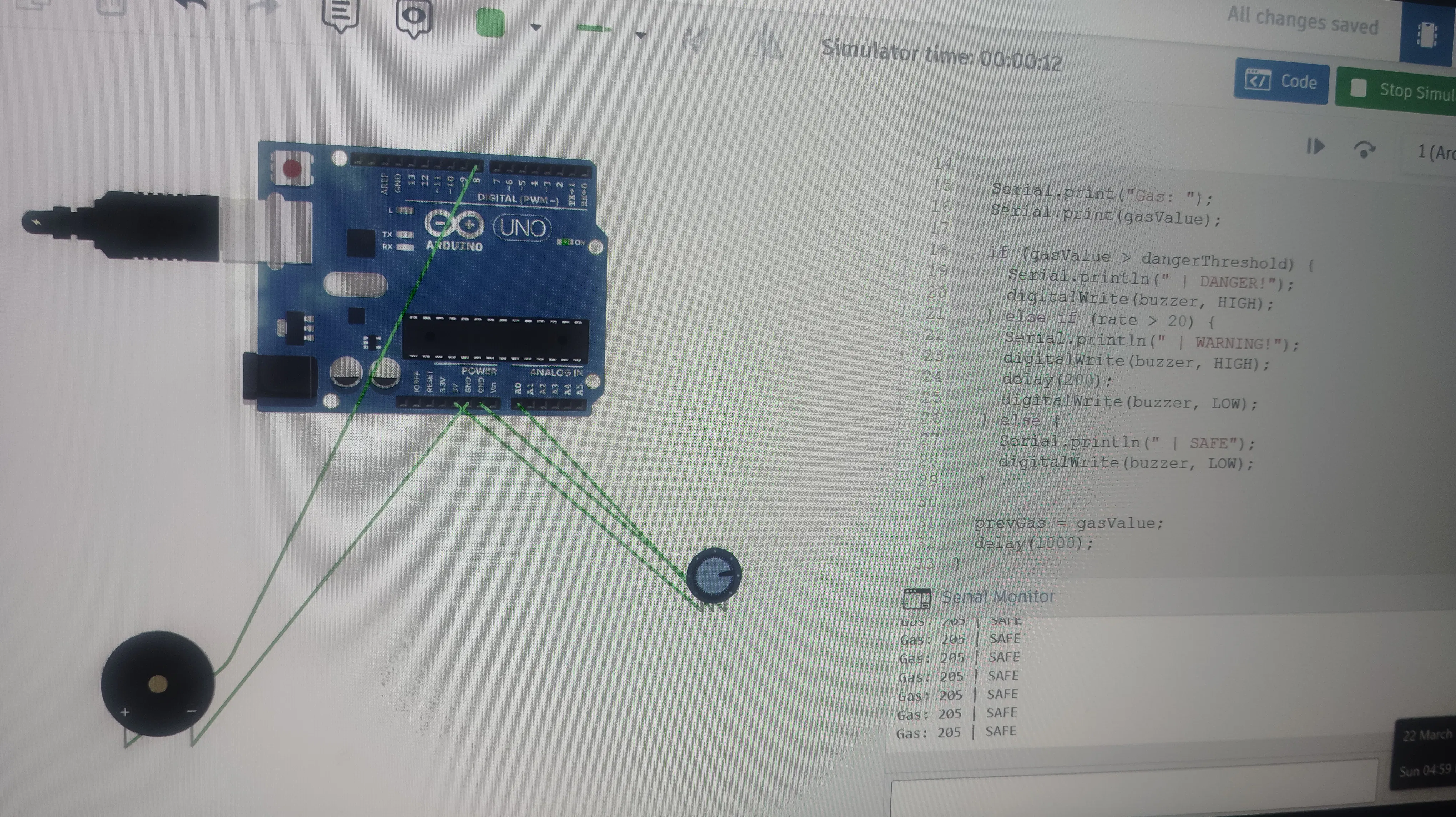
PRAHAR_Gas_Detection_Simulation
SAFE, DANGER and transition
states of PRAHAR gas detection
system using Arduino UNO R3,
Potentiometer and Piezo Buzzer.
TTD prediction algorithm working.
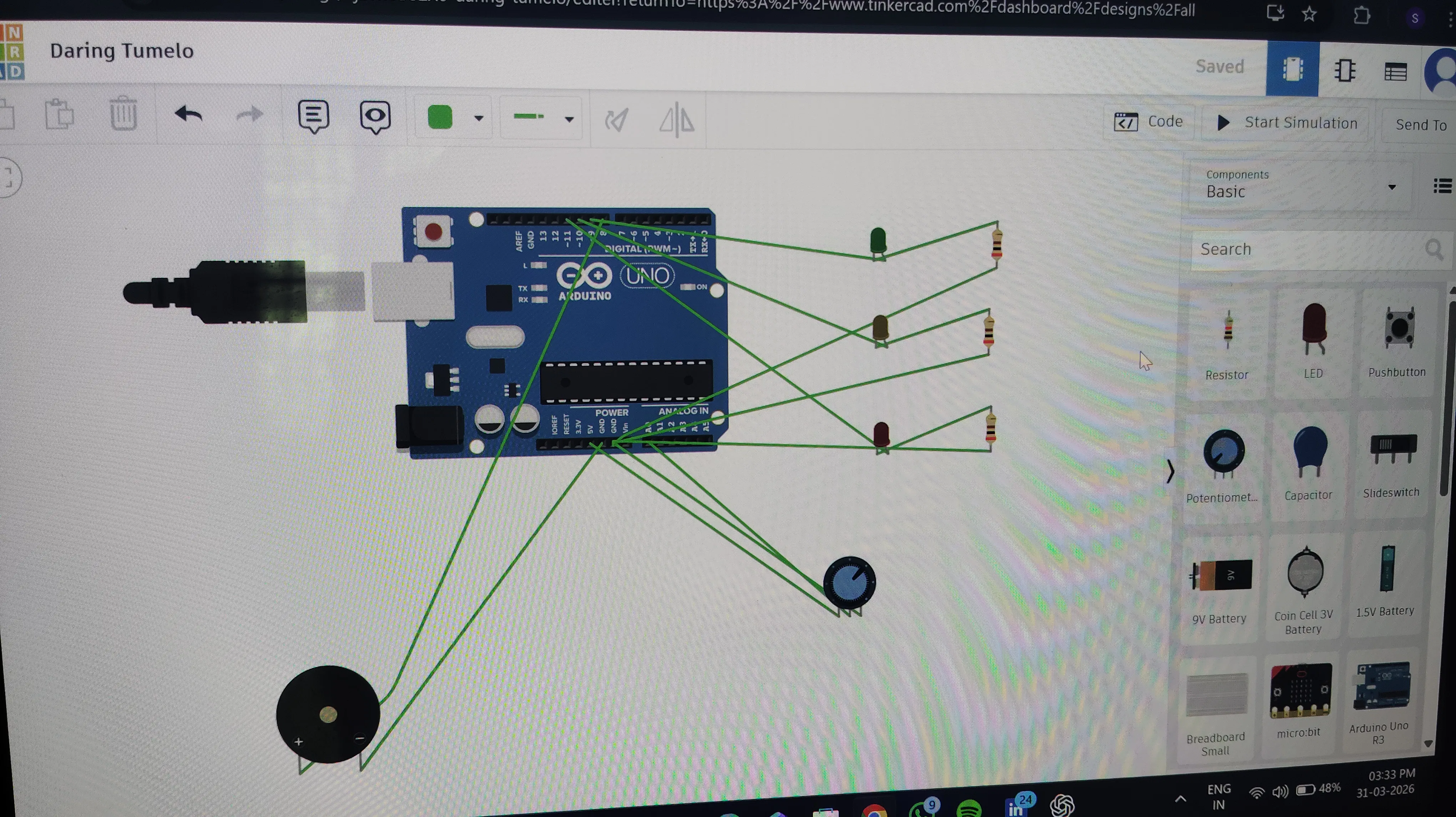
PRAHAR v3.0 — Circuit Design | Arduino
Components visible:
→ Arduino UNO — Main controller
→ Green LED (Pin 5) — Safe zone
→ Yellow LED (Pin 6) — Warning zone
→ Red LED (Pin 7) — Danger zone
→ 220Ω Resistors — LED protection
→ Potentiometer — MQ-2 simulation
→ Buzzer — Audio alert
TTD algorithm running on Arduino!
Simulation: Tinkercad
Made in India. For India.
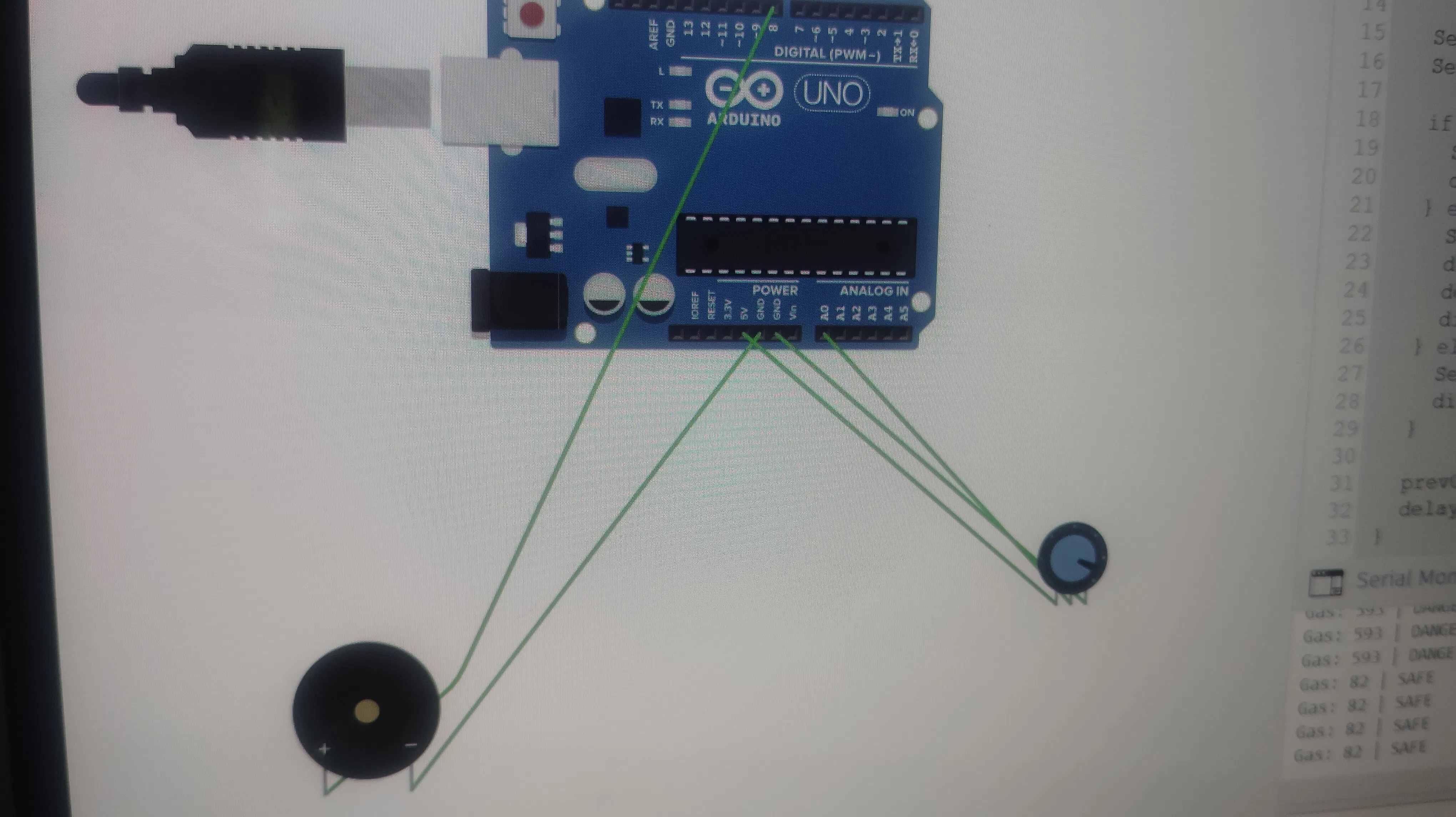
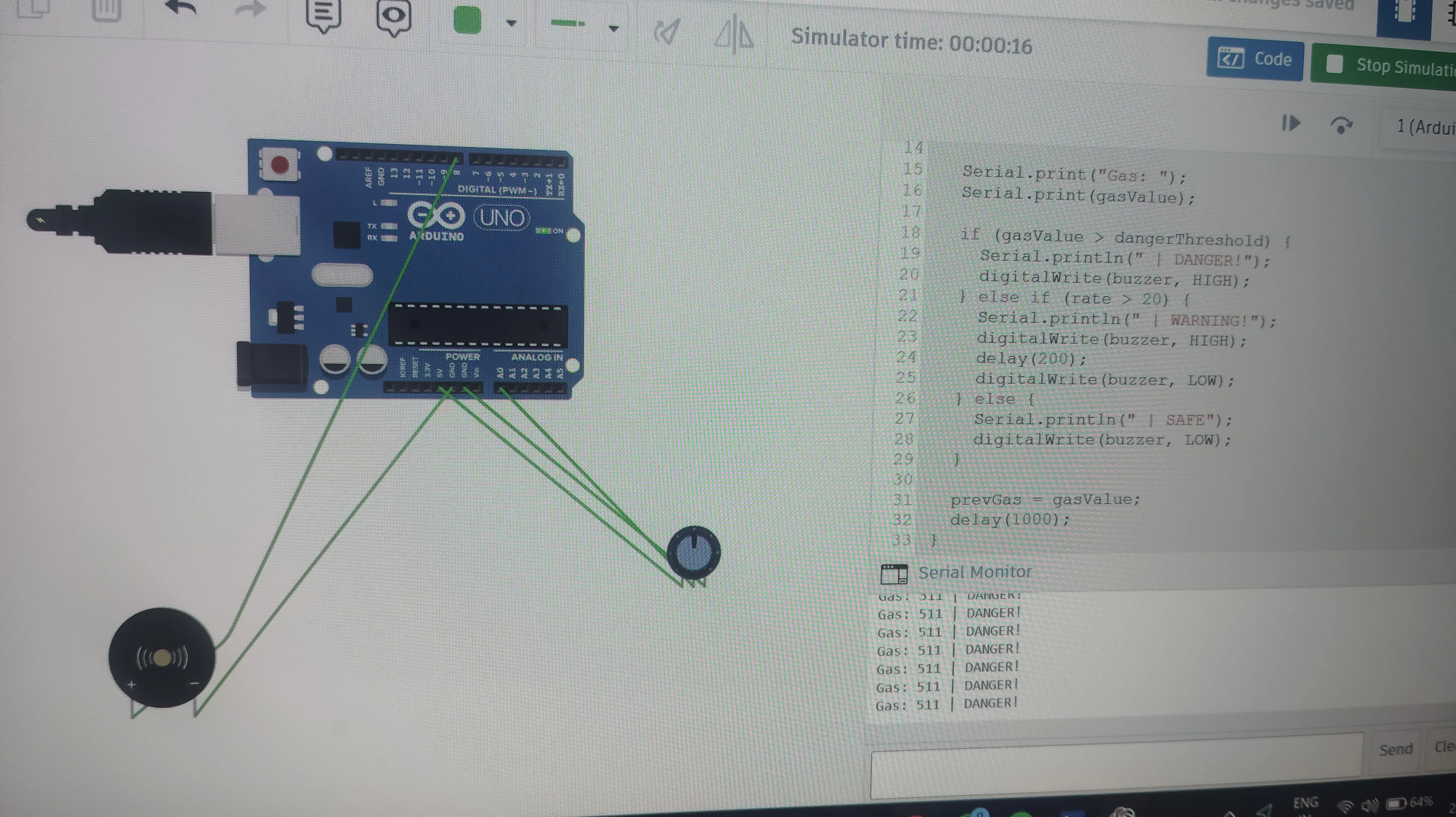
PRAHAR_Complete_Demo
full simulation demo on Tinkercad.
Circuit: Arduino UNO R3 +
Potentiometer (MQ-2 simulation) +
Piezo Buzzer
Demonstration:
→ SAFE: Gas level normal,
buzzer silent
→ DANGER: Gas level 430+,
TTD algorithm triggers
buzzer BEFORE critical level!
Rate-based prediction
not just detection!


Comments