


Hardware components | ||||||
| × | 1 | ||||
| × | 1 | ||||
 |
| × | 1 | |||
What's happening in the radio spectrum around you? FM radio stations broadcasting music, air traffic controllers guiding planes, ham radio operators chatting across continents, weather satellites beaming down images, digital data flowing through the air - all invisible but constantly present.
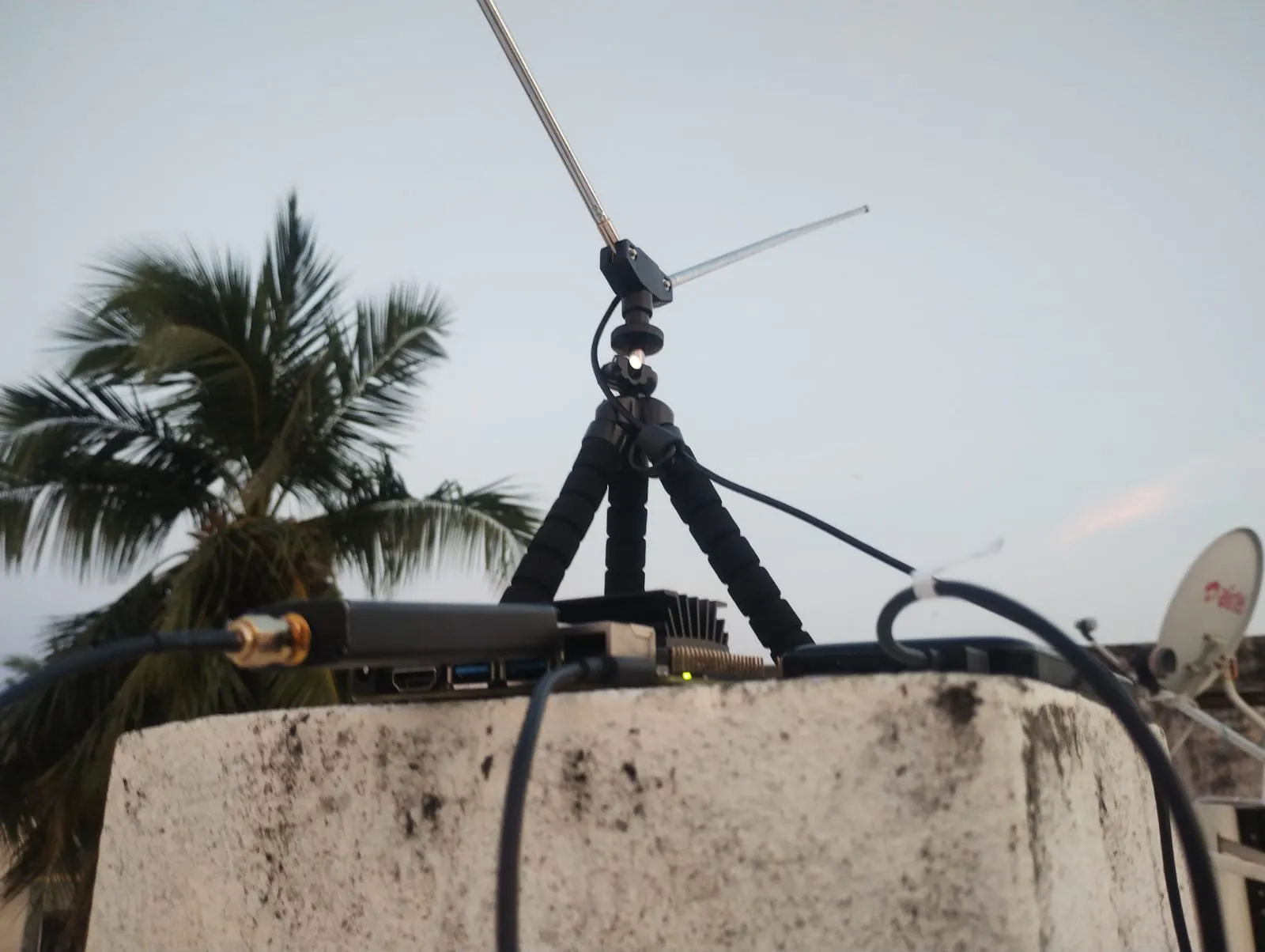
With a RTL-SDR dongle and this software, you can SEE all of this activity. This project transforms your computer and SDR into a powerful spectrum scanner that automatically finds and identifies active signals in your area.
No manual tuning required. No complex configuration. Just plug SDR antenna, run, and discover
What is RTL-SDR?RTL-SDR is a miraculous little USB dongle originally designed for watching TV on computers. Clever hackers discovered the chip inside (RTL2832U) could be repurposed as a wideband software-defined radio receiver. Today, it's the most popular SDR for hobbyists worldwide.
Specifications:
Frequency range: 24 MHz - 1.7 GHz
- Frequency range: 24 MHz - 1.7 GHz
Bandwidth: Up to 2.4 MHz
- Bandwidth: Up to 2.4 MHz
This software does all the heavy lifting for you:
The Killer Feature: FULLY CUSTOMIZABLE!You are NOT limited to the default bands! The scanner is designed to be modular and adaptable. You can easily modify bands.cpp to track ANY frequency range from 24MHz to 1.7GHz.
Fully Customizable - Add ANY frequency bands you want by editing one fileFFT-based Processing - Professional spectrum analysisThread-safe - Handles concurrent operations safely Automatic Band Scanning - Sweeps through frequency bands without manual tuningReal-time Signal Detection - Identifies peaks above noise floorSignal Classification - Automatically identifies FM, AM, Digital, and more(It can be changed based on user requirements)Bandwidth Measurement - Calculates -3dB bandwidth for each signalSNR Calculation - Measures signal-to-noise ratioPersistence Tracking - Confirms signals across multiple scans (eliminates false positives)Signal Ranking - Shows strongest signals in your area
How It WorksWhat you might detect:
10+ FM broadcast stations
Multiple police digital signals (450-470 MHz)
- Multiple business/police digital signals (450-470 MHz)
Cellular signals (700-900 MHz)
- Cellular signals (700-900 MHz)
Occasional air band traffic
- Occasional air band traffic
Ham radio repeaters
- Ham radio repeaters
What you might detect:
Heavy air band activity (118-137 MHz)
- Heavy air band activity (118-137 MHz)
ADS-B position reports (1090 MHz)
- ADS-B position reports (1090 MHz)
ACARS airline data (131.55 MHz)
- ACARS airline data (131.55 MHz)
Approach/departure control
- Approach/departure control
Ground control communications
- Ground control communications
What you might detect:
2-3 FM stations
- 2-3 FM stations
Ham radio conversations
- Ham radio conversations
NOAA weather radio (162.4-162.55 MHz)
- NOAA weather radio (162.4-162.55 MHz)
Occasional air traffic
- Occasional air trafics
What you might detect:
Marine VHF channels (156-162 MHz)
- Marine VHF channels (156-162 MHz)
Edit src/bands.cpp and add your bands:
std::vector<Band> getBands() {
return {
// Keep existing bands
{"FM Broadcast", 88.0e6, 108.0e6, 2.0e6, -80.0, "FM"},
// YOUR CUSTOM BANDS HERE
{"NOAA Weather Satellites", 137.1e6, 137.9e6, 100e3, -90.0, "APT"},
{"Pager Systems", 929.0e6, 932.0e6, 500e3, -85.0, "POCSAG"},
{"Wireless Microphones", 470.0e6, 608.0e6, 100e3, -80.0, "FM"},
};
}
If you need more information please contact me to this bhatharshit2@gmail.com Email ID


Comments