


Hardware components | ||||||
 |
| × | 2 | |||
| × | 2 | ||||
 |
| × | 1 | |||
 |
| × | 1 | |||
 |
| × | 1 | |||
 |
| × | 2 | |||
 |
| × | 2 | |||
 |
| × | 1 | |||
| × | 1 | ||||
 |
| × | 1 | |||
Software apps and online services | ||||||
 |
| |||||
| ||||||
| ||||||
| ||||||
| ||||||
| ||||||
| ||||||
Korea recorded 2, 559 forklift accident casualties in 2021–2022 (KOSHA). One workplace injury costs about USD 116, 000 once indirect costs are included (NSC Injury Facts, OSHA 3885). Proximity alarms exist, but they have three weaknesses:
- They cry wolf. A 5 m distance alarm also fires on every forklift that will pass safely. In our simulation, 85 % of its alerts are false, and workers learn to ignore them.
- One buzz says "danger", not "what now". In our first version, the remaining collisions came from workers who stopped at the buzz and then walked back into the lane before the forklift had passed.
- No server, no safety. When the network or the server fails, server-based systems go silent exactly when they are needed.
Tags and forklift modules publish their positions into oneM2M. An ETSI MEC application next to the CSE predicts collision courses. Each worker gets WAIT → GO, or STEP ASIDE when standing in the lane, and the forklift slows only as much as needed.
How it works- Sense: UWB worker tags and forklift modules publish their position up to 10 times per second (2 Hz when nothing is near): as an UPDATE of their own SDT device twin on ACME, or as a contentInstance on any CSE (Mobius, and the ESP32 firmware today).
- Notify: the edge CSE notifies the EdgeGuard MEC app through subscriptions. No polling and no custom broker.
- Predict: Kalman tracking, a turning model for forklifts (CTRV), or the forklift's planned route when the fleet system shares it.
- Decide: a collision-course test borrowed from missile guidance. If the bearing stays constant while the range closes (line-of-sight rate ≈ 0) and the closest point of approach is inside the safety radius, the two will meet. A forklift that will pass by never raises an alert.
- Cue: an alert contentInstance goes back through oneM2M. The tag shows WAIT until the forklift has passed and then GO, or STEP ASIDE. The forklift module enforces the smallest speed limit that avoids contact. Each device confirms what it did in its own
statuscontainer.
Each device is its own AE, so the originator is the device. The MEC app's decisions are oneM2M resources too, which means any oneM2M application can subscribe to them. The tree below shows the SDT data model on a zone MN-CSE (illustrative; the same tree runs on the IN-CSE in the single-CSE demos).
/cse-mn-a (zone MN-CSE on the MEC host)
├─ worker_01                AE, originator SWorker01, lbl egs:role/worker
│   ├─ tag                  flexContainer egs:wrkTg (device class "workerTag")
│   │   ├─ kinematics       egs:kinSt  posX, posY, speed, heading, sampleTime   (mni 100: history)
│   │   ├─ cue              egs:wrkCe  cueState IDLE | WAIT | ASIDE | GO
│   │   ├─ battery          cod:bat    standard oneM2M module class
│   │   └─ smd              semanticDescriptor (SAREF, RDF/Turtle)
│   ├─ relay · status       containers: D2D relay, actuator confirmations
│   └─ acp_worker_01        ACP
├─ forklift_01              AE, originator SForklift01
│   ├─ module               egs:frkMe: kinematics, speedLimit (egs:spdLt), battery, smd
│   └─ acp_forklift_01
└─ EdgeGuard AE of the MEC app: risk · alert · control · nearmiss (mni 2000) · mec_leaseInstead of opaque JSON in contentInstances, device state uses flexContainer specializations from our own SDT domain org.edgeguard.safety. The device classes workerTag and forkliftModule combine three new module classes with the standardbattery module class from org.onem2m.common. The domain is a single file that the CSE loads (config/onem2m/edgeguard.fcp):
{ "type": "egs:kinSt", "lname": "kinematicState", "sdttype": "moduleclass",
  "cnd":  "org.edgeguard.safety.moduleclass.kinematicState",
  "attributes": [
    { "sname": "posX",  "lname": "positionX",  "type": "float",   "car": "1" },
    { "sname": "posY",  "lname": "positionY",  "type": "float",   "car": "1" },
    { "sname": "speed", "lname": "speed",      "type": "float",   "car": "01" },
    { "sname": "smpTe", "lname": "sampleTime", "type": "integer", "car": "1" } ] }
With the SDT data model (ACME), a position sample is a single UPDATE of the kinematics module. The CSE keeps the history (fcied, mni) and notifies the subscribers. Mobius deployments and the current ESP32 firmware use plain contentInstances; the MEC app accepts both:
PUT /cse-mn-a/forklift_01/module/kinematics
X-M2M-Origin: SForklift01
{"egs:kinSt": {"posX": 3.5, "posY": 2.1, "speed": 1.8, "headg": 0.0, "smpTe": 1791617040123}}- Labels: every resource carries
egs:site/…,egs:role/…,egs:id/…,egs:module/…. The MEC app finds every kinematics module with one discovery request,GET /cse?fu=1&ty=28&lbl=egs:module/kinematics. A tag that registers itself is onboarded automatically, without a device list; in CI this takes about 9 s. - Semantics: each twin has a SAREF description in a
semanticDescriptor. A semantic query answers questions like "which forklifts control their drive speed?" and returns oneM2M paths an application can subscribe to:
PREFIX saref: <https://saref.etsi.org/core/>  PREFIX egs: <https://edgeguard.example/ns#>
SELECT ?d ?path WHERE { ?d a saref:Device ; egs:role "forklift" ;
saref:controlsProperty egs:DriveSpeed ; egs:resource ?path . }- One ACP per device AE: the device has full rights, the MEC app and the MEC-IPE may read, discover and subscribe, and every other device gets nothing.
- CREATE limited by child type: with
accessControlObjectDetails(chty: [23]), the MEC app may create subscriptions only and cannot write data into a device's twin. - Checked on every commit: CI runs 8 access checks against a real Mobius (a forged write from another device is refused) and checks on ACME that another device cannot update a twin (403).
- Encrypted, authenticated transport: devices use MQTT over TLS, and applications use HTTPS. In CI, plaintext HTTP and MQTT, an untrusted certificate, a wrong password, a device sending as another device, and another device reading the forklift's data are all refused (10/10).
- Privacy by placement: worker trajectories stay in the zone's edge CSE; only alerts, risk summaries and near-miss records (event positions, not trajectories) leave the site. Device-to-device frames are signed with an HMAC.
{"m2m:acp": {"rn": "acp_forklift_01", "pv": {"acr": [
   {"acor": ["SForklift01"], "acop": 63},
{"acor": ["SEdgeGuard", "SMecIpe"], "acop": 51, "acod": [{"chty": [23]}]} ]}}}- Device → CSE — Protocol: oneM2M MQTT binding over TLS (firmware today: Mca over HTTP) · Why: one open connection, no inbound port; broker password and an ACL that lets a device speak only as itself
- MEC app ↔ CSE — Protocol: Mca over HTTPS, subscriptions / notifications · Why: the CSE pushes every sample to the app; the CSE certificate is checked against the site CA
- Tags behind NAT — Protocol:
<pollingChannel>· Why: the tag long-polls; zone alerts reach it without an inbound connection - Zone MN-CSE ↔ IN-CSE — Protocol: Mcc · Why: edge to cloud, announcement of device AEs
- Device ↔ device — Protocol: ESP-NOW + HMAC, UWB ranging · Why: works with no access point and no CSE: the fallback when the network fails
- MEC services — Protocol: ETSI MEC REST (MEC 013, MEC 012) · Why: brought into oneM2M by a MEC-IPE
- MEC services through oneM2M: a MEC Interworking Proxy Entity (MEC-IPE) polls the Location and RNIS APIs and writes new values as oneM2M resources (
location/<ue>,rnis/<cell>). The MEC app subscribes to MEC data exactly as it subscribes to a device. Location supplies positions for people without a UWB fix, and RNIS cell load sets the reporting rate and the alert priority. - Deployment: the MEC app runs as a Docker container next to the CSE on the MEC host, as an active-standby pair (takeover in 0.73 s). It ran live against the public ETSI MEC Sandbox (try-mec.etsi.org) and in a custom warehouse scenario on a self-hosted AdvantEDGE (70 alerts in 2 minutes).
- Event-driven and bidirectional: a second MEC-IPE subscribes to MEC 013 zone events and MEC 012 per-UE measurement reports (RSRP / RSRQ). It writes them into oneM2M as SDT twins (
egs:mecUewithegs:ueLocandegs:rdLnk), and it executes MEC requests that oneM2M applications post intoMEC-IPE/requests(zone_subscribe, radio_subscribe, location, unsubscribe). Zone event → oneM2M resource: median 15–45 ms. - Zone broadcast: one oneM2M
<group>per zone. A DANGER alert is one request to<group>/fopt, and the CSE creates it in the inbox of every tag in that zone (p50 8–19 ms including the tag's polling channel). - Latency: the median alert latency on the edge is 25 ms, against 85 ms for a cloud-only path (measured with an injected 25 ms one-way WAN delay).
A large warehouse has several zones, each with its own MEC host and MN-CSE. When a forklift drives from zone A to zone B, its oneM2M presence moves with it, make-before-break (edgeguard/handover.py):
- Trigger: the forklift's position is 1 m inside zone B (hysteresis against ping-pong), or the serving CSE stops answering (availability).
Prepare in the background while samples keep flowing to zone A:
- state: the module values (speed limit, kinematics, battery) are read from the source and restored on the target
- security: the AE, twin and ACP are rebuilt with the same rules
- subscriptions: every subscription on the twin is re-created with the same notification URIs. This works because subscribers attach the device's ACP to their subscription, which lets the device read and carry it.
- announcement: the new AE is announced to the IN-CSE, whose AEAnnc
lnkpoints at the serving CSE - Prepare in the background while samples keep flowing to zone A:state: the module values (speed limit, kinematics, battery) are read from the source and restored on the targetsecurity: the AE, twin and ACP are rebuilt with the same rulessubscriptions: every subscription on the twin is re-created with the same notification URIs. This works because subscribers attach the device's ACP to their subscription, which lets the device read and carry it.announcement: the new AE is announced to the IN-CSE, whose AEAnnc
lnkpoints at the serving CSE - Switch: the next sample goes to zone B.
- Home record:
<IN-CSE>/<device>/servingis updated, so applications can resolve or subscribe to the device's current CSE. - Release: the AE on zone A is deleted after a short grace period.
Measured (CI, every commit):
- Location A → B — Prepared in: ≈ 115–140 ms (in the background) · Service interruption: 3–11 ms · Samples lost: 0
- Availability: zone B's CSE killed → back to A — Prepared in: ≈ 80 ms after detection · Service interruption: ≈ 306 ms · Samples lost: 3 (the detection window)
The subscribed application never re-subscribed. It kept receiving notifications, now sent by zone B's CSE (/id-mn-b).
Triggered by the network. In ESTIMED terms, the trigger authority can also be the MEC network. The MEC platform sees the forklift attach to zone B's small cell and emits ENTERING_AREA_EVENT zoneB. The MEC-IPE writes the event into oneM2M, and the forklift, subscribed to it, starts the handover. In the CI run (A → B → A at 4 m/s), interruption was 1.5–8 ms and no sample was lost. At the boundary, the RSRP of both cells crosses over at about −90 dBm.
If a device hears no heartbeat from the MEC app for 2 s, it switches to local decisions: UWB ranging between devices, direct state exchange over ESP-NOW (HMAC-signed), and alert relay to neighbours in coverage holes. It stops only when nothing else is known.
- Total network outage (180 encounters that would collide) — Collisions: 2 (v0.7 hold-then-stop: 180) · Forklift throughput: 57 % (stop-everything approach: 18 %)
- Worker or forklift in a coverage hole — Collisions: 0 / 0 (was 16 / 19) · Forklift throughput: —
Worker trajectories are personal data. To learn how people really walk (decelerating into stops and turns, which constant velocity misses), each site trains a small worker-motion model on its own data, and only weights travel through oneM2M (edgeguard/fl.py):
- Coordinator (IN-AE): a
taskflexContainer (egs:flTsk: model, rounds, clients per round, quorum, timeout, status, model version), aroundscontainer (selection per round) and amodelscontainer (every version with its parent and participants: model lineage). - Clients (one AE per site): a
participantflexContainer (egs:flPrt: sample count, availability, compute score, last round) and anupdatescontainer. - Dynamic selection: participants are found by label. The coordinator picks available clients with enough data, preferring those that waited longest. If a round reaches its quorum before the timeout, it is aggregated with FedAvg.
In the CI run, Incheon's MEC host fails in the middle of round 3, and the round is still aggregated from the other two sites. Daejeon registers before round 4 and is selected immediately.
- Constant velocity (what the risk engine assumed) — 0.604 m
- Each site training alone — 0.521 m
- Federated global model — 0.486 m
Aggregation is not delivery. Each site's model manager subscribes to the model repository and handles every new version in three steps:
- Canary: the version is evaluated on the site's own held-out data and must beat the active model.
- Activate: it is activated in the risk engine (
guidance_fl). - Monitor: the previous version is shadow-evaluated on live windows, and the manager rolls back if it wins three times in a row.
In CI, an untrained v0 and a corrupted v2 are rejected, and a Busan-specialised v3 is activated. After a layout change, v3 is rolled back to the global v1. Each step is recorded in egs:mdlDp.
The study ran on ACME. The design follows the ESTIMED proof of concept and is meant to run on the ESTIMED VM.
Swarm and orchestration (TR-0077 7.4 and 7.1)Swarm. Forklifts in a zone form a swarm: a <group> of their plan containers. Each forklift publishes its route through the intersections with arrival times and reads every member's plan with one request (<group>/fopt/la, ≈ 6 ms). It then computes the same conflict-free schedule as everyone else: loaded forklifts first, then the earliest arrival, then a 4 s headway at shared intersections. No coordinator is needed, and every participant keeps local authority. In the demo, conflicts drop from 4 to 0, at 14.5 s of total delay compared with 23.5 s for braking at each intersection.
Orchestration. MEC hosts register themselves (egs:mecHs: zone, free CPU and memory, RTT, lifecycle API, a one-second heartbeat). An operator deploys EdgeGuard by creating a single egs:depIn intent, for example "risk engine, zone A, 2 CPU, ≤ 10 ms". The orchestrator then:
- discovers hosts by label and selects one against the constraints
- deploys through the host's lifecycle API
- waits for the instance to register its own AE
- provisions it by extending the device ACPs and writing its configuration
The engine runs ≈ 0.75 s after the intent. When the zone A host crashes, the engine is running again on the second zone A host ≈ 2.3–2.7 s later, and the old instance's access is revoked.
See docs/estimed-mapping.md for how each feature maps to TR-0077 clause 7 and the ESTIMED deployment continuum (EdgeGuard is option C per zone, with an IN-CSE in the cloud).
AI safety agent with MCPA safety manager wants a shift report, not raw resources. Our agent (agent/) talks to four MCP servers: one oneM2M server per CSE (the IN-CSE and both zone MN-CSEs) and one for ETSI MEC. It runs a multi-step workflow:
- Read its own state from oneM2M, so only new near misses are processed.
- Build the device inventory with SAREF semantic queries on every CSE.
- Find near-miss hotspots and classify them: blind corner, unalerted, fast traffic, or crossing.
- Add MEC context: how many people are near each hotspot right now (Location) and the radio load (RNIS).
- For every forklift involved, look up its serving CSE in the home record and route the query to that zone's MCP server for the live speed limit.
- Validate the totals and check that the data did not change mid-run, then persist the report, the cursor and a step log in oneM2M.
If a CSE is down, the agent writes a partial report, records the error, and keeps the cursor so those records are read again on the next run. Its writes are limited to its own AE (a server-side guardrail), and its oneM2M identity is still bound by the ACPs.
Sample recommendation from the CI run:
(12, 4) m, 9 near misses: Blind corner: add the rack to the site map / install a convex mirror - 3 people within 6 m right now (-7, 0) m, 6 near misses: Fast forklift traffic: declare a speed-limited zone - forklift_02 currently without a speed limit - 1 person within 6 m right now
(12, 4) m, 9 near misses: Blind corner: add the rack to the site map / install a convex mirror - 3 people within 6 m right now (-7, 0) m, 6 near misses: Fast forklift traffic: declare a speed-limited zone - forklift_02 currently without a speed limit - 1 person within 6 m right nowHardware build
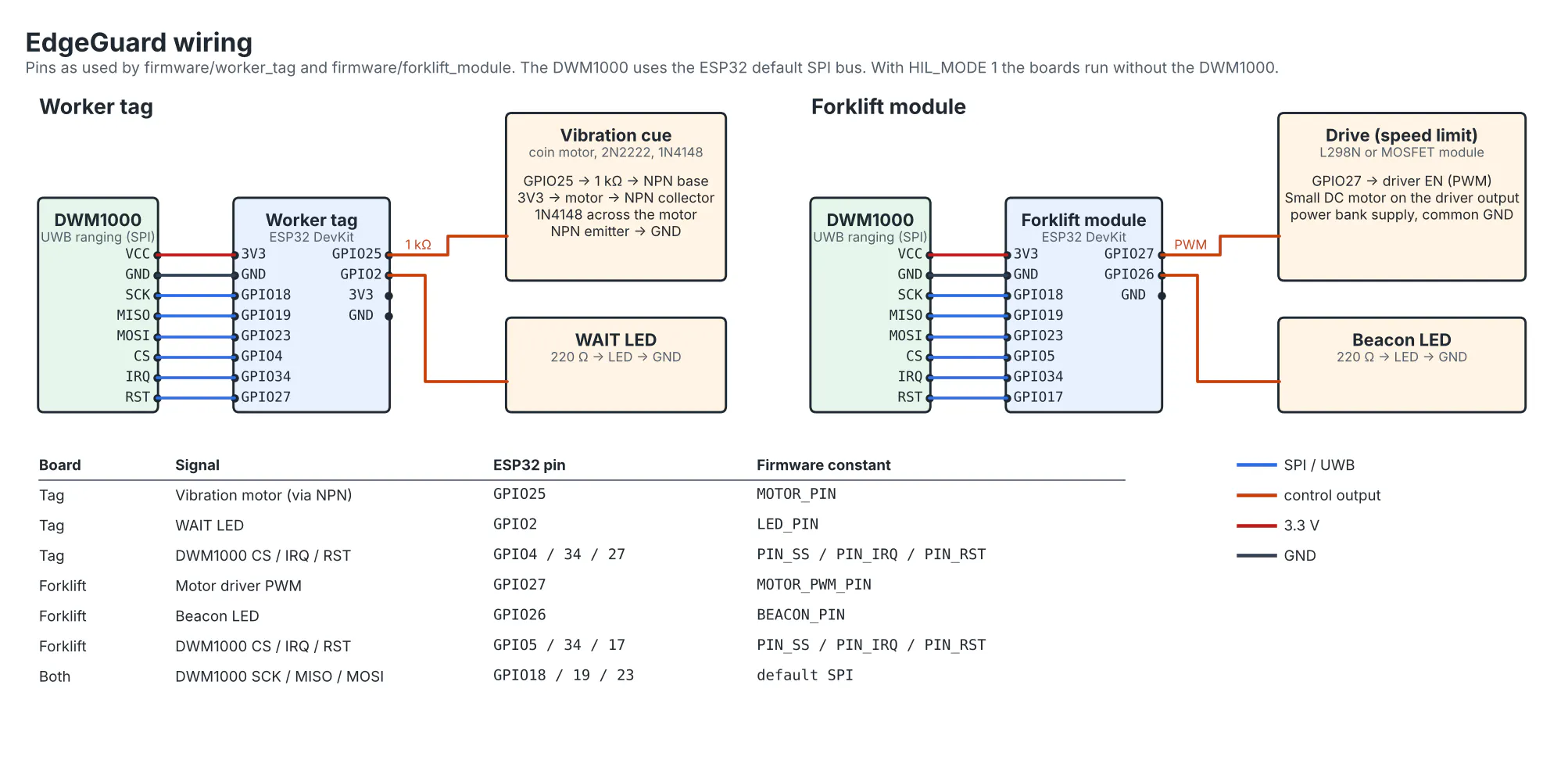
- Tag — Pin: GPIO 25 · Connection: 1 kΩ → transistor base; vibration motor on the collector (other end 3.3 V); diode across the motor
- Tag — Pin: GPIO 2 · Connection: 220 Ω → LED → GND (WAIT light)
- Forklift — Pin: GPIO 27 · Connection: motor driver PWM / EN; driver powered from a power bank
- Forklift — Pin: GPIO 26 · Connection: 220 Ω → LED → GND (beacon)
Status: the board kit and wiring are ready and the board demo is scheduled before the final; the CI evidence today is firmware-in-the-loop. The firmware (firmware/) registers the device's own AE at boot and receives alerts as oneM2M notifications. It drives the outputs and writes confirmations to <device>/status, which appear on the dashboard as HW ✓. Firmware-in-the-loop: the same sketches compile unmodified for a PC, and CI runs them against a real CSE on every commit (6 of 6 checks). A phone can act as the tag: open http://<MEC host>:9090/tag?worker=worker_01.
Against our own v1.0 (vibration-only alert, same simulator):
- Collisions, many-to-many site (8 workers, 4 forklifts, 750 conflicts) — v1.0: 100 · EdgeGuard: 4 (−96 %)
- Forklift throughput on that site — v1.0: 61.7 % · EdgeGuard: 86.0 %
- Collisions in 1, 207 one-to-one conflicts — v1.0: 145 · EdgeGuard: 1
Against a 5 m proximity alarm:
- Detected ≥ 1 s before contact — 5 m alarm: 76 % · EdgeGuard: 100 %, median lead time 2.4 s
- False alarm rate — 5 m alarm: 85 % · EdgeGuard: 30 %
Worker behaviour is modelled, so we report sensitivity: at 85 / 70 / 50 % WAIT compliance, collisions are 12 / 27 / 42 of 1, 207 (v1.0: 145).
Why oneM2M, and why we would keep using it- A hub, not a database: subscriptions replaced the broker and polling code we would otherwise have written.
- Open by design: alerts and near misses are standard resources. A WMS, a reporting tool or a camera vendor can subscribe without any integration work.
- Security comes built in: per-device ACPs with child-type restrictions gave us least privilege without writing an authentication layer.
- One model from the device to the cloud: SDT flexContainers, labels and SAREF semantics make devices discoverable (on ACME), and the same application code runs on Mobius and ACME.
- Mobility as a service feature: announcement, home records and portable subscriptions let a device change CSEs while applications keep receiving data.
Along the way we found and documented 7 interoperability issues between CSEs, including a Content-Type parsing fix for ACME (interoperability notes).
Try it yourselfgit clone https://github.com/ljw22112/Edgeguard && cd Edgeguard
pip install -r requirements.txt
scripts/acme.sh start in mn-a mn-b # IN-CSE + two zone MN-CSEs with the EdgeGuard SDT domain
scripts/run_live_demo.sh # live demo, dashboard at http://localhost:9090/
python tools/handover_demo.py --failover # CSE handover between zones
python tools/fl_demo.py # federated learning through oneM2M
python tools/agent_demo.py # AI safety agent over MCP
python tools/mobility_demo.py # MEC zone events -> network-triggered handover, signal strength
python tools/orchestration_demo.py # deploy by intent across MEC hosts
python tools/swarm_demo.py # forklift swarm
python tools/model_delivery_demo.py # canary, activate, roll back federated models
python tools/zone_demo.py # group fan-out + pollingChannel
python tools/sil_run.py # firmware-in-the-loopFull Docker stack with Mobius: cd deploy && docker compose --profile demo up -d.
- Code: https://github.com/ljw22112/Edgeguard
- Video (2 min 34 s): https://youtu.be/P2JI5ZG6PIg
- Demo videos in the repository:
results/edgeguard_final.mp4,results/edgeguard_demo_v1.3.mp4,results/edgeguard_firmware_in_the_loop.mp4 - oneM2M: https://www.onem2m.org · oneM2M specifications (TS-0001 architecture, TS-0004 protocols, TS-0023 SDT)
- ACME CSE: https://github.com/ankraft/ACME-oneM2M-CSE · KETI Mobius: https://github.com/IoTKETI/Mobius
- ETSI MEC: https://www.etsi.org/technologies/multi-access-edge-computing · ETSI MEC Sandbox: https://try-mec.etsi.org


Comments