Project Story: The Low-Cost Water Automation ProblemUrban environments and rural agricultural setups face a hidden, costly daily drain: water tank overflow and induction pump dry-running. Commercial automated controllers are either too expensive or rely on fragile ultrasonic sensors that quickly corrode under constant humidity.
RikAquaShield-Pro is a value-engineered, off-grid water management node designed to solve both problems simultaneously. Operating completely offline without complex, power-hungry IoT configurations, it drops the deployment cost to under ₹350 ($4.25 USD) while ensuring multi-year field reliability.
The Core Value-Engineering Hack (Sub-20µA Standby)To achieve true off-grid endurance on a small salvaged battery pack, the hardware footprint must be stripped of all passive energy bleeders.
- Hardware Modification: Using a fine soldering tip or a precision blade, physically desolder or sever the trace line to the onboard "PWR" SMD LED and the linear voltage regulator on the 3.3V Arduino Pro Mini [E52373].
- The Power Dividend: This hardware optimization slashes the microcontroller's passive floor consumption from milliamperes down to a microscopic sub-20 microamps (µA) baseline.
- Firmware Optimization: The system relies on deep hardware watchdog sleep cycles (
LowPower.powerDown(SLEEP_8S)) for 99% of its operational lifecycle, waking up for mere fractions of a millisecond to sample the sensor array.
Tactile Probe Continuity LogicInstead of using failure-prone optical or acoustic modules, the node utilizes simple, marine-grade stainless steel screws acting as rugged touch probes.
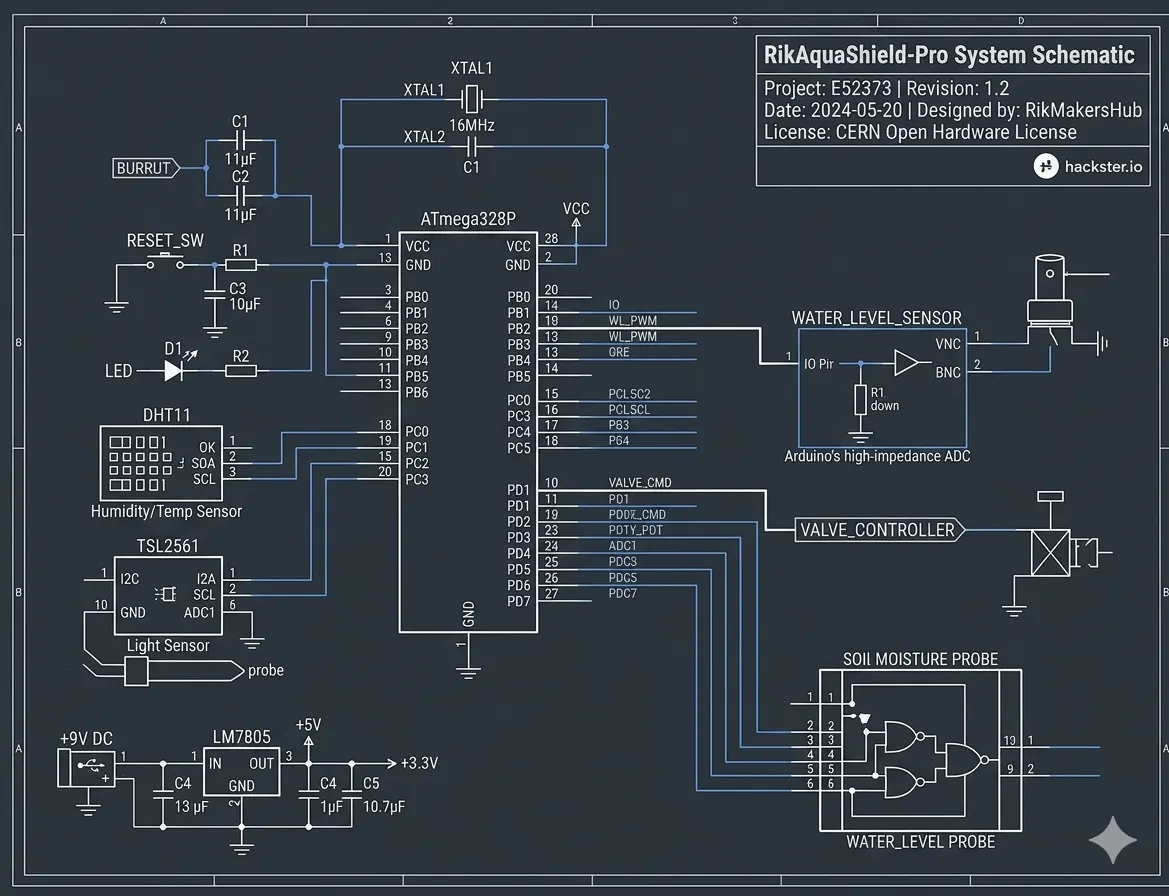
When water fills the tank and bridges the physical gap between the probes, it completes a low-voltage circuit, immediately pulling the internal pull-up network on GPIO Pin 2 to a LOW state. The microcontroller instantaneously interrupts its sleep cycle, activating a BC547 NPN transistor gate to drive an aggressive audio-visual alert matrix via a 5V piezoceramic buzzer and indicator LED.
Field Weatherproofing ProtocolBecause the node sits exposed on concrete rooftops or outdoor water tanks, environment shielding is paramount. The entire hardware stack is enclosed inside a cheap, rubber-gasketed IP65 PVC electrical junction box. To prevent driving monsoon rainwater from destroying the audio transducer, acoustic escape slots must be drilled strictly on the downward-facing surface of the enclosure, creating an effective acoustic moisture trap.
Production Live Web PortalFor complete interactive schematics, currency-adjusted bill of materials (BOM), step-by-step assembly diagnostics, and copy-pasteable source arrays, explore our live dedicated documentation server:🔗 https://rikmakershub.github.io/RikAquaShield-Pro/






_3u05Tpwasz.png?auto=compress%2Cformat&w=40&h=40&fit=fillmax&bg=fff&dpr=2)


Comments