



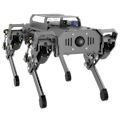
Ever watch a robot dog move and think, “It’s cool, but… a bit stiff”? Then you see Hiwonder PuppyPi. It’s different. It doesn’t just shuffle; it has a steady, lifelike trot. It can pivot instantly to track an object with its camera, or sit down smoothly on command. This combination of rock-solid stability and surprising agility in a desktop-sized platform is what first hooked me. As a maker, my immediate question was: How? What’s under the hood that makes this possible?
Tearing into the project (figuratively and literally with documentation), I found there’s no single magic trick. The secret is a masterful synergy of hardware, mechanical design, and software—all accessible and built for tinkering. Here’s my breakdown from a maker’s lens.
The Muscle: Not Your Hobbyist ServosPop off a leg cover, and you’ll find the core of the motion: high-torque, stainless steel gear servos. Eight of them. These aren't the basic servos you find in a starter kit.
- Built for Punishment: The stainless steel gears are the first clue. This robot is designed for the repeated impact of walking, and for carrying add-ons like the optional robotic arm. This durability means you can prototype aggressively without constant fear of stripping gears.
- They Talk Back: This was the key insight. These are “smart” servos with a feedback loop. They constantly stream data on position, speed, and even temperature back to the Raspberry Pi brain. This closed-loop control is non-negotiable for stability; the system can make micro-adjustments in real-time, ensuring every leg hits its exact target angle, every single step.
💡Here are PuppyPi tutorials: source codes, video tutorials and various experimental cases, etcThe Skeleton: Elegant Force Transmission
The servos provide power, but the leg linkage structure is what turns simple rotation into elegant, multi-axis motion. It’s a beautifully simple system of connected rods.
- Biomimetic Efficiency: The linkage creates a natural, elliptical path for the foot—a smooth lift, forward push, and placement. This is far more energy-efficient and stable than a primitive piston-like up/down motion. It’s the difference between a march and a trot.
- Engineered Leverage: The geometry isn’t accidental. It amplifies and directs the servo’s force optimally into the ground. This gives the PuppyPi a powerful push-off for agility and creates a stable base that handles turns and minor floor imperfections without toppling.
Here’s where the maker fun truly begins. The hardware sets the stage, but the Raspberry Pi running ROS (Robot Operating System) and the software algorithms bring it to life.
- Inverse Kinematics (IK) – The Real “Secret Sauce”: You don’t manually code eight servo angles to take a step. Instead, you work with high-level commands. Tell the IK solver: “Move this foot forward 5cm and up 2cm.” It instantly calculates the exact angles for all three servos in that leg to make it happen. This abstraction is powerful for development.
- Dynamic Gait Generation in ROS: For walking, the system uses this IK engine in real-time to coordinate all four legs. The gait planner (a ROS node) continuously calculates footfall patterns to maintain balance while moving or turning. Want to implement a custom gait or tweak the trot speed? You’re working with these high-level planners, not wrestling with raw servo pulses.
- ROS – The Glue: ROS is the central nervous system. The gait planner, IK solver, servo drivers, and sensor inputs (camera, LiDAR) all communicate seamlessly over the ROS network. This modularity is a maker’s dream. Swapping out a navigation algorithm or integrating a new sensor follows a standard, well-documented paradigm.
When you send a “turn left” command via a controller or your own code:
- The ROS gait planner node adjusts the footfall pattern.
- The IK solver recalculates trajectories for all legs dozens of times per second.
- Precise commands flow to the smart servos.
- The servos drive the linkages, creating a coordinated turn.
- Servo feedback streams back to confirm, closing the loop.
This inherent stability isn’t just for cool walking demos. It’s what transforms the PuppyPi from a neat gadget into a serious prototyping platform.
- AI Vision that Works: A shaky platform ruins computer vision. The PuppyPi’s stability allows its camera to provide a clean video feed for reliable object tracking, face detection, or gesture control using libraries like OpenCV and MediaPipe.
- A True Mobile Manipulator: The optional robotic arm needs a stable base to be useful. This platform allows you to explore mobile pick-and-place and “fetch” scenarios credibly.
- Accurate Mapping & Navigation: Adding the optional LiDAR for SLAM works because the sensor isn’t jiggling, leading to clean, accurate maps for autonomous navigation projects.
The “secret” is holistic, accessible engineering. The Hiwonder PuppyPi succeeds by pairing robust, feedback-driven hardware with biomimetic mechanics and orchestrating it all through open, ROS-based software.
For the Hackster community, the value is clear: this is a platform where you can start with high-level ROS applications (navigation, vision) and dive as deep as you want—right down to tweaking gait algorithms and IK parameters. It removes the years of work needed to build a stable quadruped from scratch and lets you focus on your innovative application layer.
My next project? Leveraging this stable platform to implement a vision-based “follow-me” behavior using ROS, where the PuppyPi autonomously tracks and follows a person through a cluttered environment. The foundation it provides makes ambitious projects like this not just possible, but practical.


Comments