



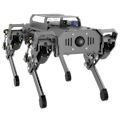
If you've ever watched a robotic dog try to walk, you've probably seen the shaky, uncertain steps that make it look like it's on ice. So when I first saw the PuppyPi from Hiwonder moving with a confident, steady trot, I was genuinely impressed. What makes its "dog steps" so stable and natural while others stumble?
The answer isn't a single magic trick—it's a clever combination of thoughtful hardware design, serious computing power, and accessible, intuitive software. Let's break down how PuppyPi achieves its remarkably stable gait.
1. A Body Built for Dynamic BalanceReal stability starts with a body that can respond. PuppyPi’s core design focuses on dynamic balance—staying upright while in motion.
Agile Leg Structure: Its linkage-based leg mechanism allows for faster, wider swings of the lower leg. Crucially, the motion paths of the upper and lower legs are designed to avoid interference, much like the natural joints of an animal. This hardware foundation is key to its flexibility and stability.
Lightweight & Responsive Frame: The body is crafted from high-strength hard aluminum alloy. This makes it both light and rigid. When combined with metal bearing joints, it minimizes inertia, allowing the robot to turn quickly on a tabletop or make precise movements. Every control command translates into a smooth, accurate action.
🧐For all codes, videos, experimental cases, please check PuppyPi tutorials.2. The "Cerebellum": Real-Time Processing on a Raspberry Pi 5
A great body needs a fast brain to control it. At PuppyPi's core is the new Raspberry Pi 5, offering 2-5 times the performance of its predecessor.
This power is dedicated to real-time gait control. As PuppyPi walks, this "cerebellum" is making constant, micro-second adjustments:
How should it switch gaits between a walk and a trot for different surfaces?
How does it adjust its posture to handle slight slopes or uneven ground?
This continuous calculation transforms stability from a static pose into an active, intelligent process of maintaining balance.
3. An Intuitive Language for Tuning MovementHere’s where PuppyPi truly shines for makers and learners. It turns complex robotics control into an interactive, visual experience.
Gait Parameter Tuning: Using the companion PC software, you can directly adjust key parameters for gaits like Walk and Trot—think foot contact time, swing height, and step cycle. You see the changes in the robot's behavior in real time, creating an instant feedback loop for understanding locomotion.
Visual Pose Editing: Want PuppyPi to strike a specific pose? Instead of wrestling with complex inverse kinematics equations, you use a visual drag-and-drop editor. Simply set the target position for a foot, and the software automatically calculates all the necessary joint angles. It demystifies advanced robotics concepts and makes experimentation accessible.
This process—from tuning to testing—forms a complete learning cycle. You’re not just watching a pre-programmed walk; you’re building an intuitive understanding of what makes robotic movement stable.
4. From Stable Gait to Smart PlatformPuppyPi’s stability isn't just for show; it makes the robot a reliable mobile platform for more advanced projects.
Thanks to the Raspberry Pi 5's capabilities and built-in support for ROS (Robot Operating System), you can easily expand its functions:
Add a LiDAR for mapping and navigation.
Attach a robotic arm for intelligent grasping.
Use its built-in wide-angle camera with AI models for face recognition, object tracking, or visual cruising.
PuppyPi evolves from a gait-learning platform into a complete "Perception-Decision-Action" development system. Whether you're testing a SLAM algorithm or exploring embodied AI, PuppyPi lets you prototype in a dynamic, real-world environment.
Final ThoughtsWhether you're a student, an educator, or a developer with a creative project in mind, PuppyPi offers more than just a steady walk. It provides a trustworthy platform where learning is hands-on, ideas become tangible, and every step of your exploration is both solid and engaging. Its stability is the foundation that lets you focus on what matters: building, coding, and creating.


Comments