



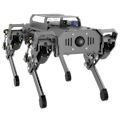
Walk into many STEM labs, and you’ll see them: desktop robots often relegated to being "advanced demos" or single-use teaching aids. They demonstrate a concept, then gather dust. The Hiwonder PuppyPi is engineered to break that cycle. It’s not a consumable teaching tool; it’s a comprehensive, professional-grade platform that bridges the gap from foundational coding to advanced research. By combining a Raspberry Pi brain, a robust ROS-native framework, and industrial-grade expandability, it transforms from a classroom curiosity into a powerful weapon for innovation in both education and competitive robotics.
Part 1: Redefining Educational Hardware: The "Trifecta" Advantage of PuppyPiTo understand its educational impact, you must see how PuppyPi differs from typical educational kits. Its value lies in a combination of three core principles.
First, True Open-Source & Professional Authenticity. At its heart, PuppyPi runs on a standard Raspberry Pi with native support for ROS 1 & ROS 2. This is critical. Students aren't learning a proprietary, simplified language for a toy. They are using Python, Gazebo simulation, and tools like Rviz—the exact same frameworks used in university labs and cutting-edge industries. The skill set they build is directly transferable to their future careers, teaching "real engineering" from day one.
Second, Hardware as a Growing Platform. Beyond its durable CNC aluminum frame and high-torque smart servos lies its superpower: modular expansion. The same base unit can start with its onboard AI camera for vision projects, then seamlessly integrate the official ToF LiDAR for SLAM mapping, and later mount the 2-DOF robotic arm for mobile manipulation. This means one platform can scale with student ability, serving a multi-year curriculum from introductory programming to graduate-level projects, maximizing investment.
Third, The Seamless Simulation-to-Reality Loop. This is a game-changer for pedagogy. PuppyPi comes with a high-fidelity Gazebo simulation model. Students can safely, and at zero cost, develop and test complex algorithms—like navigation or computer vision—in a virtual world. With confidence, they can then deploy the same code directly to the physical robot with minimal tweaks. This practices the modern "Sim-to-Real" engineering workflow, teaching crucial concepts in iteration, testing, and real-world validation.
Part 2: Integrating into the STEM Classroom: Tiered Learning & Project ExamplesHow does this translate to actual lesson plans? PuppyPi supports a scaffolded learning journey.
For High School & Technical Programs: Igniting Interest.
Goal: Introduce core CS concepts, kinematics, and systems thinking.
Project-Based Learning Examples:
- CS Fundamentals with Python: Move beyond print statements. Code dynamic action sequences, making the dog dance or navigate a simple maze.
- Interactive Sensor Loops: Use the AI camera for projects like color-based ball tracking or gesture control, tangibly demonstrating the input-process-output cycle.
- Physics & Kinematics Labs: Experimentally discover how adjusting gait parameters like step length and height affects stability and speed.
For University & College Courses: Deepening Expertise.
Goal: Teach applied robotics, control systems, computer vision, and AI.
Free download PuppyPi tutorials, and you can get all schematics, source codes, video tutorials and various experimental cases, etc.
Advanced Project Modules:
- ROS In-Depth: Have students create custom ROS nodes for publisher/subscriber communication and service calls to control the robot, building distributed software skills.
- Applied Computer Vision: Implement real-world tasks like visual line following, AprilTag detection for positioning, or object tracking using OpenCV/MediaPipe on the live camera feed.
- Full-Stack Autonomous Navigation: Integrate the LiDAR to complete an end-to-end SLAM, path planning, and autonomous navigation project—a capstone-level achievement.
- Control Systems Design: Develop and tune a PID controller to improve the robot's posture stability or the smoothness of its arm movements.
💡People Also Read: Unleash Your Pi: Code a Robot Dog PuppyPiPart 3: Powering Robotics Competitions: From Prototype to Podium
In competitions like RoboMaster, VEX, or RoboCup, PuppyPi shifts from a learning tool to a strategic prototyping accelerator.
1. Rapid Prototyping for Agile Development. Teams face the constant challenge of testing ideas without risking their final, expensive competition platform. PuppyPi serves as a high-fidelity, low-risk testbed. Need to validate a new object recognition algorithm, a navigation stack, or a multi-agent communication protocol? Develop and iterate on PuppyPi first, saving crucial time and budget before integration on the main robot.
2. A Direct Platform for Core Challenges. Many competition tasks align perfectly with PuppyPi's capabilities:
* Mobile Challenges: Use it directly as a highly agile quadrupedal platform or to prove out navigation logic.
* Vision Tasks: Leverage its onboard AI camera and processing power to develop and benchmark recognition algorithms.
* Manipulation Events: With the robotic arm, research and practice mobile pick-and-place strategies.
* Swarm Intelligence: Multiple PuppyPi units can form a low-cost swarm to test cooperative algorithms and communication protocols, a topic often reserved for well-funded labs.
3. Building Holistic Engineering Teams. Success in competition requires more than clever code; it demands mechanical, electrical, and software integration. Working with PuppyPi forces students to debug real hardware-software interactions, cultivate system-level thinking, and develop the resilient "full-stack" troubleshooting skills that judges—and future employers—highly value.
The true value of PuppyPi isn't in its hardware specs, but in its capacity as a bridge. It connects theoretical knowledge to applied creation, and classroom learning to competitive ambition. For educators and coaches, it represents an investment not in a device, but in student agency and future readiness. Supported by Hiwonder's extensive documentation, code libraries, and an active community, deploying PuppyPi is a step towards cultivating the next generation of innovators: those who don't just understand how technology works, but who are equipped to build it and solve real problems with it. Ready to move beyond the toy box? The platform is here. The question is what your students will build with it.


Comments