



Hardware components | ||||||
| × | 1 | ||||
 |
| × | 1 | |||
You say, "MentorPi, find my blue mug, and tell me if it's empty." It doesn't just hear keywords. It understands the command. It maps a path, uses its vision to scan for a blue mug, analyzes the image, and reports back. All autonomously.
MentorPi is a robotics platform that strips away the complexity of AI and hands you the core components: a multimodal AI brain, 3D vision, and top-tier hardware, all integrated on ROS 2. It focus entirely on the intelligence that powers perception, decision-making, and movement. This is your direct path to mastering the algorithms that make robots smart.
Hiwonder MentorPi is built on a simple, powerful core idea: you should be able to talk to your robot like a friend. Its core is a multimodal large AI model that processes your natural language, breaking down complex instructions into actionable tasks.
"Navigate to the conference room and count the number of chairs."
"Find the red object closest to the door."
"Patrol the perimeter of the lab and alert me if you see a person."
"Go to the football field and tell me the color of the football"
MentorPi doesn't just scan for keywords. It performs semantic understanding. It knows that "navigate to" requires its SLAM system, "count the chairs" requires its vision model, and "patrol" defines a continuous navigation task. This integration of a high-level AI "brain" with low-level robotic functions is the essence of modern robotics, and with MentorPi, it's accessible right out of the box.
Hardware Designed for Perception, Not PrescriptionWhat make it possible? It starts with a carefully chosen set of hardware that give the robot a rich, real-time sense of its surroundings. A Raspberry Pi 5 acts as the high-level brain, running ROS 2 and AI models, while a co-processing STM32 microcontroller handles precise motor control and sensor data filtering, ensuring responsive and stable operation.
A high-resolution 3D depth camera is central to its perception. It doesn't just capture color RGB images; it captures depth information, creating a point cloud that tells the robot the exact distance to every pixel in its view. This is non-negotiable for understanding spatial relationships.
A TOF LiDAR spins 360 degrees, performing millions of distance measurements per second to build a precise, centimeter-accurate map of the surrounding area. This is the foundation for all reliable autonomous navigation.
An AI Voice Interaction Box with a noise-canceling microphone array and built-in speaker allows for clear voice commands and verbal feedback, creating a truly interactive experience.
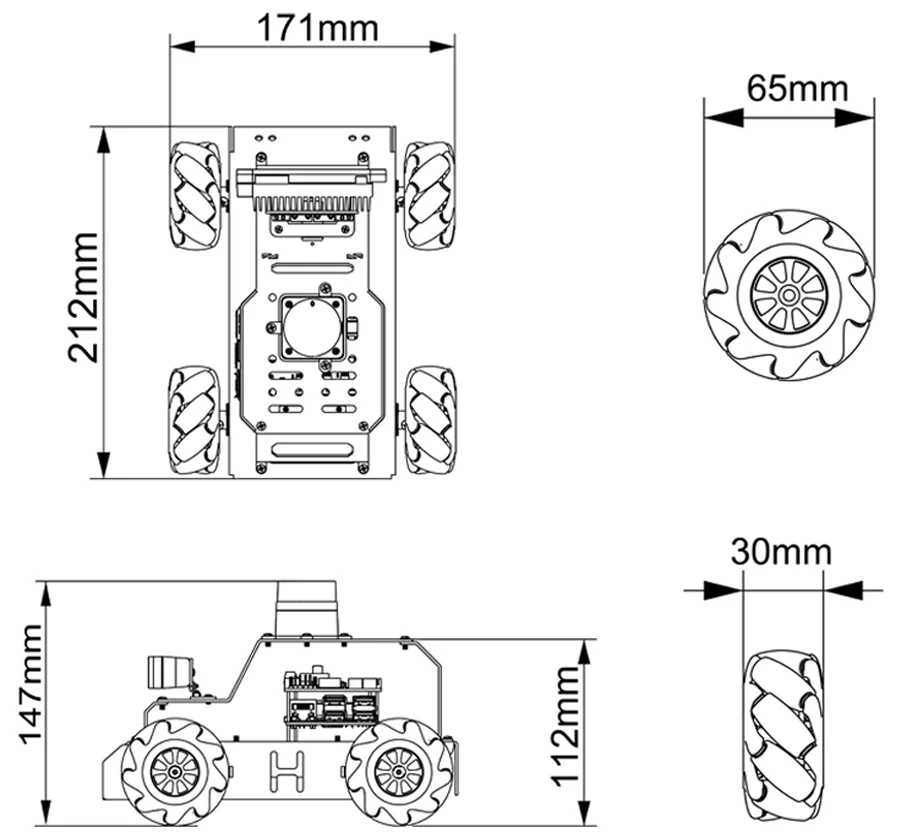
We don't force one solution. Choose the Mecanum wheel chassis for omnidirectional movement in tight spaces, the Ackermann chassis for car-like navigation, or the tank chassis for tackling rough or uneven surfaces.
High-Precision Mapping & Navigation: The Art of Confident MovementWithout reliability, there is no true autonomy. MentorPi's navigation stack isn't a black box; it's a transparent, customizable system built on ROS 2's Navigation2 framework.
Using its LiDAR and IMU data, MentorPi performs SLAM (Simultaneous Localization and Mapping). It can explore an unknown space to create a detailed map, and then, in a known space, it can always locate itself within that map.
Hiwonder MentorPi enables Intelligent path planning with reliable precision. It integrates global path planning algorithms (A*/Dijkstra) with local dynamic strategies (DWA/TEB), enabling real-time perception, obstacle avoidance and dynamic path adjustments for stable navigation, transportation and sorting, even in complex environments.
You can also command it to execute complex sequences: "Go to Point A, then Point B, then return home." It manages the entire mission flow autonomously, recalculating routes as needed. This is perfect for applications like automated inventory checks or facility patrol.
MentorPi doesn't just "see" images; it interprets scenes in 3D. This is the critical difference between a simple camera and a perception system. The 3D depth camera allows MentorPi to understand an object's position in a metric space. It can report not just "I see a chair, " but "I see a chair 2.3 meters away, and it is 0.5 meters wide." This is fundamental for any task requiring spatial reasoning.
For the actual task of identifying objects, MentorPi leverages the latest in deep learning with the YOLOv11 (You Only Look Once v11) model. This allows it to identifies, classifies, and locates objects with remarkable speed and accuracy. In autonomous driving projects, MentorPi can automatically complete tasks such as traffic light recognition, road sign detection, and parking. With MentorPi, you have the ideal platform to learn and practice autonomous driving technologies. If you want to learn more, you can read and refer to MentorPi tutorials.
This is where the pieces come together. The multimodal AI large model is the cognitive engine that orchestrates everything. This closed-loop interaction—from language to perception to action and back to language—is the hallmark of a truly intelligent system. It's not just following a script; it's executing a plan it formulated itself.
What Will You Build? With MentorPi, you'll create your own ROS2 robot capable of mapping, autonomous driving, and human robot interaction. More than just a robot, it's your gateway to mastering AI and large AI model development for a wide range of fun and embodied AI projects.
The platform is designed for students, maker and engineers who want to move beyond theory and get their hands dirty with the technologies shaping the future of autonomy. Dive into MentorPi tutorials or Explore the source codes on Hiwonder GitHub repository. Let's build the next generation of intelligent machines, together


Comments