


Hardware components | ||||||
 |
| × | 1 | |||
 |
| × | 1 | |||
Software apps and online services | ||||||
 |
| |||||
Hand tools and fabrication machines | ||||||
 |
| |||||
 |
| |||||
Gesture-Controlled Smart Glove with Li-Fi Silent Data Transfer
1. Project Overview
The Gesture-Controlled Smart Glove with Li-Fi Silent Data Transfer is an assistive communication prototype designed to help people communicate their basic needs through hand gestures and visible light communication.
This project is especially intended to support patients with speech difficulties, including some paralysis patients and hospitalized patients who find verbal communication difficult.
The system converts finger movements into predefined messages and transmits the information using an LED as a light transmitter. At the receiver end, an LDR detects the light signals, and an LCD displays the corresponding message.
2. Why Did We Develop This Project?
Communication is an important part of healthcare. Some patients may have difficulty speaking because of medical conditions, physical limitations, or recovery after medical procedures. They may find it difficult to communicate basic needs to doctors, nurses, and caregivers.
Our goal is to develop a simple, affordable, and wearable electronic system that helps such patients communicate their needs without speaking.
For example, patients may need to communicate messages such as “HELP ME, ” “I NEED WATER, ” “OK, ” or “I NEED ASSISTANCE.”
This project explores how electronics, embedded systems, sensors, and visible light communication can be combined to support people who face communication challenges.
3. How Does It Work?
The system consists of two main sections: a transmitter and a receiver.
Transmitter Section
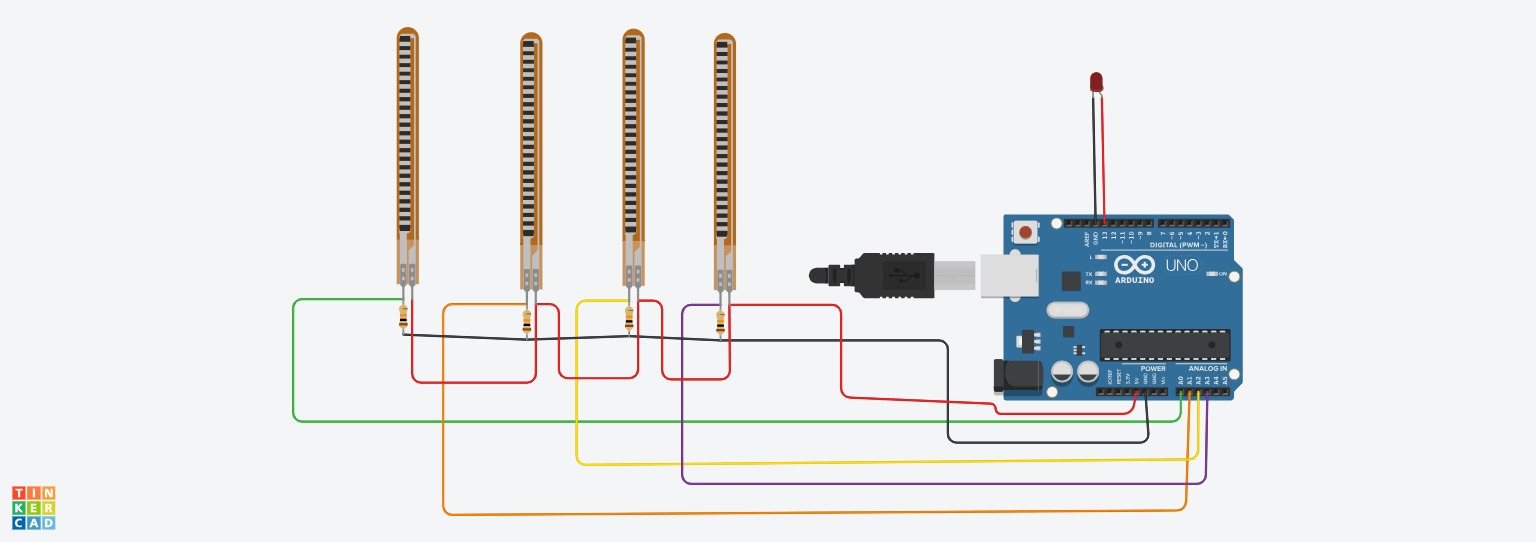
The transmitter consists of flex sensors connected to an Arduino.
- Flex sensors detect the bending of fingers.
- The Arduino reads the sensor values.
- Different finger positions represent predefined gestures.
- Based on the detected gesture, the Arduino controls an LED.
- The LED transmits the encoded information through visible light.
Receiver Section
The receiver consists of an LDR, an Arduino, and an LCD display.
- The LDR detects changes in the light received from the transmitter LED.
- The receiver Arduino processes the detected signals.
- The system identifies the corresponding predefined message.
- The message is displayed on the LCD for the caregiver or another person to read.
This enables silent, light-based message transmission between the glove and the receiver.
4. Real-World Applications
1. Support for Paralysis Patients
Some paralysis patients retain limited finger movement but experience difficulty speaking. For patients who can perform the required gestures, this system may provide an alternative way to communicate basic needs.
2. Hospitalized Patients
Patients in hospitals who have difficulty speaking may use predefined gestures to communicate simple requests to doctors, nurses, or caregivers.
3. Patients with Speech Difficulties
The glove can help users communicate predefined messages such as “HELP ME, ” “OK, ” and “I NEED ASSISTANCE” without speaking.
4. Patient Care and Assistance
The system could be developed to help patients alert caregivers when they need attention, water, or other basic assistance.
5. Silent Communication
The prototype demonstrates light-based communication in environments where silent messaging may be useful, including hospital rooms, laboratories, and other quiet environments.
Important limitation: The current prototype requires the user to perform recognizable finger movements. It is not suitable for every paralysis patient, particularly those who cannot move their fingers. Further development and clinical evaluation would be required before healthcare deployment.
5. Components Used
- Arduino boards
- Flex sensors
- LED for visible light transmission
- LDR (Light Dependent Resistor)
- LCD display
- Resistors
- Connecting wires
6. Key Features
- Gesture-based message generation
- Arduino-based sensor processing
- LED-based visible light communication
- LDR-based light signal detection
- LCD message display
- Low-cost electronics prototype
- Potential for wearable assistive communication
7. Project Innovation
The innovation of this project is the combination of finger gesture detection and visible light communication in a simple assistive communication prototype.
Instead of requiring the user to speak, the system detects predefined finger movements and converts them into messages. The information is transmitted through light and displayed at the receiver.
This project demonstrates the practical application of electronics engineering, embedded systems, sensor interfacing, and optical communication to address a real-world communication challenge.
8. Future Scope
The project can be improved in several ways:
- Add more gestures and predefined messages.
- Improve the reliability of light signal detection under different lighting conditions.
- Develop a smaller and more comfortable wearable design.
- Add sound alerts to notify caregivers.
- Introduce alternative controls, such as eye-blink detection, for users who cannot move their fingers.
- Test communication reliability and usability with appropriate supervision before considering healthcare applications.
9. Conclusion
The Gesture-Controlled Smart Glove with Li-Fi Silent Data Transfer is a prototype that explores an alternative method of communication for people who experience speech difficulties.
By combining flex sensors, Arduino, an LED transmitter, an LDR receiver, and an LCD display, the system converts finger gestures into readable messages.
Our main aim is to explore how affordable electronics and embedded systems can contribute to assistive technology and potentially improve communication between patients and caregivers.
Project Name: Gesture-Controlled Smart Glove with Li-Fi Silent Data Transfer
Developed under: VoltageAxis
Our Mission: Using innovative electronics to make communication more accessible.


Comments