



Hardware components | ||||||
| × | 1 | ||||
| × | 1 | ||||
Software apps and online services | ||||||
 |
| |||||
Hand tools and fabrication machines | ||||||
 |
| |||||
Feel Nature Through Light, Sound, and Motion
Feel Nature Through Light, Sound, and Motion1. Project Overview
Calm Nature is a palm-sized interactive ambient gadget that creates a quiet sense of nature through light, sound, and motion.
Rather than playing prerecorded video or environmental audio, the device generates its behavior in real time using physics simulations. When the user gently tilts the device, the built-in IMU detects its orientation and changes the direction of gravity inside a virtual world. Particles, ripples, and bubbles respond naturally to that movement, and the results are rendered as soft light on an 8×8 NeoPixel matrix.
Particle collisions and other simulated events are also translated into subtle sounds through the built-in speaker. The result is not a fixed animation, but a small physical world that continuously changes as the user moves the device.
2. ConceptLEDs are often used to attract attention: bright, sparkling, colorful, and deliberately noticeable. That can be effective, but it can also become visually tiring.
Calm Nature explores the opposite approach.
Instead of asking the viewer to look at the LEDs, it uses them to communicate gently and almost incidentally. The goal is to create light that can remain nearby without demanding attention.
The device combines soft illumination, quiet sound, and simple physical interaction to suggest familiar natural phenomena in the palm of the hand. It can be handled like a small tactile puzzle, or simply moved without any particular goal as a calming object.
By combining light, sound, physics, and interaction, Calm Nature turns a very small 8×8 display into an interactive ambient experience.
The simulation is updated at 60 steps per second, allowing the internal world to evolve continuously in response to gravity, collisions, damping, and user movement. Because the state depends on both simulation dynamics and interaction, the resulting patterns are unlikely to repeat in exactly the same way.
3. Key FeaturesA compact system built around an M5StickS3 and an 8×8 NeoPixel matrix
- A compact system built around an M5StickS3 and an 8×8 NeoPixel matrix
Real-time gravity control using the M5StickS3's built-in IMU
- Real-time gravity control using the M5StickS3's built-in IMU
2D and 3D physics simulations rendered onto only 64 LEDs
- 2D and 3D physics simulations rendered onto only 64 LEDs
HSV color processing and alpha blending for softer color transitions
- HSV color processing and alpha blending for softer color transitions
A custom 3D-printed LED separator and diffuser layer that reduce glare and soften the display
- A custom 3D-printed LED separator and diffuser layer that reduce glare and soften the display
Real-time sound generation synchronized with collisions and simulated events
- Real-time sound generation synchronized with collisions and simulated events
Button-selectable animation and sound modes
- Button-selectable animation and sound modes
Portable operation using the M5StickS3's built-in battery
- Portable operation using the M5StickS3's built-in battery
The basic rendering approach is similar to a small real-time graphics system: a virtual model is simulated first, then projected and rendered onto the physical 8×8 LED display.
4. Simulation Modes4.1 Particle CubeVisual SimulationTwenty to thirty particles are placed inside a virtual 1.0 × 1.0 × 1.0 cube.
Each particle moves according to simulated gravity, velocity, angular motion, boundary collisions, and particle-to-particle collisions. Initial HSV color and alpha values are assigned to the particles so that overlapping contributions can be blended during rendering.
The three-dimensional particle field is projected toward the display plane and accumulated into the 8×8 output grid. Color blending and correction are then applied before the final values are sent to the NeoPixel matrix.
This makes the 64-LED display behave less like a conventional pixel animation and more like a small window into a simulated 3D world.
SoundPlease see the demo video for the actual sound character.
Three sound themes are provided:
a dry, granular sound inspired by flowing sand
- a dry, granular sound inspired by flowing sand
a soft popping sound inspired by bubbles
- a soft popping sound inspired by bubbles
a light resonant sound inspired by wind chimes
- a light resonant sound inspired by wind chimes
Sound level and pitch vary according to particle collisions, allowing the audio to respond to the simulated motion rather than simply playing a fixed loop.
4.2 Water RippleIn this mode, the LED surface is treated as a small body of water.
Virtual droplets fall onto the surface and generate expanding ripples. The simulated wave height is mapped to HSV brightness and color, while droplet events generate corresponding water-like sounds.
The intention is not to reproduce a photorealistic water surface, but to capture the recognizable behavior of ripples using only light and motion.
4.3 Swamp BubbleThis mode represents bubbles rising from below a dark water surface.
Virtual gas bubbles rise, expand near the surface, and burst. Each burst generates a small ripple and a soft sound. Bubble size influences the acoustic response, creating subtle variation from event to event.
4.4 2D Physics SimulationIn addition to the 3D particle system, Calm Nature uses 2D grid-based simulations for surface phenomena such as water, moving particles, and bubbles.
Although the physical display contains only 8×8 LEDs, some calculations are performed on a finer internal virtual grid. The result is then downsampled to the 8×8 matrix. This allows smoother motion and more natural transitions than calculating the simulation directly at the final LED resolution.
Water SurfaceThe water surface is modeled as a grid in which each cell contains a height and velocity value.
The simulation includes:
droplets appearing at varying positions
- droplets appearing at varying positions
impact energy added to the local surface height
- impact energy added to the local surface height
wave propagation to neighboring cells
- wave propagation to neighboring cells
gradual damping
- gradual damping
conversion of wave height to HSV brightness
- conversion of wave height to HSV brightness
brightness modulation based on the local surface gradient
- brightness modulation based on the local surface gradient
These calculations create a gentle visual impression of ripples spreading across a quiet pond.
Ground / Particle SurfaceThe ground mode treats the display as a plane on which particles move under gravity.
The simulation includes:
gravity direction derived from the IMU
- gravity direction derived from the IMU
particle-to-particle collision detection
- particle-to-particle collision detection
boundary collisions
- boundary collisions
friction and damping
- friction and damping
velocity-dependent collision response
- velocity-dependent collision response
Particle density is projected to the 8×8 display and blended in HSV color space.
Swamp SurfaceThe swamp model extends the water-surface simulation by adding bubbles.
The simulation includes:
gas bubbles generated below the surface
- gas bubbles generated below the surface
upward motion caused by buoyancy
- upward motion caused by buoyancy
expansion near the surface
- expansion near the surface
bubble bursting
- bubble bursting
small ripples generated by each burst
- small ripples generated by each burst
The size and energy of each bubble are reflected in the corresponding sound, producing a gently changing ambient texture.
Why Use 2D Simulation?With a display resolution of only 8×8 pixels, photorealistic rendering is neither practical nor necessary. What matters is preserving the behavior of a phenomenon.
For this reason, Calm Nature does not rely on prerecorded images. Instead, it calculates processes such as:
wave propagation
- wave propagation
particle movement
- particle movement
collision response
- collision response
energy loss and damping
- energy loss and damping
Only the resulting physical state is converted into light. This allows a very low-resolution display to suggest natural motion without attempting to imitate a high-resolution screen.
5. HardwareM5StickS3
- M5StickS3
8×8 NeoPixel matrix, connected to GPIO9
- 8×8 NeoPixel matrix, connected to GPIO9
Custom 3D-printed grid separator that optically isolates the LEDs
- Custom 3D-printed grid separator that optically isolates the LEDs
Diffusion paper over the LED surface
- Diffusion paper over the LED surface
Portable operation from the M5StickS3's internal battery
- Portable operation from the M5StickS3's internal battery
The diffuser and separator are important parts of the design, not merely cosmetic additions.
A bare NeoPixel matrix produces intense point sources with clearly separated LEDs. Calm Nature deliberately modifies that appearance.
The separator and diffuser are used to:
optically isolate adjacent LEDs before diffusion
- optically isolate adjacent LEDs before diffusion
turn individual point sources into softer illuminated cells
- turn individual point sources into softer illuminated cells
reduce harsh boundaries between colors
- reduce harsh boundaries between colors
reduce glare
- reduce glare
create a display that is more comfortable to view for longer periods
- create a display that is more comfortable to view for longer periods
The optical construction is therefore part of the interaction design: the same simulation would feel much more aggressive if viewed directly on an uncovered LED matrix.
6. SoftwareThe project is developed with Arduino IDE using:
M5Unified
- M5Unified
FastLED
- FastLED
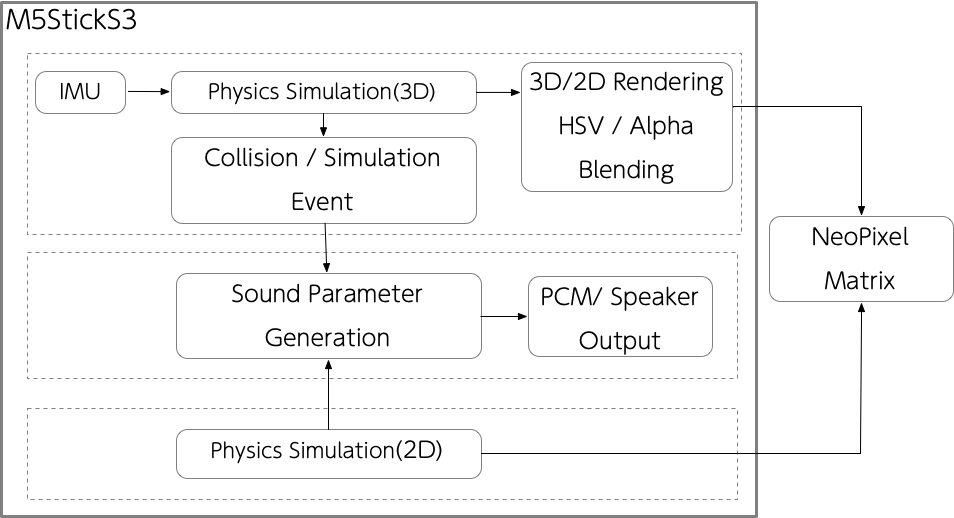
IMU → Physics Simulation → 3D/2D Rendering → HSV / Alpha Blending → Color Correction → NeoPixel Matrix
Audio follows a parallel event-driven path:
Collision / Simulation Event → Sound Parameter Generation → PCM / Speaker Output
Current operating rates:
Physics simulation: 60 updates per second
- Physics simulation: 60 updates per second
LED rendering: 30 frames per second
- LED rendering: 30 frames per second
Separating the simulation rate from the display rate keeps motion responsive while avoiding unnecessary LED refresh work.
7. What Makes Calm Nature Different?Calm Nature is designed as a handheld object rather than a passive LED display.
Tilting and rotating the device changes gravity inside the simulated environment. The device calculates the resulting behavior in real time and translates it into restrained light and sound.
The important part of the project is therefore not a collection of predefined animations. It is the relationship between:
the user's hand → virtual physics → light → sound
A very small display becomes expressive because its behavior is generated rather than replayed.
The project also explores a different role for LEDs: not as attention-seeking indicators, but as a quiet ambient material that can suggest movement, texture, and natural processes.
8. Suggested PhotosMain project image
Device held in the hand
Particle Cube mode
Water Ripple mode
Swamp Bubble mode
Internal construction
Controller and enclosure
LED display module
3D-printed separator
Diffuser layer
10. Build
Install Arduino IDE.
- Install Arduino IDE.
Install the M5Unified and FastLED libraries.
- Install the M5Unified and FastLED libraries.
Connect the NeoPixel matrix data input to GPIO9.
- Connect the NeoPixel matrix data input to GPIO9.
Upload the firmware to the M5StickS3.
- Upload the firmware to the M5StickS3.
Charge the internal battery through USB Type-C for portable operation.
- Charge the internal battery through USB Type-C for portable operation.
Calm Nature is intended as a small platform for physics-based ambient expression.
Future simulation modes may include phenomena such as fire, lightning, snow, smoke, or other natural processes, while preserving the same basic idea: generate behavior through simulation and express it with restrained light and sound.
The wireless capabilities of the M5StickS3 could also be used as future input sources. For example, changes in the surrounding radio environment could become another invisible phenomenon translated into movement, color, or sound.
The long-term idea is to develop Calm Nature into a palm-sized digital nature library: a collection of small simulated environments that can be experienced through touch, motion, light, and sound.


Comments