


Hardware components | ||||||
_ztBMuBhMHo.jpg?auto=compress%2Cformat&w=48&h=48&fit=fill&bg=ffffff) |
| × | 1 | |||
 |
| × | 1 | |||
 |
| × | 1 | |||
 |
| × | 1 | |||
 |
| × | 1 | |||
 |
| × | 1 | |||
 |
| × | 1 | |||
 |
| × | 1 | |||
Software apps and online services | ||||||
 |
| |||||
 |
| |||||
 |
| |||||
Poultry farming depends heavily on stable environmental conditions to ensure bird health, productivity, and egg quality. While factors like feed, ventilation, and housing temperature are commonly monitored, water temperature is often overlooked despite its significant impact on poultry performance.
In our family-owned poultry farm, we observed that during hot weather, drinking water temperature can rise significantly. This reduces water intake, which in turn lowers feed intake and can negatively affect egg production and shell quality. Since no continuous monitoring system existed for water temperature, changes often went unnoticed until production losses appeared.
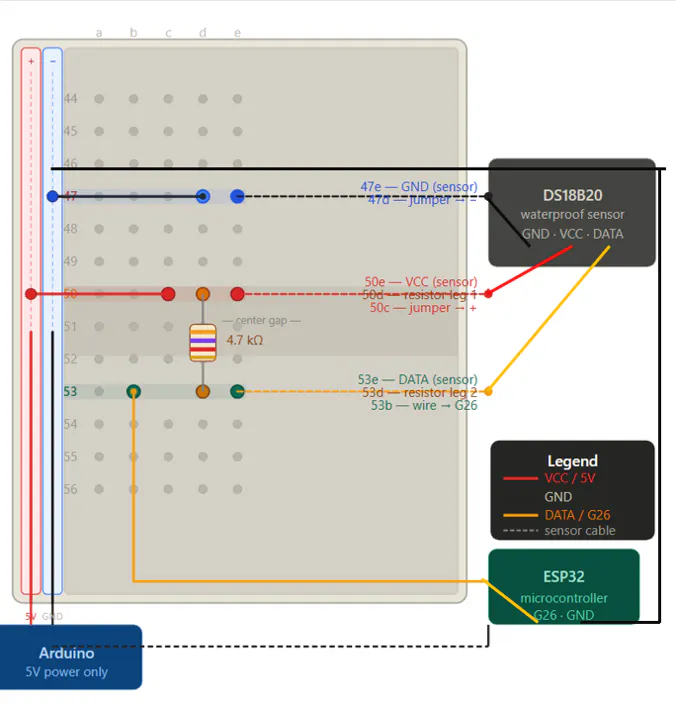
This project was developed to solve that problem by creating a low-cost Internet of Things (IoT) system using an ESP32 microcontroller to monitor poultry drinking water temperature in real time. The system provides continuous monitoring, cloud-based data logging, mobile alerts, and visual dashboards to support faster decision-making and improve farm management.
The system was tested over a four-week period in a commercial poultry farm with approximately 20,000 chickens. The experiment was divided into two phases.
In the first phase, the system only monitored and recorded water temperature without sending alerts or triggering any actions. During this period, temperature fluctuations were clearly observed, especially during peak heat hours where values frequently exceeded safe limits (around 30°C).
In the second phase, real-time alerts were activated. When the water temperature exceeded safe thresholds, notifications were sent immediately to the farm worker who's job was near the cooler, he manually activated a cooling system for a fixed period of 30 minutes per alert.
This intervention successfully reduced temperature peaks, keeping most values near or below the safe limit during hot periods. This proves that our alerts worked, because as you can clearly see how the temperature peaked quickly, but was immediately shut down by the cooler. The temperature during peak heat hours was fluctuating around 29 and below, directly from the cooler effectively cooling the drinking water.
A key performance indicator was egg damage. During the first phase, the farm recorded an average of 26 cracked egg cartons per day (~780 eggs). In the second phase, this decreased to 22 cartons per day (~660 eggs), representing a reduction of approximately 120 eggs per day (15.4%).
DiscussionThe results suggest that real-time monitoring and alert-based intervention can improve operational outcomes in poultry farming. High water temperatures are known to reduce water and feed intake in poultry, which can lead to heat stress and weaker egg production.
By detecting temperature increases early and responding quickly, the system helped reduce the time birds were exposed to unfavorable conditions. This likely contributed to the reduction in cracked eggs observed during the second phase.
The project also demonstrates the advantage of using low-cost IoT technologies in agriculture. By combining ESP32, cloud storage (Google Sheets), and mobile alerts (Blynk), the system provides a simple and scalable alternative to expensive industrial monitoring solutions.
However, the study was conducted over a limited period, and poultry production is influenced by multiple factors beyond water temperature. Therefore, longer testing is required to fully confirm long-term effects.
This project successfully developed and tested a low-cost IoT system for real-time monitoring of poultry water temperature using an ESP32 microcontroller. The system enabled continuous monitoring, cloud-based data storage, mobile alerts, and visual analytics.
Field testing showed that introducing real-time alerts and timely cooling responses contributed to a reduction in production losses, with cracked egg decreasing by approximately 15.4%.
The system demonstrates that simple and affordable digital technologies can significantly improve decision-making in poultry farming. Unlike traditional monitoring methods, this solution provides real-time awareness and faster response to environmental changes.
While further long-term testing is needed, the results show strong potential for scalability and impact in modern agriculture.


Comments