


Hardware components | ||||||
 |
| × | 1 | |||
| × | 1 | ||||
 |
| × | 1 | |||
 |
| × | 1 | |||
GÖK SİPER is an autonomous electronic warfare and security system designed to detect and neutralize unauthorized UAV (Unmanned Aerial Vehicle) communications. As drone threats become more common in restricted airspaces, I developed this system to provide a low-cost yet high-performance defense solution using the power of Raspberry Pi 5.
1. Technical Architecture & Hardware
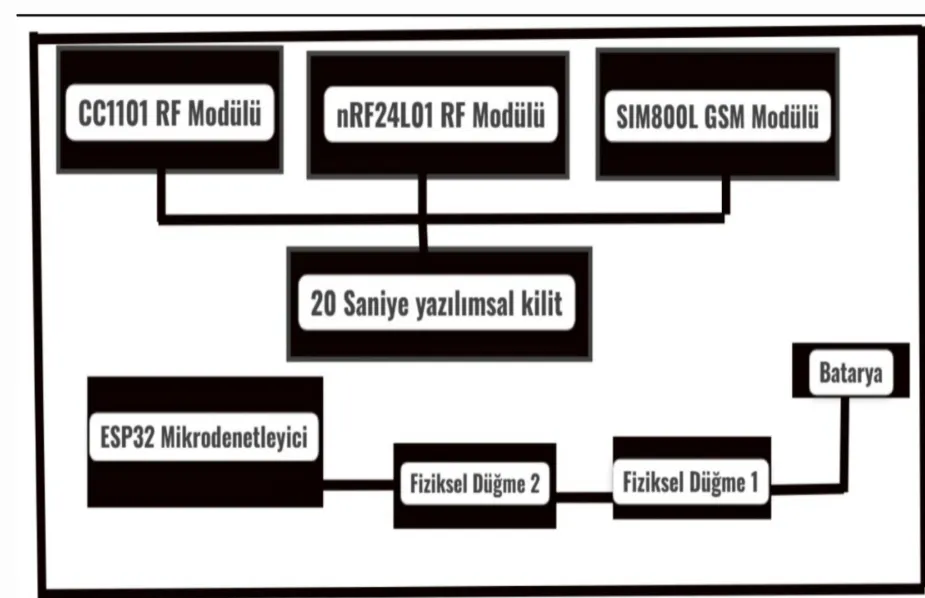
The system integrates multiple RF transceivers to cover a wide spectrum of frequencies used by commercial and custom drones:
Controller: Raspberry Pi 5 (8GB RAM) for real-time signal processing and multi-module management.
- Controller: Raspberry Pi 5 (8GB RAM) for real-time signal processing and multi-module management.
2.4 GHz Band: nRF24L01+ modules for high-speed frequency hopping and signal interference.
- 2.4 GHz Band: nRF24L01+ modules for high-speed frequency hopping and signal interference.
Sub-GHz Band: CC1101 module for long-range, low-frequency control signals.
- Sub-GHz Band: CC1101 module for long-range, low-frequency control signals.
Communication: SIM800L GSM module for remote status reporting and autonomous alerts.
- Communication: SIM800L GSM module for remote status reporting and autonomous alerts.
During the development phase, I overcame two major technical hurdles:
SPI Bus Optimization: Since both the nRF24 and CC1101 modules share the same SPI bus, I implemented a custom software logic to manage Chip Select (CS) pins with microsecond precision. This prevents data collisions and ensures seamless multi-band operation.
- SPI Bus Optimization: Since both the nRF24 and CC1101 modules share the same SPI bus, I implemented a custom software logic to manage Chip Select (CS) pins with microsecond precision. This prevents data collisions and ensures seamless multi-band operation.
Thermal Management: To maintain 24/7 autonomous operation, I integrated an active cooling system to prevent frequency drifting caused by the Raspberry Pi 5’s high-performance CPU.
- Thermal Management: To maintain 24/7 autonomous operation, I integrated an active cooling system to prevent frequency drifting caused by the Raspberry Pi 5’s high-performance CPU.
The core system is built on Python 3, utilizing multi-threading to handle simultaneous scanning and interference. The algorithm dynamically switches between Passive Guard (Scanning) and Active Defense (Interference) modes based on detected signal strength thresholds.
4. Safety and Legal ComplianceControlled Testing: All RF interference tests were conducted within a Faraday Cage to prevent leakage into the public spectrum.
- Controlled Testing: All RF interference tests were conducted within a Faraday Cage to prevent leakage into the public spectrum.
Emergency Kill-Switch: The system includes a hardware-level override to immediately cease all transmissions.
- Emergency Kill-Switch: The system includes a hardware-level override to immediately cease all transmissions.
Future Goals: I aim to integrate AI-based signal classification to distinguish between "friendly" and "unauthorized" drones automatically.
- Future Goals: I aim to integrate AI-based signal classification to distinguish between "friendly" and "unauthorized" drones automatically.
GÖK SİPER - System Architecture & Block Diagram


Comments