



Hardware components | ||||||
 |
| × | 1 | |||
 |
| × | 1 | |||
 |
| × | 1 | |||
 |
| × | 1 | |||
 |
| × | 1 | |||
| × | 1 | ||||
| × | 1 | ||||
| × | 1 | ||||
| × | 1 | ||||
| × | 1 | ||||
 |
| × | 1 | |||
| × | 1 | ||||
| × | 1 | ||||
| × | 1 | ||||
| × | 1 | ||||
| × | 1 | ||||
 |
| × | 1 | |||
Software apps and online services | ||||||
 |
| |||||
 |
| |||||
| ||||||
 |
| |||||
| ||||||
| ||||||
Hand tools and fabrication machines | ||||||
 |
| |||||
 |
| |||||
 |
| |||||
 |
| |||||
The night sky is the one interface a phone makes worse
Every other object you carry outdoors has gotten a dedicated tool. Navigation has a handheld GPS. Photography has a light meter. The sky still only has your phone — and the phone is actively bad at it.
Hold a glowing slab over your head and you throw away the 20–30 minutes your eyes spent adapting to the dark; you lose the faint targets you came out for the moment the screen lights up. Push-to systems that guide a telescope onto an object start at $300 and only bolt to a telescope. And the question every observer actually asks first — is tonight even worth setting up for? — has no single answer. You check a weather app, a moon-phase app, and a light-pollution map, and then guess.
Pocket Sky Transit is a handheld celestial sighting instrument — a Brunton Pocket Transit aimed upward. You point it at a star, a planet, a satellite pass, or a bearing you saved last week; it tells you what you're looking at, which way to nudge, and whether the conditions tonight are good. It is the only sky-and-orientation instrument in this contest's field, and it is built to be used the way field instruments are used: by feel, in the dark, without ever looking at a menu.
---
An instrument, not an app
The design rule the whole project is held to: the hardware is not a touchscreen in a housing.
The screen is a readout only. It reports state — target, heading, conditions, lock — and never becomes something you operate. Every function lives on a physical control.
You operate it blind. A detented dial whose clicks you can count; one recessed round key (Back); one raised bar key (Mode). Three controls, told apart by feel, with gloves on.
Red light, and not much of it. A 626 nm red-on-black palette, PWM-dimmable to near zero, minimal lit area, no animation. Hold the dial two seconds and it dims toward full dark.
You aim with the sky, not the screen. A machined notch-and-bead sight on the top edge — in the sextant and surveying-transit tradition — is the primary aiming device. The display only confirms the lock.
---
How it works
Point → identify → align
GPS position and time feed an on-device ephemeris (Skyfield, with NASA JPL DE440s data) that gives every catalog object a real-world azimuth and elevation. A 9-DOF IMU with on-chip sensor fusion gives the instrument's own pointing direction at 100 Hz. The difference between the two is projected onto the round display as a target marker that drifts toward the center reticle as you turn — and, at the same time, as a haptic "hot/cold" ramp: the pulse rate climbs as the sight closes on the target, so you can find an object with the instrument at your side and your eyes on the real sky. Lock is confirmed by a single tick you feel, not a flash you see.
--
Is tonight worth it — one number
A single observing-conditions score fuses barometric pressure trend, moon phase and altitude, sun altitude and astronomical twilight, and the temperature-to-dew-point margin: "Tonight 7/10, best window 21:40–23:15, dew likely after 01:00." Every ambient sensor in the device feeds this readout — none is a bolt-on dashboard widget.
Satellite passes, computed on the device
Stored orbital elements (TLEs stay valid for weeks) and on-device SGP4 propagation predict visible passes: "ISS pass in 4 min — appears WSW 10°, peak S 61°, mag −3.1." No connection required.
Share a sky target over LoRa
Lock onto an object, press to share, and a paired unit guides its user's hand to the same point in the sky. This is collaborative observing on dedicated hardware — and a genuine answer to "the most connected accessory, " because almost every other entry in the field is a single isolated device. Bearing-and-distance to a saved waypoint is the always-available single-unit fallback.
Turn any telescope into a push-to telescope
A printed Vixen-style finder-shoe adapter clips the instrument to a telescope's accessory rail. A two-star alignment on power-up cancels the offset between the sight axis and the optical axis; the display then reads "nudge ↑1.9° ←0.7°" until the target is centered in the eyepiece. A $300 capability for the cost of a bracket — and the clearest single answer to "why dedicated hardware instead of a phone."
Ask out loud
An I2S MEMS microphone and a fixed offline speech grammar handle spoken target selection — "where's Jupiter?", "next ISS pass", "show me Vega" — with no network and no conversational assistant. It is target selection, nothing more.
---
Why the Arduino UNO Q — and why it needs both processors
Remove either processor and the product is impossible.
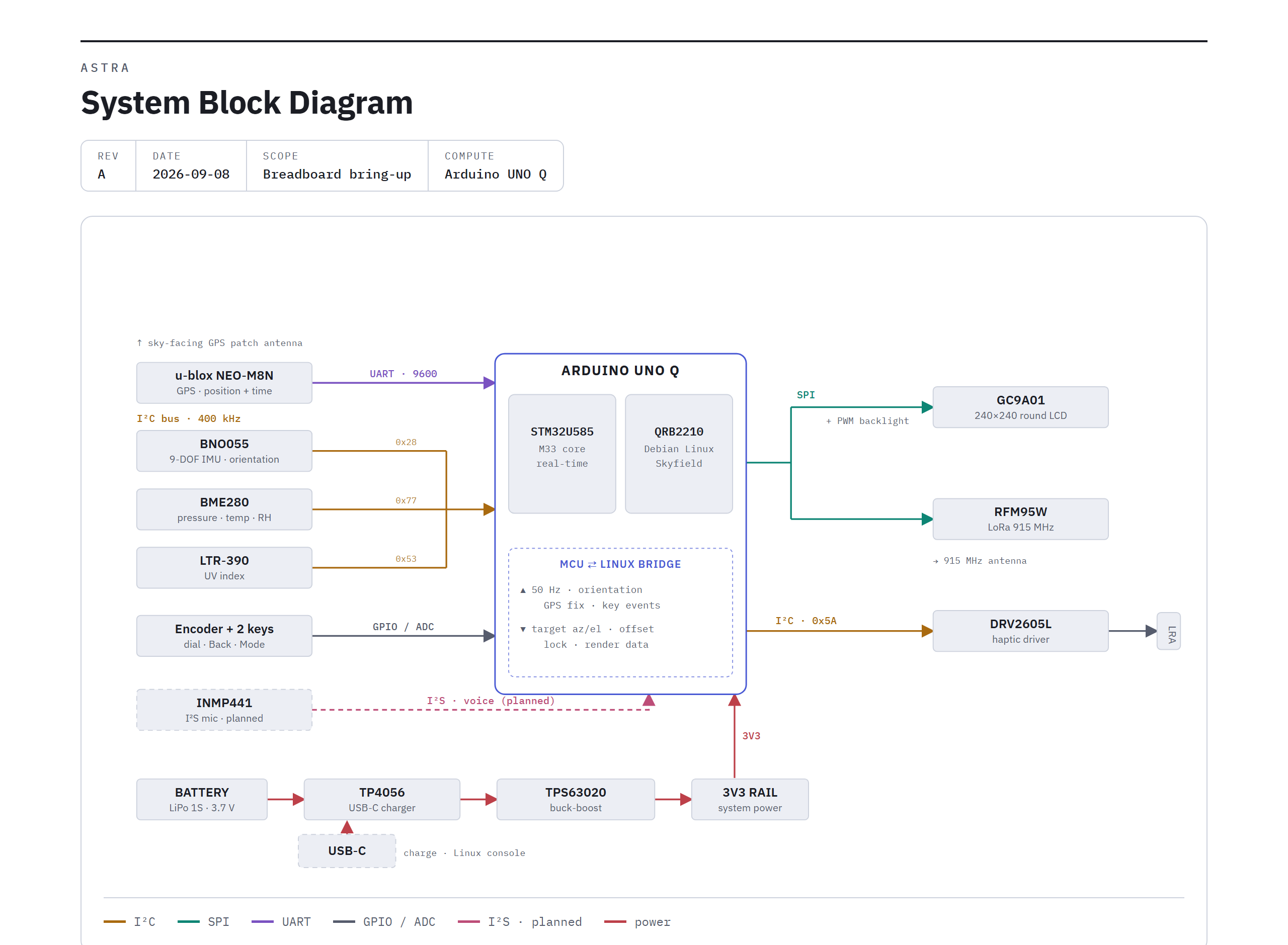
STM32U585 MCU — hard real-time, always on:
100 Hz IMU quaternion loop, GPS NMEA parsing, LoRa TX/RX with timing, rotary encoder quadrature decode, button debounce and detent counting, haptic waveform synthesis on the DRV2605L, BME280 and UV polling, display backlight PWM. The pointing loop never stalls because the screen redrew or the radio was busy.
Qualcomm QRB2210 MPU, Debian Linux — the data and software ecosystem:
Skyfield plus multi-megabyte JPL ephemeris files (needs a filesystem and NumPy — cannot run on the M33), SGP4 propagation, the conditions-score fusion, the star and Messier catalogs, offline speech recognition, reticle rendering, and the network path for refreshing TLEs and event data.
Bridge / RPC: the MCU streams orientation, fix, and sensor data to Linux at ~20 Hz; Linux returns the target's screen position and lock state. The MCU keeps ownership of the haptic lock response so it stays low-latency even if the Linux side hiccups.
The ephemeris and catalog work needs the Linux software stack. The pointing loop needs determinism Linux can't give. That split is the product.
---
The enclosure — designed in Fusion around the real board
The shell is modeled in Autodesk Fusion around the imported Arduino UNO Q STEP model, not around guessed dimensions.
Body: portrait, 112 × 63 × 24 mm, 10 mm corner radius, 2.5 mm nominal wall, one-handed. The thumb reaches the dial and both shaped keys without shifting grip.
Board fit: the 53.34 × 68.58 mm UNO Q sits on four bosses on the standard Arduino UNO hole pattern, 3.5 mm standoff, M3 self-tapping pilots, with an 8 mm component envelope toward the display and 1.8 mm on the solder side.
Display: a 1.28" GC9A01 round LCD behind a 30.5 mm cover glass, in a raised 38 mm bezel that stands 2 mm proud of the face, with a TPU gasket seat.
Sight: a molded rear notch standing 6 mm proud of the top edge with a clean V groove, and a 9 mm front bead post on the face — matte, rounded, non-weaponlike.
Antenna and EMI plan: the active GPS patch antenna sits on the top face with a ground plane and a clear sky view; the LoRa antenna has its own zone; the IMU magnetometer is kept away from the LiPo, the buck-boost converter, and the LRA so heading doesn't drift.
Mounts: a 1/4"-20 brass heat-set insert in the base, a lanyard boss, and the separate printed Vixen finder-shoe adapter as an accessory.
Assembly: front and rear shells, screw bosses, a snap-fit perimeter, a cosmetic parting line at the equator.
---
Built to pass through airport security
Binoculars, compasses, sextants, and telescopes all fly in carry-on luggage — the precedent is on our side, as long as the instrument doesn't look like a weapon part.
The sight is a sighting notch in the sextant and surveying-transit tradition, matte and rounded, not a rifle sight.
Any laser pointer is a telescope-mount accessory only and is never part of the carry configuration.
The single LiPo cell is far under the 100 Wh carry-on limit; a UN 38.3-tested cell is specified.
---
Made for production — ~750 units for Autodesk University 2027
Wall and draft: ~2.5 mm uniform wall, draft angles on all vertical faces, boss-to-wall fillets and ribs — an injection-mold-ready design from the start.
Process for 750: HP Multi Jet Fusion nylon or SLA for the production run through PCBWay — no hard tooling at this volume — with a bead-blast matte finish; the geometry scales directly to aluminium bridge tooling or steel molds if volume grows.
Hardware: brass heat-set inserts for the 1/4"-20 socket and the M2 assembly screws; a TPU display gasket.
Electronics: a custom carrier PCB designed in Fusion Electronics and fabricated by PCBWay, carrying the sensor block, the LoRa front end with its antenna keep-out, and the power path, so the interior is a clean stack instead of stacked breakout boards.
---
Useful long after the conference
Year-round: stargazing, astrophotography session planning, telescope push-to, saved-waypoint bearings.
For the AU audience specifically: the same conditions engine predicts golden hour, blue hour, and clear-sky windows — directly useful to the architects, photographers, and media professionals at Autodesk University.
A real product category: star pointers and push-to controllers already sell as consumer products. This is a better one, at a lower price, in a pocket.
---
Roadmap to the December deadline
Targeting-math prototype in Python + Skyfield on a laptop — az/el for planets and ~100 bright stars, device quaternion → pointing az/el → gnomonic screen-space delta → lock threshold. Validated against Stellarium.
Conditions-score and satellite-pass modules.
Bridge / RPC message schema, stubbed on both the MCU and Linux ends.
Offline speech grammar spike.
Haptic ramp on a real LRA + DRV2605L.
Enclosure refinement in Fusion around the finalized antenna and magnetometer keep-outs.
Carrier PCB in Fusion Electronics → PCBWay.
Breadboard bring-up → integration → field test → demo video.
-----------------------------------------------------------------------------------------------------------------------
source 1 - Official Uno Q Page


Comments