



Hardware components | ||||||
 |
| × | 1 | |||
 |
| × | 1 | |||
| × | 1 | ||||
| × | 1 | ||||
 |
| × | 1 | |||
 |
| × | 1 | |||
Software apps and online services | ||||||
 |
| |||||
 |
| |||||
Hand tools and fabrication machines | ||||||
 |
| |||||
 |
| |||||
 |
| |||||
 |
| |||||
 |
| |||||
In many situations, we rely on feeling to judge whether a room is too hot or too humid.However, this approach is unreliable and often leads to delayed responses.
In environments like server rooms, storage areas, or even bedrooms, unnoticed temperature changes can cause serious problems.
To solve this, I built a simple IoT device called Heat Guard.
💡 C onceptHeat Guard is designed to transform subjective feeling into measurable data.
The system reads temperature and humidity using a DHT22 sensor, calculates the heat index, and sends the data to a smartphone via WiFi using the Blynk platform.
This allows users to monitor environmental conditions in real-time from anywhere.
🔧 H ardware OverviewThe device is built using simple and affordable components:
- Wemos D1 Mini (ESP8266)
- DHT22 Temperature & Humidity Sensor
- TP4056 Charging Module
- 18650 Battery
- 10K Resistor
All components are placed inside a small project box, making it portable and easy to deploy.
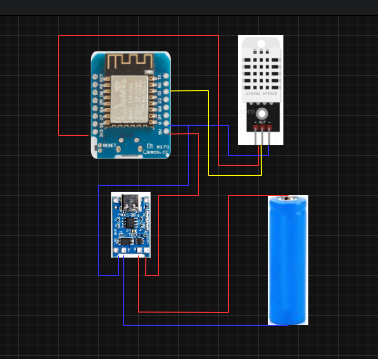
🔌 W iring ExplanationThe wiring is straightforward:
- DHT22 connected to 3.3V, GND, and GPIO (D4)
- A 10K pull-up resistor between VCC and DATA
- Battery connected through TP4056 module to power the system
This simple setup ensures reliability while keeping the design minimal.
💻 S oftware & LogicThe system works in a loop:
- Connect to WiFi
- Read temperature and humidity
- Calculate heat index
- Send data to Blynk
- Enter light sleep mode for 5 minutes
This approach balances performance and power efficiency.
📡 M onitoring via SmartphoneUsing Blynk, the data is visualized in real-time:
- Temperature
- Humidity
- Heat Index
Users can access the data anytime, enabling faster decision-making.
🔋 P ower EfficiencyTo reduce power consumption, the device uses light sleep mode.
- Active time: ~5–10 seconds
- Sleep interval: 5 minutes
- Average current: ~3–5 mA
With a 1000 mAh battery, the system can run for approximately 8–12 days.
📊 R esultsThe system successfully:
- Monitors environmental conditions in real-time
- Sends stable data to the cloud
- Operates continuously using battery power
It proves that a simple setup can deliver meaningful insights.
🚀 A pplicationsHeat Guard can be used in:
- Server rooms
- Warehouses
- Indoor environments
- Animal enclosures
- Smart home setups
- Requires WiFi connectivity
- Light sleep is not as efficient as deep sleep
- No automatic alert system (basic version)
- Add alert notifications (overheat warning)
- Implement deep sleep for longer battery life
- Add actuator control (fan / relay)
- Integrate with MQTT or other IoT platforms
Heat Guard demonstrates that IoT solutions do not need to be complex or expensive.
By combining simple hardware with efficient software design, we can create a practical system that helps prevent problems before they occur.
From feeling… to data.


Comments