Thin-Pod is a small, reproducible vibration-sensing node for rotating machinery and mechanical structures. It combines an analogue MEMS vibration sensor, a custom carrier PCB, a Qorvo DWM3001C UWB development kit, and a gateway architecture based around an STM32 NUCLEO-N657X0-Q board. The project is designed as a practical open-hardware route into machinery-health sensing: measure vibration locally, transmit short diagnostic windows over UWB, and hand the data to a gateway for DSP, feature extraction and eventual TinyML.
Thin-Pod began with a fairly simple question: could a small, understandable open-hardware node do useful vibration telemetry without becoming a black-box industrial product?
Industrial vibration monitoring is powerful, but much of the commercial ecosystem is expensive, closed, or designed around complete vendor stacks. Thin-Pod takes a different route. It is deliberately visible. The measurement chain can be followed from the accelerometer output, through a simple analogue conditioning network, into an ADC-capable UWB board, across a local UWB link, and onward to a gateway where the heavier signal processing can happen.
Initial iteration of Thin-Pod on a breadboard
The current system has two main hardware roles.
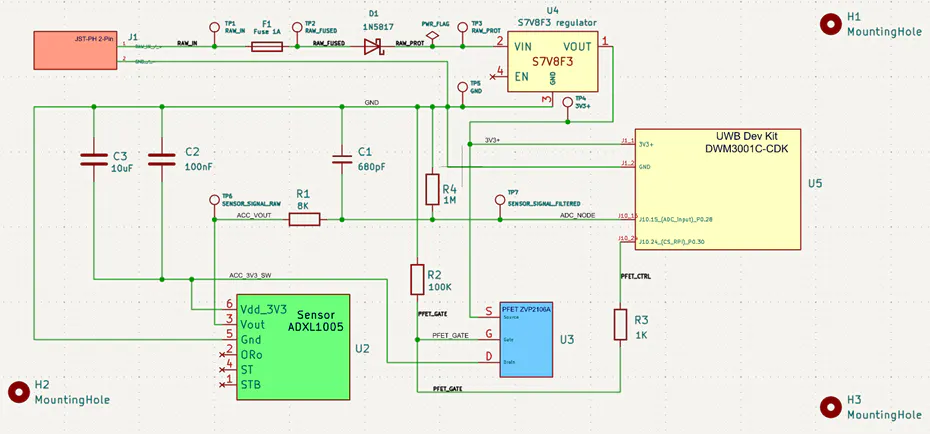
The first is the Thin-Pod sensor node. This is the board attached to, or placed near, a machine or test object. It contains the ADXL1005 vibration sensor path, local power regulation, reverse-polarity protection, a high-side PFET switch for the accelerometer supply, labelled test points and an interface to the Qorvo DWM3001C-CDK.
Initial iteration of Thin-Pod's Gateway on a breadboard (Power via PoE)
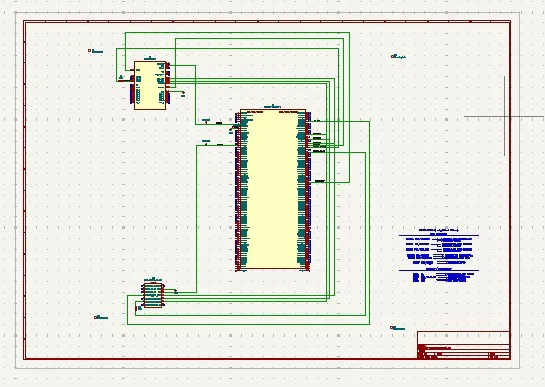
The second is the Gateway. This is the receiving and processing side. The Gateway architecture uses a Qorvo DWM3001C-CDK for UWB reception and an STM32 NUCLEO-N657X0-Q as the main MCU platform for future DSP, feature extraction and TinyML experimentation. A Seeed Studio XIAO ESP32-C6 has also been included in the Gateway carrier design as a possible Wi-Fi backhaul or network interface.
Thin-Pod iteration on a biscuit board
The intended data path is:
Mechanical vibration
↓
ADXL1005 analogue output
↓
RC filtering and ADC input node
↓
DWM3001C-CDK ADC-capable input on the Thin-Pod side
↓
UWB packet/window transport
↓
Gateway DWM3001C-CDK
↓
STM32 NUCLEO-N657X0-Q
↓
DSP, feature extraction, logging and future TinyML
Thin-Pod aims to be a documented measurement chain that is useful as an engineering instrument.
Thin-Pod PCB rev 0.1 working prototype
The project is useful because it sits at a fertile boundary between analogue electronics, embedded firmware, RF transport, mechanical measurement, DSP and open hardware. It is a small, legible platform for learning how such systems begin: a sensor, a power supply, grounding discipline, signal conditioning, sampling, transport, and a gateway that can convert raw vibration into useful information.
This makes Thin-Pod suitable for education, experimentation and early research. It can support discussions about anti-alias filtering, ADC sampling, UWB packetisation, edge feature extraction, secure firmware update strategy, power budgeting, PCB manufacture, test-point planning and repeatable bring-up.
Vibrations picked up by Thin-Pod sensor displays on oscillscope (image credit - G Dawson)
The project uses the Analog Devices ADXL1005 as the vibration sensor. Its analogue output is intentionally useful for learning because it does not hide the signal path behind a digital sensor interface. The board exposes the supply rails, filtered signal node, ADC node and power-control path as labelled test points. This makes Thin-Pod less like a sealed sensor puck and more like a small vibration instrument that can be inspected, modified and taught from.
Thin-Pod also uses UWB in a deliberately instrumentation-led way. Rather than treating it only as an indoor-positioning technology, the project uses UWB as a robust local transport layer for short vibration data windows. The design direction is not to stream everything forever. A better systems approach is to capture short, meaningful windows of vibration, attach metadata, and transmit selected frames to a gateway for analysis. That keeps the radio traffic realistic and leaves a clear path towards multi-pod systems.
Thin-Pod KiCad Schematic (Power via JST connector)
Thin-Pod fits the Best of 2025 Competition as an MCU-centred embedded systems project. It uses development boards in a real hardware application, documents the build path, includes a custom PCB (see the project's Github repository for Gerber files), exposes a complete BOM, and has a clear contribution beyond a one-off demo (short videos on the project's Github).
Thin-Pod rev 0.1 is now a real manufactured object with measured evidence behind it (see Github repository). The board has powered up, the accelerometer rail works, the filtered ADXL1005 output sits at the expected bias, and mechanical taps produce a clear dynamic response on the oscilloscope. The UWB link has already been brought up separately, giving the project a credible path from sensor node to gateway.
The next step is firmware integration: sample the filtered accelerometer output, packetise short vibration windows, transport them across UWB and hand them to the STM32 gateway for feature extraction. This is where Thin-Pod moves from a one-off sensor board towards a compact open vibration-telemetry platform, with a measurement chain that can be inspected, tested and is reproducible.
View of one of the generated Thin-Pod Gerber files




_4YUDWziWQ8.png?auto=compress%2Cformat&w=48&h=48&fit=fill&bg=ffffff)


Comments