



Hardware components | ||||||
 |
| × | 1 | |||
 |
| × | 1 | |||
 |
| × | 1 | |||
 |
| × | 1 | |||
 |
| × | 1 | |||
| × | 1 | ||||
Software apps and online services | ||||||
 |
| |||||
The Spark: Catching Leaks Before They BurstWalk through any municipal or agricultural distribution network during a dry spell, and the value of every drop of water is clear. Yet, billions of liters are silently lost worldwide each day—not through sudden, catastrophic pipe bursts, but via microscopic stress fractures, joint degradation, and early-stage cavitation.
These micro-leaks spray water underground for weeks without dropping system pressure enough to trigger traditional flow meters. By the time surface pooling occurs or a meter flags a differential, major structural damage and soil erosion have already taken place. Current detection methods are either intrusive, requiring system shutdowns to install inline sensors, or rely on infrequent manual surveys. We asked a simple question: What if water pipes could continuously monitor their own structural integrity and alert us before minor defects become major failures?
That question led to AquaPulse.
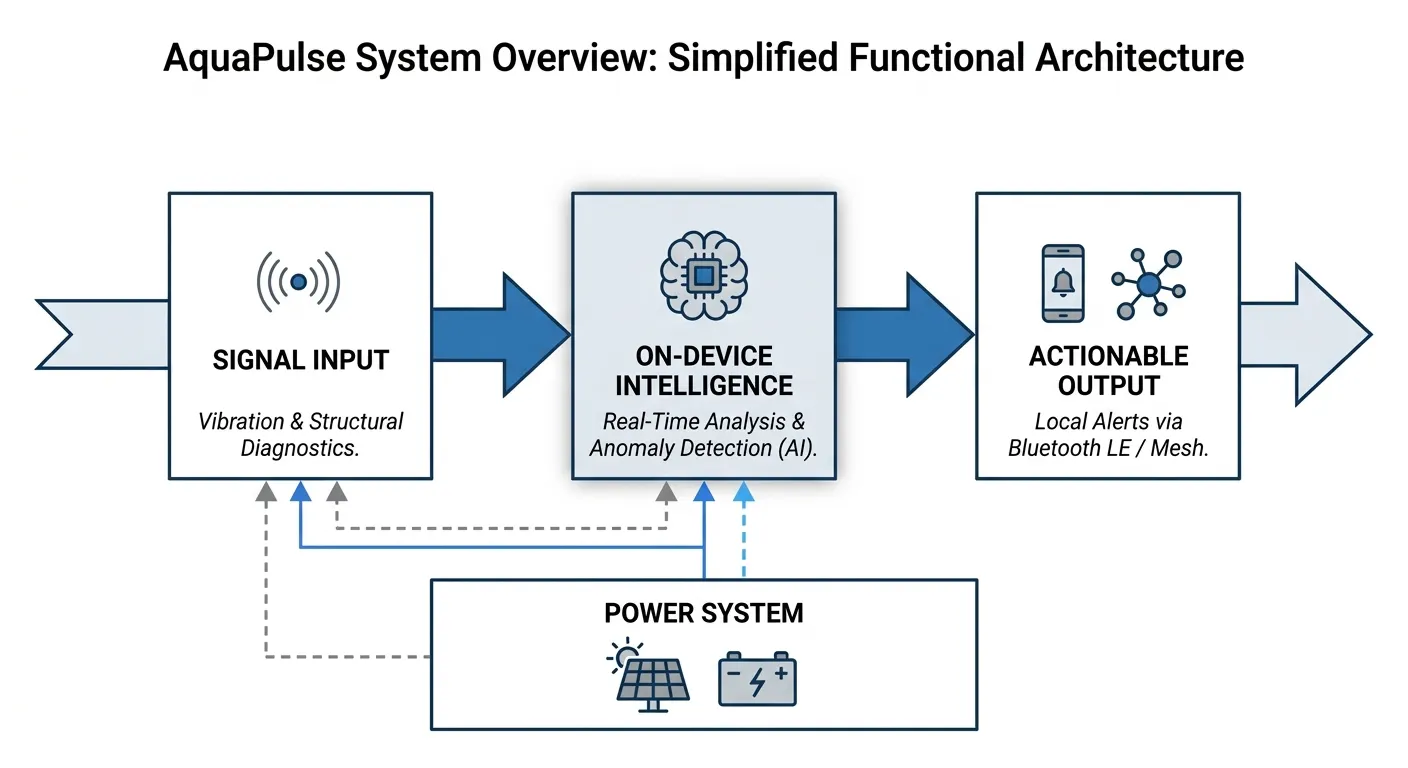
What AquaPulse DoesAquaPulse is a non-intrusive, continuous monitoring node designed to clamp directly onto the exterior of pressurized supply and irrigation pipes. Powered by the Nordic nRF54LM20 DK, it acts as a low-power structural stethoscope. Instead of cutting into plumbing, AquaPulse listens to high-frequency acoustic vibration signatures within the pipe material itself, using localized Edge AI to classify pipe health and broadcast proactive alerts over Bluetooth LE or Bluetooth Mesh.System Architecture & Workflow1.Acoustic Signal Capture: High-pressure fluid escaping through micro-cracks generates ultrasonic stress waves ($10\text{ kHz} - 40\text{ kHz}$) inside the pipe wall. A contact transducer picks up these mechanical vibrations.
2.Signal Conditioning: An ultra-low-noise operational amplifier filters out low-frequency ambient noise (such as traffic or passing machinery) before passing the signal to the nRF54LM20’s 14-bit ADC.3.On-Device Edge AI: The nRF54LM20 extracts spectral features using Fast Fourier Transform (FFT). A quantized Neuton AI anomaly detection model running directly on the integrated Axon NPU analyzes the spectral patterns in real time to detect cavitation and micro-fractures.4.Wireless Alerts & Low Power: Streaming raw audio to the cloud wastes energy and bandwidth. By running inference locally on the NPU, the node remains in a deep-sleep state most of the time, waking its radio only to transmit structured alerts ("Normal", "Minor Cavitation Detected", or "Active Micro-Leak Warning") via Bluetooth LE or Mesh to field technicians.
Real-World Impact
1.Zero-Downtime Installation: Clamps onto existing infrastructure in minutes without interrupting water delivery.
2.Proactive Conservation: Catches micro-fractures early, preventing burst pipes and severe resource loss.
3.Autonomous Operation: Combining local NPU processing with Bluetooth LE enables long-term, low-maintenance field deployment powered by a small Lithium ion battery and micro-solar harvester.


Comments