



Hardware components | ||||||
 |
| × | 1 | |||
 |
| × | 1 | |||
| × | 1 | ||||
Software apps and online services | ||||||
| ||||||
| ||||||
In an increasingly connected world, true off-grid communication remains a complex challenge. Existing consumer walkie-talkies lack text-based telemetry, while cellular networks are vulnerable to localized outages. I set out to build a robust, decentralized communication tool utilizing the M5Stack ecosystem, designed for secure, low-latency transmission without relying on external infrastructure.
Initially, I developed the protocol over ESP-NOW, taking advantage of the ESP32's native capabilities for fast, peer-to-peer communication. However, while ESP-NOW is excellent for rapid, localized data transfer, it lacks the penetration and range required for wilderness or disaster-recovery scenarios.
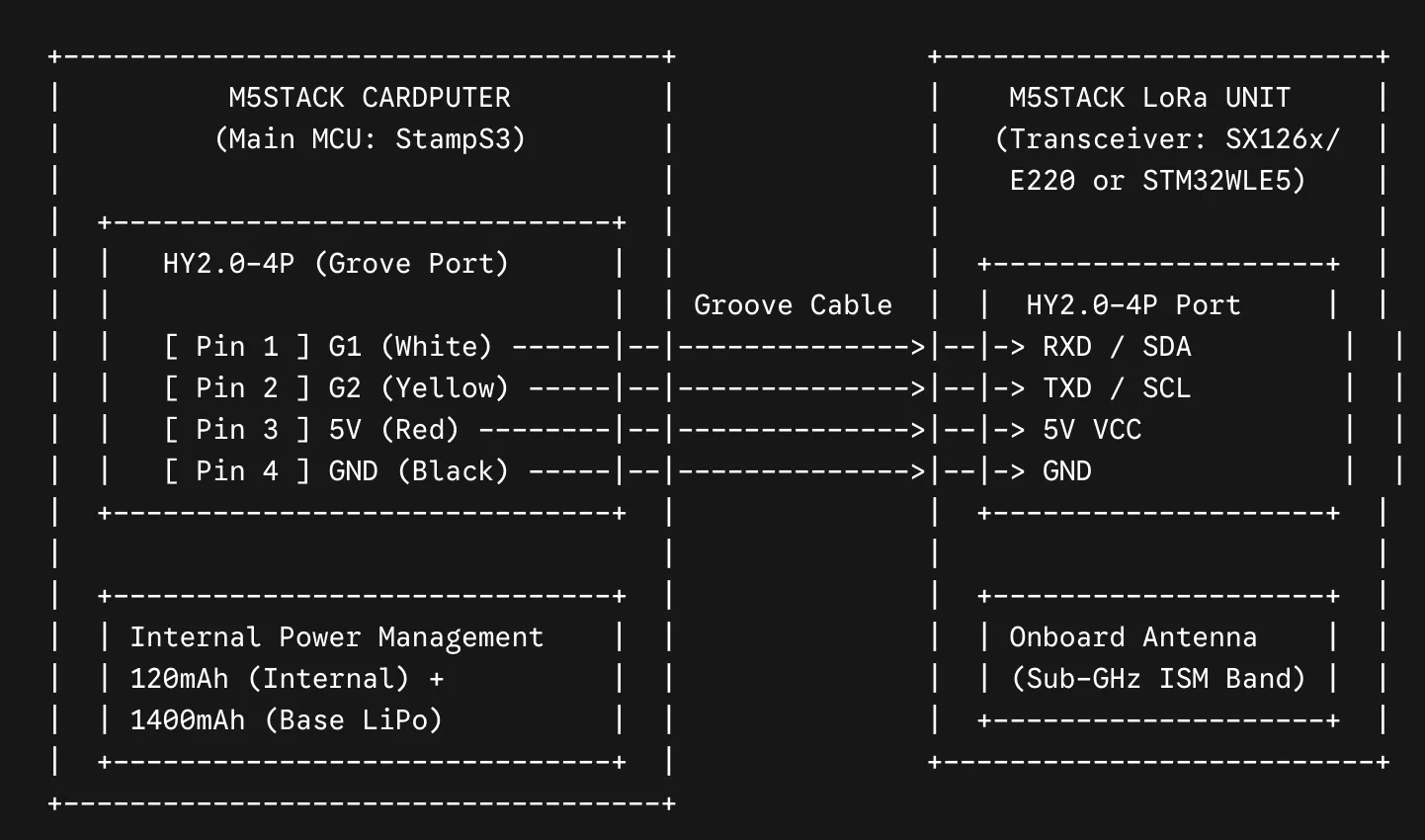
To solve this, I expanded the architecture into a Dual-Mode System. By interfacing the M5Stack controller with a dedicated LoRa Unit, the firmware dynamically routes messages based on range and payload size.
How It Works:The system is built on a custom embedded firmware architecture (RTOS-driven) that manages two distinct RF stacks:
Tactical Mode (ESP-NOW): Used for localized communication. It provides higher bandwidth, allowing for rapid text exchange and immediate device discovery within a few hundred meters.
- Tactical Mode (ESP-NOW): Used for localized communication. It provides higher bandwidth, allowing for rapid text exchange and immediate device discovery within a few hundred meters.
Long-Range Mode (LoRa): When the ESP-NOW handshake fails due to distance, the system falls back to the LoRa module. Utilizing the Semtech SX127X transceiver, messages are modulated into chirp spread spectrum (CSS) signals, pushing the range out to several kilometers at the cost of bandwidth.
- Long-Range Mode (LoRa): When the ESP-NOW handshake fails due to distance, the system falls back to the LoRa module. Utilizing the Semtech SX127X transceiver, messages are modulated into chirp spread spectrum (CSS) signals, pushing the range out to several kilometers at the cost of bandwidth.
System Architecture & Firmware Design:The firmware leverages a modular IPC (Inter-Process Communication) design.
Message Queue: User inputs from the M5Stack keyboard are pushed to a central FreeRTOS queue.
- Message Queue: User inputs from the M5Stack keyboard are pushed to a central FreeRTOS queue.
Link Manager Task: A dedicated task evaluates link strength. If the target node responds to an ESP-NOW ping, the payload is dispatched over the 2.4GHz band.
- Link Manager Task: A dedicated task evaluates link strength. If the target node responds to an ESP-NOW ping, the payload is dispatched over the 2.4GHz band.
Hardware Abstraction: A custom driver interfaces with the LoRa unit via SPI. If ESP-NOW fails, the payload is compressed, wrapped in a LoRaWAN-style frame, and transmitted over the sub-GHz band.
- Hardware Abstraction: A custom driver interfaces with the LoRa unit via SPI. If ESP-NOW fails, the payload is compressed, wrapped in a LoRaWAN-style frame, and transmitted over the sub-GHz band.
Future Roadmap:The next phase involves integrating a highly optimized local LLM on edge devices for predictive text and message summarization, as well as porting the codebase to integrate with secure, self-custodial identity protocols.


Comments