



The summer heat in Japan is abnormal, and it's been particularly terrible in recent years. Fortunately, Japan is doing relatively well this year, but in exchange, Europe and America are experiencing unprecedented high temperatures. I feel sad every time I hear news of people dying. In areas without air conditioning, there's no escape from heat waves exceeding 40 degrees Celsius.
I was thinking of repainting the exterior walls of my house during the winter and got quotes from contractors, but it's over budget and I can't proceed. But I reconsidered — wasn't there something else I should do before tackling the walls? Then, I looked at the windows. It's said that if I can block the sunlight by putting blackout curtains on both the inside and outside of the windows, the perceived temperature near the windows can drop by 3-5 degrees Celsius.
My living room has a south-facing window that lets in almost pointless sunlight in the summer. The sunlight is directly behind the monitors connected to my PC and gaming consoles at the same height. Even in the middle of winter, the outside of this window feels warm from the sunlight, and the concrete floor gets so hot that it's almost unbearable to walk on barefoot. If I try growing tomatoes in sauvage style here, I might also get the benefit of a green curtain. Let's give it a try.
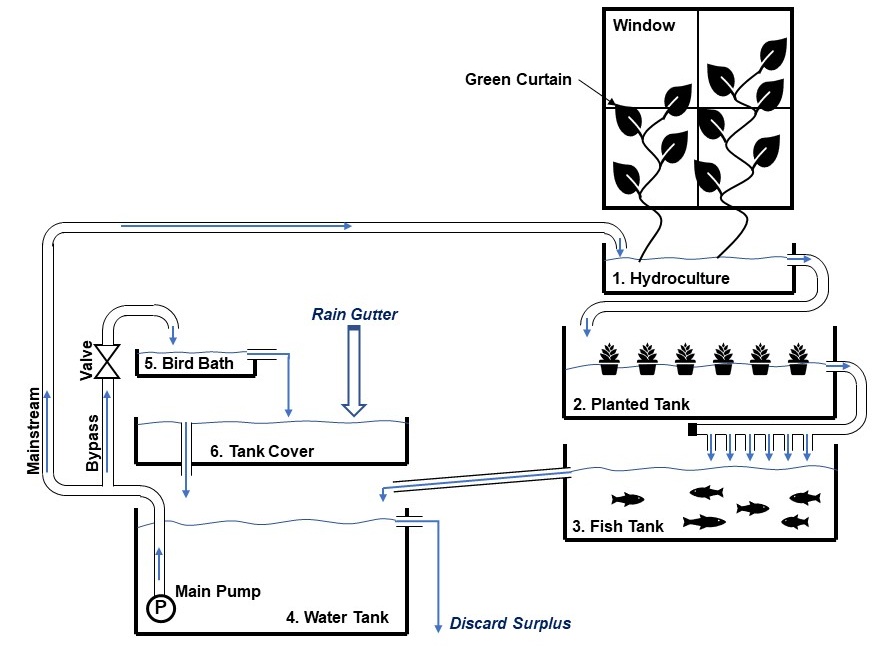
Architecture: System Layout & SchematicsThis schematic illustrates the dual-route hydraulic circulation of the aquaponics system, carefully designed to optimize water distribution and eliminate pump strain.
Mainstream Loop: Driven by the Main Pump located in the Water Tank (4), water is lifted to the Hydroculture unit (1) to feed the green curtain at the window. The water then cascades sequentially through the Planted Tank (2) and the Fish Tank (3) before returning to the main Water Tank (4).
Bypass Loop & Backpressure Control: To prevent pump failure caused by backpressure, a parallel bypass route of equal pipe diameter is integrated. This line diverts water through the Bird Bath (5) and the Tank Cover (6) back into the tank. Crucially, a control valve is installed exclusively on this bypass side, allowing precise flow regulation without placing stress on the main pump's rotor mechanism.
Engineering Insights: Solving Air-Locks and Enhancing Pump DurabilityDeveloping a reliable fluid circulation system required overcoming several physical and mechanical challenges. Here are the key engineering insights gained through the prototyping process:
Preventing Air-Locks via Outlet Elevation:To ensure uninterrupted gravity-driven drainage, the outlet must be positioned strictly above the water level of the receiving tank. If the outlet becomes submerged, air gets trapped within the line, creating an air-lock that completely stalls the circulation.
Eliminating Hose Sag with Rigid PVC Pipes:In sections where the plumbing gradient is gentle, flexible hoses are prone to minor sagging. This slight dipping accumulates water and eventually triggers unexpected air-locks. To eliminate this risk, I replaced flexible hoses with rigid PVC pipes in all low-slope areas to maintain a perfectly straight, sag-free gradient.
DIY Pump Repair & Slip-Clutch Modification:During early testing, running out of water or facing sudden backpressure caused the main submersible pump to fail. Disassembling it revealed that the joint between the motor shaft and the impeller had broken. Instead of discarding it, I tightly wrapped waterproof PTFE tape around the rotating shaft to press-fit the impeller back in place. This DIY fix accidentally created a makeshift slip-clutch: if an excessive load occurs again, the impeller will safely slip on the tape rather than destroying the motor or snapping the shaft.
Backpressure Mitigation via Strategic Valve Placement:To permanently solve the pump stress issue, the hydraulic layout had to be redesigned. A common mistake is using a narrower bypass line and placing a valve on the mainstream, which chokes the pump and builds up high backpressure. The optimal solution is to use the exact same pipe diameter for both the mainstream and bypass lines, and place the control valve exclusively on the bypass side. This ensures that surplus water can always escape freely, shielding the pump from unnecessary strain.
Results & Ecological Balance: Medaka Survived, Shijimi LostWhen heavy rain from the typhoon brought a large amount of water into the rainwater collector, the tank filled up in just a few hours. Even after two weeks, thanks to rain every few days, the water level in the tank showed no signs of decreasing. For now, the basic system construction was a success.
However, perhaps due to the water becoming too acidic or unable to withstand the sudden change in water temperature, all the clams died. The medaka, freshwater prawns, and marsh shrimp are surviving without any problems. As we head into the height of summer, I want to see if they will successfully reproduce and increase in number. Furthermore, I was a little surprised that shellfish were more vulnerable to environmental changes than fish and crustaceans, so I want to investigate specifically what values were unfavorable.
Conclusion: A Resilient Architecture Shared Across BordersI have an acquaintance, or rather, I had one, in a region of northern Germany where air conditioning was considered unnecessary. I don't think I'll see him again since I quit my job, but he was incredibly helpful to me during a business trip last summer.
During my two-week solo business trip, the company held a summer party, and we drank beer together from midday while playing soccer with his kids. I'm very grateful. He's meticulous in his work, and above all, he's a kind father who cherishes his family. I felt that even though we're in different countries, our desire to protect our livelihoods is similar. I want to dedicate this project to that acquaintance. I've completed a prototype, and I'm going to wait and see how it goes for a few years.
Future Plan: Smart Monitoring and Top-Down Sensor SelectionI'd like to build loggers for temperature, pH, and other environmental data to monitor seasonal changes. When I visually inspected the tomato leaves, I noticed some were slightly yellow; it might be a magnesium deficiency. Hmm, is there a simple way to selectively measure only magnesium concentration? I plan to select the necessary sensors in a top-down manner to determine the easiest and most stable way to achieve both harvesting and insulation. Fortunately, I have enough time, so I want to choose slowly and carefully. I hope you will look forward to my next report.


Comments