


Hardware components | ||||||
 |
| × | 1 | |||
| × | 1 | ||||
| × | 1 | ||||
| × | 1 | ||||
| × | 1 | ||||
Software apps and online services | ||||||
| ||||||
| ||||||
Hand tools and fabrication machines | ||||||
 |
| |||||
 |
| |||||
| ||||||
## Overview
“Threepio” is a fully embedded, AI-powered conversational droid head that enables real-time voice interaction on a Raspberry Pi.Inspired by the character from Star Wars, this project recreates the experience of interacting with a conversational robot in a physical, real-world form.By combining hardware, software, and design, the system moves AI interaction off the screen and into a tangible object. Something that can be spoken to naturally, like how an interaction with the character would go in the real world.
---
## Why I Built This
One idea from science fiction always stuck with me: conversational droids. Machines and systems with their own personalities that can communicate naturally and respond in real time.This project was inspired by that vision. I wanted to use modern tools to embed AI into a physical system that can listen, respond, and exist in the same space as the user.Rather than building a static prop, the goal was to create something interactive, that can hold a seamless conversation, much like what we see in the films.
---
## How It Works
The system runs a real-time voice interaction pipeline entirely on a Raspberry Pi.1. Audio is captured through an I2S MEMS microphone 2. Speech is converted to text using a speech-to-text system 3. The text is processed by a language model to generate a response 4. The response is converted into speech using a text-to-speech system 5. Audio is played back through an internal speaker system So, the whole system looks like: Mic → STT → LLM → TTS → Speaker
---
## Hardware Design
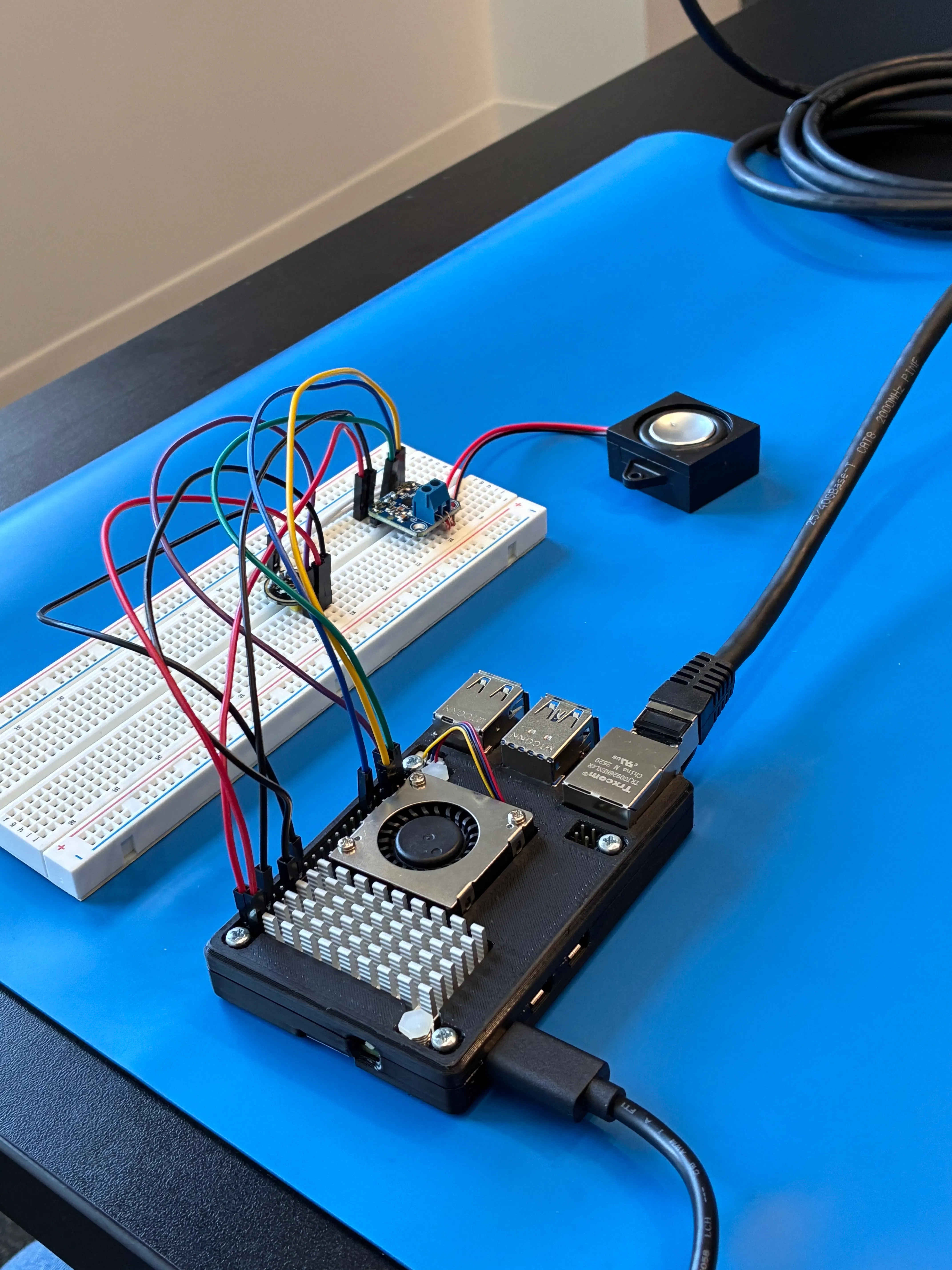
All components are integrated directly into the enclosure, making the system fully self-contained.The audio system uses a MAX98357A amplifier paired with an exciter instead of a traditional speaker. This allows sound to travel through the structure itself, creating the effect that the voice originates from within the head.
---
## Key Challenges
One of the biggest challenges was balancing latency with the limitations of embedded hardware. Achieving fast response times while maintaining natural conversational flow required careful system design.Another challenge was audio integration. Using an exciter required experimentation with placement and structure to achieve the desired sound quality.
---
## Results
The final system enables real-time conversational interaction in a fully embedded format. It responds naturally to spoken input and produces character-style voice output in a compact, physical form.This project demonstrates how ideas originally imagined in science fiction can begin to take shape through modern AI and embedded systems.
---
## Future Improvements
Future iterations could include full-body integration, improved spatial audio, and more advanced conversational memory systems.
---
## Resources


Comments