


Hardware components | ||||||
 |
| × | 1 | |||
| × | 1 | ||||
| × | 1 | ||||
| × | 1 | ||||
| × | 1 | ||||
| × | 1 | ||||
| × | 1 | ||||
Software apps and online services | ||||||
 |
| |||||
| ||||||
Building a motion-sensing product usually takes 12–24 months before you sell anything: design and certify a board, write firmware and radio code, get OTA updates right, stand up servers, a database and an API, build iOS and Android apps, then collect data and train models. Most of that has nothing to do with what makes your product different.
MeltiNode is that whole stack, already built. You bring the idea — a padel coaching app, a home-rehab kit, a fall-safety add-on for your software — and you can have it running in days.
WHAT'S ALREADY DONE FOR YOU
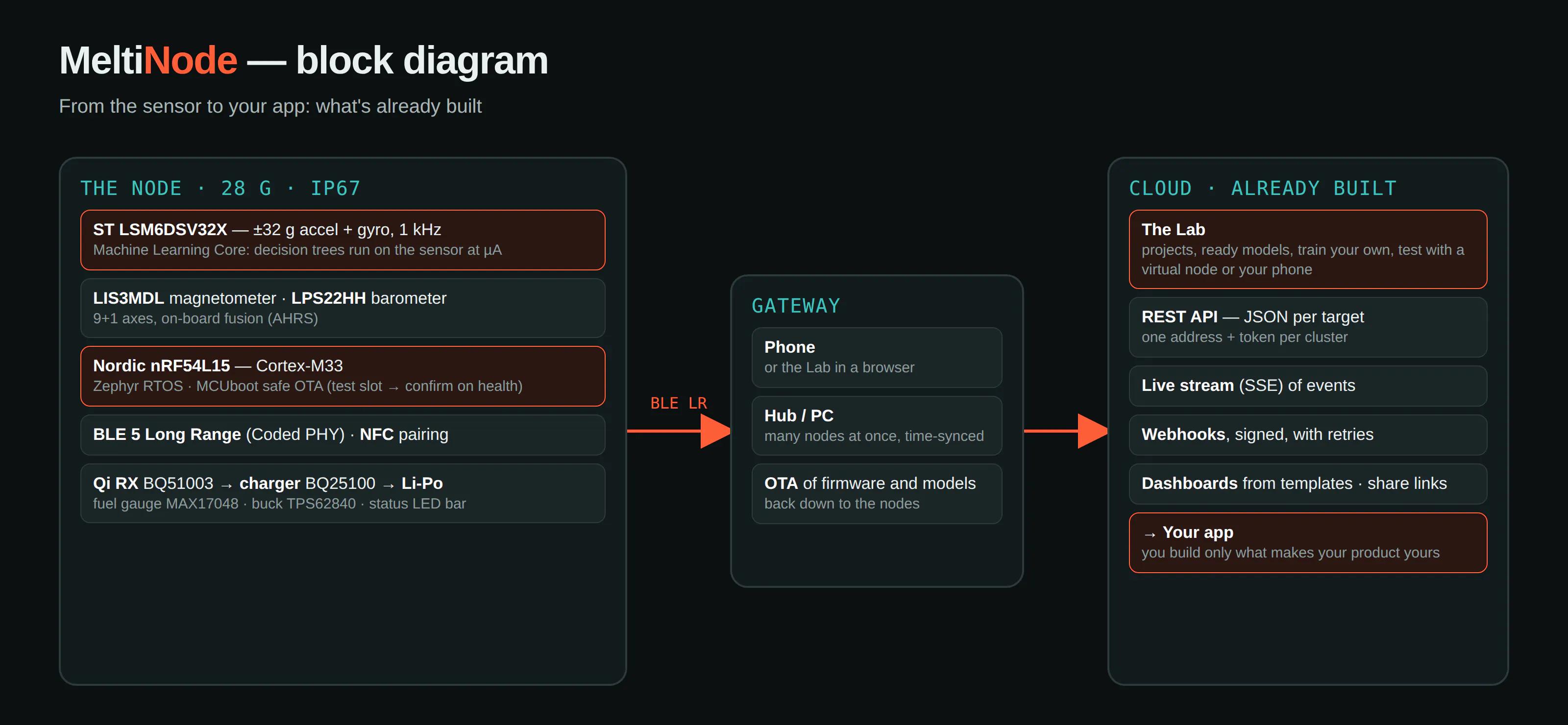
• The node: sealed, IP67, Qi wireless charging, BLE Long Range + NFC. 28 g, 34 × 30 × 11 mm.
• The firmware: Zephyr + MCUboot with safe OTA — a bad update rolls back instead of bricking the node.
• The models: ready ones for sport, health and industry, or train your own in the Lab. They run on the sensor itself, and your model stays your IP.
• The data path: JSON over a REST API, live event stream and signed webhooks, one address per group of nodes.
• The dashboard: ready from a template for every group, plus read-only share links.
• The business model: sell it by subscription under your own name, at your own price. Your customers pay you.
HOW IT GOES
1. Day 1 — the recipe: who wears it, where the sensors go, which models, what comes out in the JSON. An assistant proposes it, you adjust it.
2. Same day — the test: run it with a virtual node on your PC or with your phone as a live node, before any hardware arrives.
3. A few days — the launch: connect the API to your software, buy the nodes, and your customers subscribe to you.
AND THE SENSOR MEASURES WHAT OTHERS CAN'T
Most consumer IMUs top out at ±16 g. A punch, a landing, a sprint or a fall goes past that, so they clip the moment that matters. MeltiNode measures up to ±32 g on 9+1 axes (accel, gyro, magnetometer, barometer) at 1 kHz, with a Machine Learning Core (ST LSM6DSV32X) classifying gestures on the chip at microamps, on a Nordic nRF54L15.
TRY THE WHOLE FLOW NOW — FREE, NO HARDWARE
The Lab is live: build a project, pick models, test it with a virtual node or your phone, and read the data from the API.
→ https://www.meltinode.com/lab?utm_source=hackster&utm_medium=community&utm_campaign=prelaunch
WHERE WE ARE
Working prototype streaming live on the bench; the production case (over-molded silicone rubber) is out for quotes with manufacturers, and we're preparing the launch. Certification (CE, FCC, Bluetooth SIG) is on us before we ship. The Lab, the API and the dashboards are live today.
HONEST SCOPE
±32 g is for intense body and limb motion — combat sports, jumps, sprints, swimming, rehab, work safety. It is not for head-impact / concussion sensing, which needs ±200–400 g.
Join the launch list for founding pricing: https://www.meltinode.com/?utm_source=hackster&utm_medium=community&utm_campaign=prelaunch
Block diagram — from the sensor to your app


Comments