



Hardware components | ||||||
 |
| × | 1 | |||
| × | 1 | ||||
| × | 1 | ||||
| × | 1 | ||||
| × | 1 | ||||
 |
| × | 1 | |||
| × | 1 | ||||
Software apps and online services | ||||||
 |
| |||||
Modern navigation systems are powerful, but they often depend heavily on smartphones, internet connectivity, and frequent charging. During hiking, trekking, cycling, camping, or emergency situations, these dependencies can become limitations. Phones drain quickly outdoors, screens are difficult to read in sunlight, and power availability becomes uncertain in remote areas.
TrailNAV was created as an attempt to build a simple, reliable, and energy-efficient navigation companion designed specifically for off-grid outdoor use.
Instead of focusing on complex maps or heavy interfaces, TrailNAV focuses on the essentials:
- direction
- destination guidance
- low power operation
- readability in sunlight
- long endurance
The device combines a sunlight-readable ePaper display, GPS navigation, digital compass sensing, solar charging, and ultra-low-power embedded electronics into a compact handheld form factor.
What makes TrailNAV special is that it was designed and built entirely as a DIY hardware project using simple materials like PVC sunboard sheets and hand-crafted assembly methods, proving that practical outdoor technology can be built with accessible tools and components.
The idea behind TrailNAV came from a simple question:
"What if there was a lightweight navigation device that could continue working for days outdoors without depending on mobile networks or frequent charging?"
While smartphones provide excellent navigation features, they are not always ideal for remote outdoor environments:
- battery drains rapidly with GPS usage
- bright sunlight reduces visibility
- touchscreens become inconvenient in rain or gloves
- network dependency limits usability in remote areas
TrailNAV was designed to solve these problems through:
- ultra-low-power hardware
- ePaper technology
- dedicated physical buttons
- solar-assisted charging
- minimal distraction interface
The goal was not to replace smartphones, but to create a focused navigation companion that remains dependable in outdoor environments.
Solar Assisted Charging: A rear-mounted solar panel continuously charges the internal Li-ion battery through an MPPT charging module, extending operating time during outdoor use.
Ultra Low Power ePaper Display: The 2.7-inch Waveshare ePaper display consumes power only during updates, allowing long battery life while remaining perfectly readable in direct sunlight.
GPS Navigation: Using the NEO-M8N GPS module, TrailNAV provides:
- destination guidance
- directional navigation
- heading information
- distance estimation
without requiring internet connectivity.
Digital Compass: The integrated QMC5883L magnetometer enables real-time directional heading and compass visualization.
Physical Button Interface: Three tactile buttons allow simple and reliable interaction even while wearing gloves or during motion.
Off-Grid Operation: TrailNAV is designed to work independently of:
- cellular networks
- cloud services
- online maps
- continuous charging infrastructure
making it suitable for trekking, cycling, camping, field exploration & emergency navigation
Hardware Overview- Seeed Studio XIAO ESP32-C6
- 2.7" Waveshare ePaper Display (264×176)
- NEO-M8N GPS Module
- QMC5883L Magnetometer
- 3.7V Li-ion Battery
- MPPT Solar Charging Module
- Rear Mounted Solar Panel
- Custom PVC Sunboard Enclosure
The first step was deciding the overall dimensions of the device based on the size of the electronic components. A compact handheld size of 10 cm x 6.5 cm was selected to make the device comfortable to hold and suitable for outdoor carrying. To improve appearance and ergonomics, the corners were chamfered at 45 degrees.
The enclosure was designed using a PVC sunboard sheet. The structure included a central base section, four foldable side walls and a top cover. The design was first sketched digitally and then converted into a printable A4 cutting template. The enclosure was fabricated manually using PVC sunboard sheet (3 mm), hobby cutter, steel ruler and cutting mat.
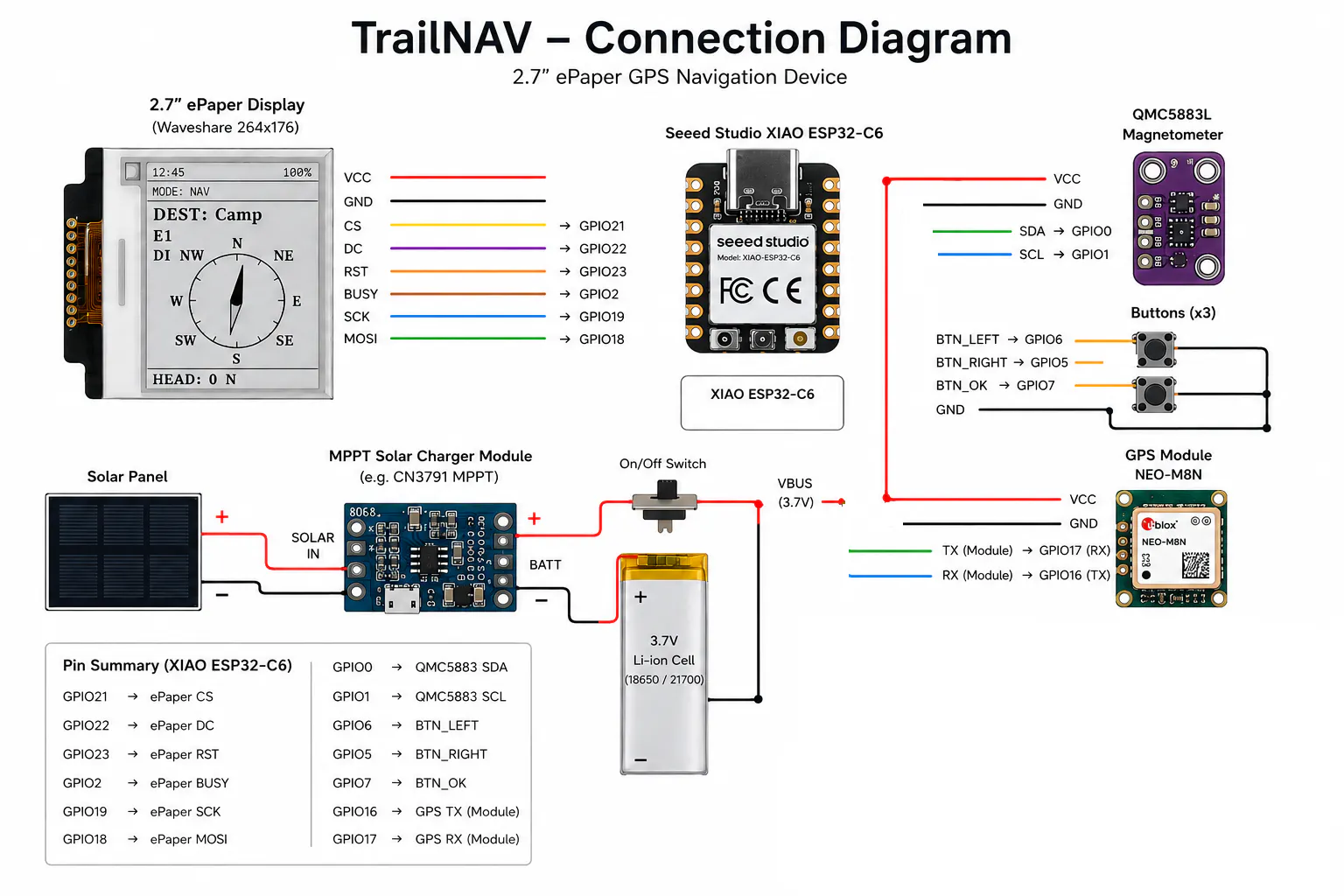
All module connections were completed manually using soldering iron and jumper wires. You can refer the connection diagram attached at the bottom of the project.
The firmware development begins with configuring the Arduino IDE for the ESP32-C6 platform. The ESP32 board package from Espressif Systems is installed, and the “ESP32C6 Dev Module” board is selected. The project uses multiple libraries for hardware communication and rendering.
- GxEPD2: ePaper Display Library
- TinyGPS++: GPS Library
- DFRobot QMC5883L: Magnetometer Library
Add these headers at the top of the firmware.
#include <SPI.h>
#include <Wire.h>
#include <TinyGPS++.h>
#include <QMC5883LCompass.h>
#include <GxEPD2_BW.h>
#include <Fonts/FreeSerifBold9pt7b.h>Inside setup():
- initialize serial monitor
- initialize GPS UART
- initialize display
- initialize compass
- initialize buttons
Define screen modes.
enum ScreenMode
{
  SCREEN_STATUS,
  SCREEN_DESTINATIONS,
  SCREEN_COMPASS,
  SCREEN_NAVIGATION
};
Checkout the full code on Github.
BOOT DEVICE
↓
WELCOME SCREEN
↓
STATUS SCREEN
↓
SELECT DESTINATION
↓
START NAVIGATION
↓
LIVE GPS + COMPASS GUIDANCETrailNAV demonstrates how a compact embedded system can combine GPS navigation, digital compass orientation, and low-power ePaper rendering into a practical offline exploration device. By integrating the ESP32-C6, GPS module, magnetometer, and ePaper display into a modular firmware architecture, the system provides reliable outdoor navigation without requiring internet connectivity
The project establishes a strong foundation for future development including breadcrumb tracking, return-to-home navigation, route logging, BLE synchronization, LoRa communication, and advanced offline mapping capabilities. Most importantly, TrailNAV shows how open-source embedded Microncontrollers can be used to build a fully functional standalone navigation system optimized for solar-powered outdoor usage.
Happy Building 🚀🧭☀️



Comments