


Hardware components | ||||||
 |
| × | 1 | |||
| × | 1 | ||||
| × | 1 | ||||
Software apps and online services | ||||||
 |
| |||||
 |
| |||||
Over the years, I've tried dozens of different bedside lamps and alarms.
But none were "just right". Some were too bright at night. Others were difficult to see from bed without glasses. Some had a blaring alarm while others only allowed an alarm to be set within next 24 hours. So I decided it was time to simply build my own to address these shortcomings and to add a few new smart features along the way.
Key Features- Integrated Hardware: A single device providing lighting, clock and alarm functions. Three independent ESP-based controllers act together as a single device.
- Versatile Lighting: Individually controllable RGBW bulb and LED Strip for "normal" and "night" modes. Each light source can have independent state, color and brightness settings.
- High-End Display: Auto-dimming touch screen with configurable fonts, colors and sizes. Configurable dimming levels based on measured ambient light levels.
- Time in 12 or 24-hour format. Indoor/Outdoor temperature in °F or °C.
- Control lighting, set alarms and more right from the touch panel.
- Advanced Alarms: Define up to five active alarms. Allows long-term advanced scheduling with various repeat options. Multiple active alarms can co-exist.
- Gentle Wake Option: Alarm sounds quietly and slowly increases in volume.
- Selectable Alarm Sounds: Use one of the provided sounds or provide your own MP3 sounds.
- Customizable Snooze Range: Set your snooze time from 0-60 minutes.
- Dual Touch Sensors: Up to two configurable additional capacitive touch sensors. Primary functions can toggle the lights, or change brightness of lights or the display with a simply tap. Special Alarm functions: Buttons can automatically become alarm snooze/stop buttons when alarm sounds.
- Flexible Control Options: Multiple methods provided for interacting with the system.
- Single integrated web app: Access the embedded web interface from any computer, tablet or phone. No separate app install needed.
- Optional Integrations: Control all features from external systems (e.g. Home Assistant, NodeRED, etc.). Both MQTT and an HTTP API are provided.
- Home Assistant: One-click integration with Home Assistant. No configuration or YAML needed!
- Local Control: Only WIFI needed for full basic functionality. Internet-based data use is optional.Optionally sync time to an external NTP server (but also supports local server) or optionally get current weather/temperature from OpenWeatherSource (OWS) or use local sources.
- Device Charging: Dual USB ports for charging two devices simultaneously.
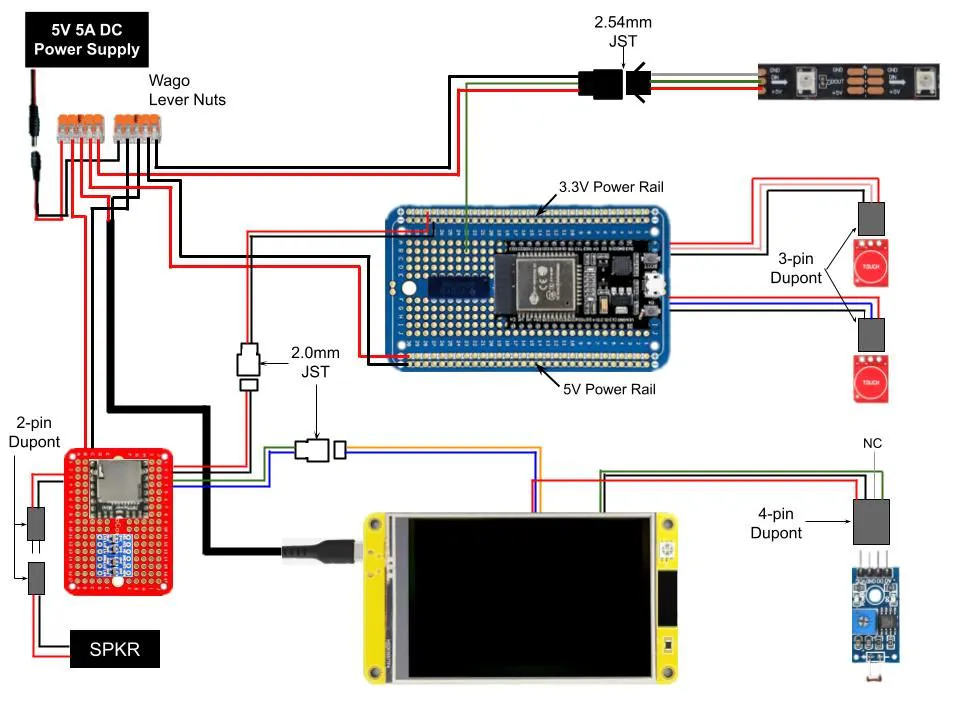
Full information on parts, wiring diagrams, build instructions and firmware installation and use are all provided in the following sources:
Build and Firmware details:
Firmware Installation and Use Guide
Additional Information and NotesThe project and related firmware are designed for specific hardware. In some cases, substitutions may be freely made and others may require firmware modifications. A full parts list, including those items that can be substituted, is included in the written build guide.
The entire project is thoroughly documented. In addition to dedicated guides for the physical build and firmware use, the code itself is heavily documented. The project is designed to be modular and should be adaptable to other designs by anyone with intermediate coding skills.


Comments