



Hardware components | ||||||
 |
| × | 1 | |||
 |
| × | 1 | |||
 |
| × | 1 | |||
Hand tools and fabrication machines | ||||||
 |
| |||||
 |
| |||||
 |
| |||||
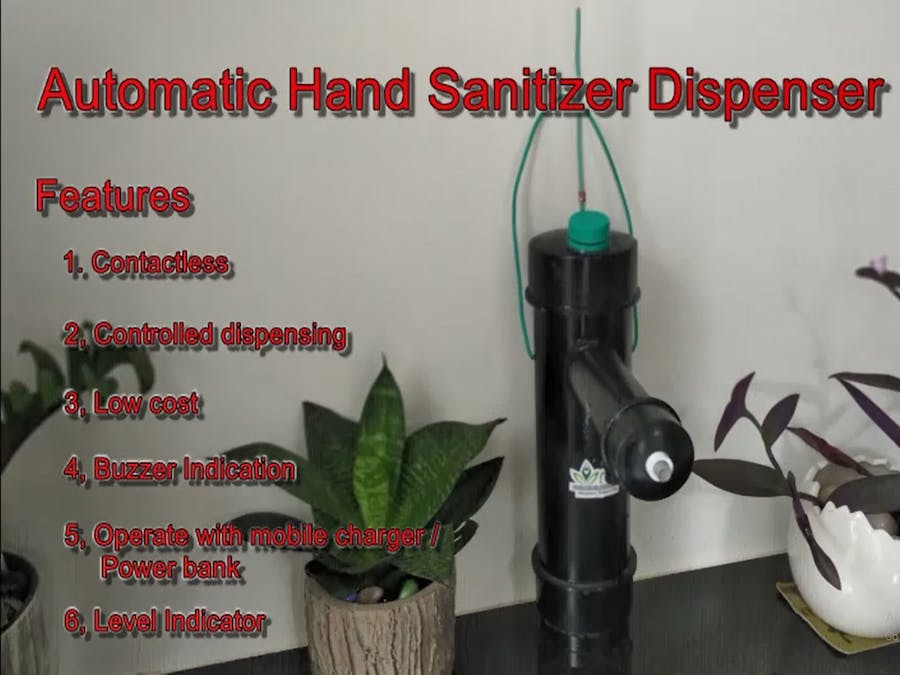
Ever since the covid19pandemic we were using hand sanitizer to Break The Chain of the virus spread. In order to boost this effort, this project introduce aims to build contact lesshand sanitizer dispenser with efficient dispensing for sustainable and a viable option to be used for the commercial purpose.
The project has the following features.
- Contact less
- Controlled Dispensing
- Adjustable Nozzle Flow
- Operation Buzzer indication
- Operate with Mobile charger or Power bank
- Portable and easy installation at public places
- Low cost
- DIY and easy made
Step 1:
Take 2 1/2" PVC Pipe and end cap. Attach the end cap to one end with PVC solvent.
Step2:
Take 1 3/4" PVC pipe and end cap and make a hole on the end cap for the ON/ OFF Push Switch.
Step3:
Now, Take Spray bottle head and disassemble it to get the tube and nozzle. Cut the unnecessary projections of the nozzle. Attach PCB wire Connectors to nozzle side projection.
Step4:
Make holes in 1 3/4" PVC pipe for the IR sensor and nozzle.
Step5:
Make hole in the 2 1/2" PVC pipe and take a submersible pump and install it inside with tube and wire projecting out of the hole. Insert the nozzle to the end of the tube.
Step6:
Now, make the Circuit as per circuit diagram given below.
Step7:
Attach Switch assembly, Micro USB Female connector, PCB circuit and nozzle to the PVC pipe using screws, washers and nuts.
Step8:
Make Float Assembly by using tube, metal cable and a small dropper plastic bottle.
Step9:
Make a hole on the large end cap to install the float assembly. Mark the extreme points with colour tapes.
Step10:
Spray paint the entire assembly and attach the metallic cable for handle and bottle neck for sanitizer refill port. And now it is ready to be used.
U1 - Voltage Regulator 7805
U2 - IC NE555
Q1 & Q3 - Transistor BC557
Q2 - Transistor BC547
R1 - Resistor 1K
R2 - Resistor 47K
D1 - Diode
C1 - Capacitor
The circuit works on any 5v DC supply. When the user shows the hand in front of the IR proximity sensor. a LOW output is generated at the output pin of the sensor which is reversed with PNP transistor BC557 which is then fed to the timer IC NE555 forming a RC network. This network determines the length of time it takes to charge the capacitor C1.
The value of capacitor C1 controls the ON delay time. It can be found by
ON Delay Time = 1.1 X R2 X C1
The bigger the resistor and capacitor value, the longer the delay
The reason why the circuit turns on automatically is because pin 6, the threshold pin, is initially LOW. When pin 6, the threshold pin, is LOW, the output is HIGH. That's why the LED is on. This pin represents the voltage across the capacitor. Initially, because it takes time for a capacitor to charge up, it's going to have very low voltage initially until it builds up voltage. Once a few seconds pass by, the capacitor is able to charge up. As it charges up to greater than 2/3 of the supply voltage, then the output goes LOW. This is why the LED eventually shuts off. It's when the capacitor charges to 2/3 of the supply voltage. Once the threshold reaches this voltage, then the pin is HIGH. So the output goes LOW and the LED turns off.
When pin 3 is high it is amplified by darlington pair of NPN Transistor BC547 and PNP Transistor BC557 to drive the pump and the buzzer. A Diode is used in order to protect the transistors from the inductive load of the pump.
The Pump pumps out the sanitizer through the tube connected to a nozzle with a check valve this prevents the excess leaking of sanitizer after operation.
The level of sanitizer can be constantly monitored by the mechanical float level indicator works on the Archimedes principle of floating.
The weight of the body should be equal or less than the weight of the displaced liquid for the body to float.
Weight of the body (W) = Weight of metal cable + Weight of Dropper Bottle
Weight of Sanitizer displaced (S) = Density of Sanitizer X Volume of the Dropper Bottle Immersed.
Make sure to choose the Dropper bottle with sufficient volume to make at least S = 2W for reliable working on different sanitizers with different densities available in the market.
For more information refer the video below.



Comments