



Hardware components | ||||||
| × | 1 | ||||
| × | 1 | ||||
| × | 1 | ||||
| × | 1 | ||||
Software apps and online services | ||||||
 |
| |||||
The REYAX RYS352A continuously receives positioning data from multiple navigation satellite constellations, including GPS, GLONASS, Galileo, BeiDou, and QZSS. The Heltec WiFi LoRa 32 V4 processes the incoming NMEA data, extracts the latitude, longitude, and connected satellite count, and displays this information on the onboard OLED display.
Once connected to a Wi-Fi hotspot, the ESP32 starts an embedded web server and generates a local IP address. Opening this IP address in any web browser connected to the same network displays an interactive OpenStreetMap interface where the current location and travelled path are updated automatically in real time.
Since the entire application runs directly on the ESP32, no cloud platform, API keys, or external services are required. This makes the project lightweight, beginner-friendly, and an excellent starting point for more advanced IoT and location-tracking applications.
Project FeaturesThis GPS tracker offers several features that make it suitable for both learning and practical embedded applications:
- Supports multiple GNSS constellations including GPS, GLONASS, Galileo, BeiDou, and QZSS.
- Displays live latitude, longitude, and connected satellite count on the onboard OLED display.
- Hosts a browser-based tracking webpage directly on the ESP32.
- Visualizes the current position and travelled path using OpenStreetMap.
- Eliminates the need for third-party cloud platforms or subscription services.
- Requires only a few hardware connections, making assembly quick and straightforward.
- Provides an excellent platform for extending the project with additional IoT features.
The firmware is developed using the Arduino IDE together with the Heltec ESP32 board package. The project also uses the TinyGPS++ library for parsing NMEA data, while the built-in Wi-Fi and WebServer libraries provide network connectivity and host the browser-based tracking interface.
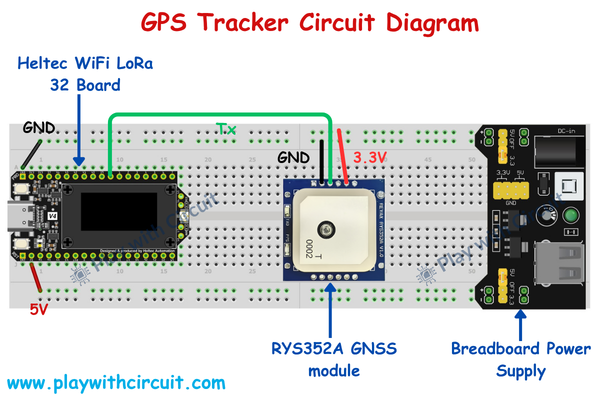
Circuit ConnectionsOne of the advantages of this project is its simple wiring. The REYAX RYS352A communicates with the Heltec board through UART, requiring only power, ground, and a single transmit connection. The module's VCC pin is connected to the 3.3 V supply, the GND pin is connected to ground, and the TX pin is connected to GPIO38 on the Heltec WiFi LoRa 32 V4.
For an even cleaner hardware setup, the RYS352A can also be connected directly to the dedicated GNSS Molex connector available on the Heltec board, reducing the number of external jumper wires.
For portable outdoor testing, a 12 V lithium battery together with the breadboard power supply provides a convenient standalone power source.
How the Project Works?When the system is powered on, the Heltec board first connects to the configured Wi-Fi hotspot and starts an embedded web server. At the same time, the REYAX RYS352A begins searching for available navigation satellites and continuously transmits standard NMEA data through its UART interface.
The firmware running on the Heltec board parses the incoming NMEA sentences using the TinyGPS++ library and extracts useful information such as latitude, longitude, and the number of connected satellites. These values are immediately displayed on the onboard OLED display, allowing the current positioning status to be monitored directly on the device.
Once connected to the same Wi-Fi network, any smartphone, tablet, or computer can access the board by entering the IP address shown on the OLED display into a web browser. The browser loads a lightweight tracking page that displays the current location on an interactive OpenStreetMap interface. As the tracker moves, the webpage automatically updates the marker position and records the travelled path in real time.
After uploading the firmware and verifying the hardware connections, the GPS tracker was tested outdoors to evaluate its real-world performance. Since GNSS receivers require a clear view of the sky, the system was allowed a few minutes to acquire sufficient satellites before beginning the test.
For the field test, the hardware was powered using a portable battery and placed inside a moving vehicle. As the vehicle travelled through different locations, the REYAX RYS352A continuously updated its position while the Heltec board processed the incoming coordinates and refreshed the browser interface automatically.
Throughout the test, the onboard OLED displayed the current latitude, longitude, and connected satellite count, while the browser-based map accurately followed the vehicle's movement. The travelled route was continuously recorded and displayed as a path on the OpenStreetMap interface, demonstrating stable communication between the GNSS receiver, the ESP32, and the embedded web server.
If you would like to explore the complete tutorial for this project—including the circuit diagram, source code, and detailed explanations—you can visit: GPS Tracker


Comments