


The International Space Station (ISS) is the most expensive object ever built by humans. It orbits Earth every 90 minutes at an altitude of approximately 400 km. On a clear night—especially during summer—you can often spot it crossing the sky with the naked eye.
NASA publicly shares the ISS's real-time location and even provides a free API that anyone can use to access this data. Interestingly, the ISS also has a radio repeater that allows radio operators to communicate with others when it passes overhead. If you're lucky, you might even get a reply from the astronauts themselves—provided they're on the radio at that moment!
That inspired me to build a simple device that notifies me whenever the ISS is passing near my location.
Supplies- ESP8266 NodeMCU × 1
- Green LED × 1
- Red LED × 7
- Buzzer × 1
- 220 Ω Resistor × 8
- Perf Board × 1
- Female Header Pins
Begin by soldering the female header pins onto the perf board. These header pins will allow you to easily mount and remove the ESP8266 NodeMCU whenever needed.
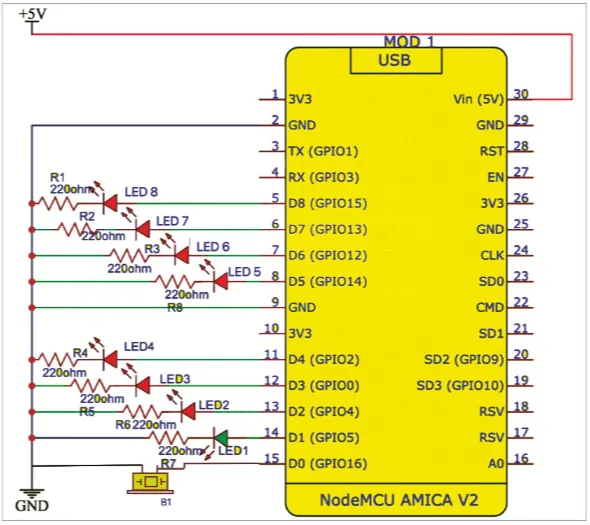
Step 2: Solder the LEDs, Resistors, and BuzzerNext, solder the LEDs, resistors, and buzzer onto the perf board according to the wiring diagram provided. Double-check all connections before proceeding to the next step.
Download the project code and update the following variables with your own information:
ssid— Your Wi-Fi network namepassword— Your Wi-Fi passwordmyLongitude— Longitude of your locationmyLatitude— Latitude of your location
After updating these values, upload the code to the ESP8266 board.
Step 4: Power On the DeviceOnce the ESP8266 is powered on:
- The first LED will start blinking, indicating that the device is attempting to connect to Wi-Fi.
- When the Wi-Fi connection is established, the blinking will stop.
- The LEDs will then display the current distance of the ISS from your location.
- As the ISS gets closer, more LEDs will illuminate.
- When the ISS is nearby, the buzzer will sound to alert you.
This project makes tracking and spotting the ISS both fun and interactive. Not only does it notify you when the station is nearby, but it also helps you appreciate one of humanity's greatest engineering achievements.
I hope you enjoyed building this project and learned something new along the way. If you found it useful, don't forget to leave a like and follow me for more exciting electronics and maker projects.
Thanks for visiting, and I'll see you in the next project!


Comments