



Energy monitoring becomes much more useful when electrical data can be viewed remotely instead of only being read from a local meter.
In this project, we build a connected three-phase energy monitoring system using the OWON PC4713 Smart Energy Meter, three external current transformers (CTs), Wi-Fi or Ethernet connectivity, and the Tuya platform.
The goal is to monitor real-time and historical electrical data from a mobile app while also supporting different electrical systems and bidirectional energy measurement for applications such as grid consumption and solar production.
The PC4713 supports 2.4 GHz Wi-Fi and 10/100 Mbps Ethernet, allowing the installer to choose the network connection that best fits the deployment.
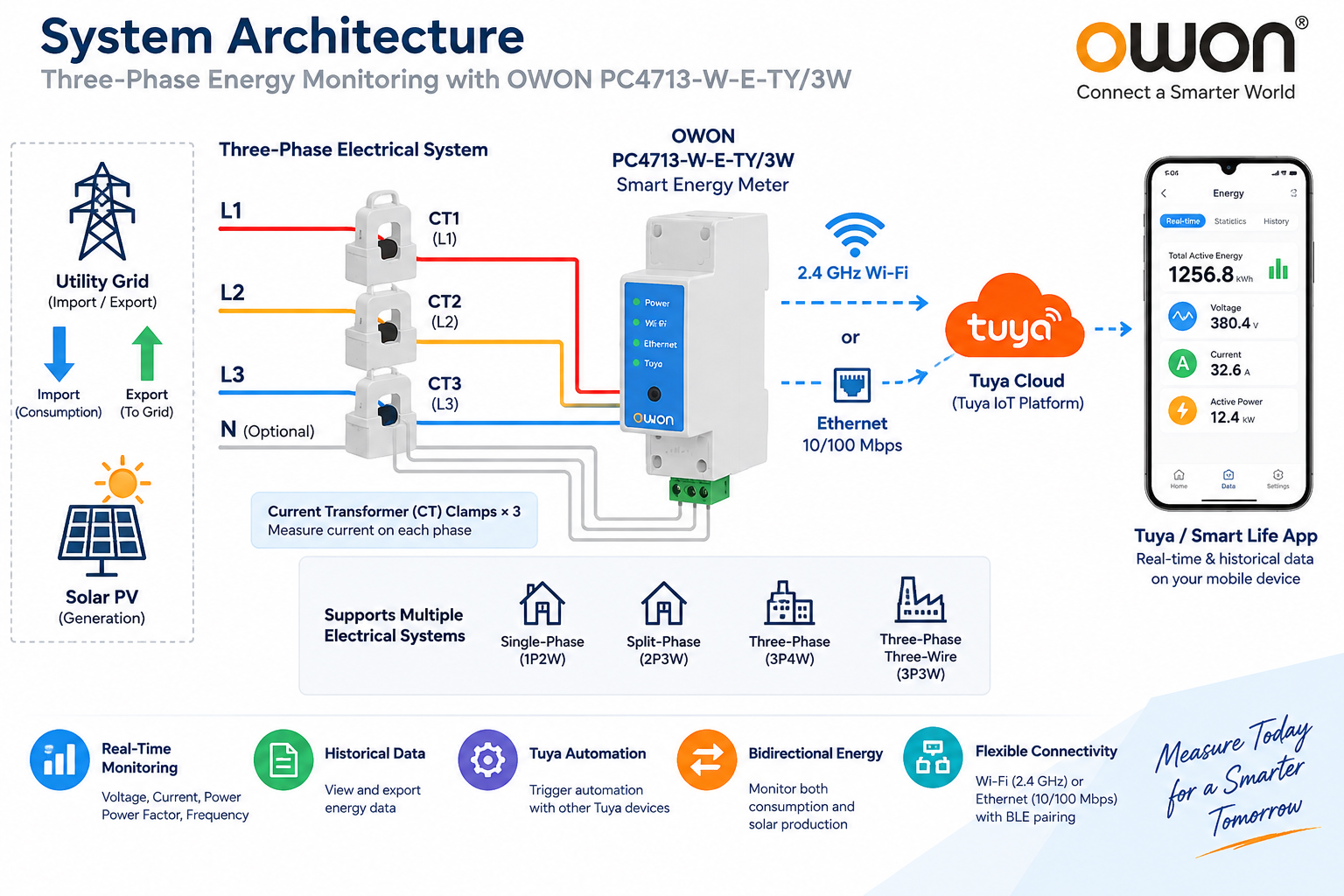
How the System WorksThe basic architecture is straightforward:
Electrical System → 3 × CT Clamps → PC4713 → Wi-Fi / Ethernet → Tuya Platform → Mobile App
The CT clamps measure current on the monitored conductors while the PC4713 collects the electrical measurements.
The meter then connects to the network through Wi-Fi or Ethernet so that energy information can be monitored remotely through the Tuya-compatible application.
Ethernet is particularly useful for fixed energy-monitoring installations where a wired network connection is available and greater network stability is preferred. The product also supports BLE for pairing.
Once the system is connected, the meter can provide electrical measurements including:
- Voltage
- Current
- Power factor
- Frequency
- Active power
- Reactive power
- Apparent power
The system also provides energy measurement for monitoring electricity consumption and production. Real-time and historical energy information can be viewed through the mobile application, and historical data can be exported for further analysis.
This makes the system useful not only for checking current electrical conditions but also for understanding how energy consumption changes over time.
Step 1: Install the Energy Meter and CT ClampsThe PC4713 uses external current transformers, which makes it possible to measure current without routing the main load current directly through the meter.
For a typical three-phase monitoring application, three CT clamps are installed on the corresponding conductors.
Correct phase correspondence and CT orientation are important, particularly when bidirectional energy monitoring is required.
The PC4713 is designed for 35 mm DIN-rail mounting, making it suitable for installation inside or alongside electrical distribution equipment.
Safety: Installation and wiring inside electrical panels should be carried out by qualified personnel in accordance with applicable electrical codes and safety requirements.
Safety: Installation and wiring inside electrical panels should be carried out by qualified personnel in accordance with applicable electrical codes and safety requirements.
One useful feature of this monitoring architecture is that it is not limited to only one type of electrical system.
The PC4713 supports:
Single-PhaseSplit-PhaseThree-PhaseThree-Phase Three-Wire (3P3W)
This makes the same energy-monitoring concept applicable to different residential, commercial and distributed-energy installations.
The appropriate wiring configuration should always be selected according to the actual electrical system being monitored.
Step 3: Connect Through Wi-Fi or EthernetThe meter provides two network connection options:
Wi-Fi: 802.11 b/g/n at 2.4 GHzEthernet: 10/100 Mbps
Wi-Fi provides flexibility when running an Ethernet cable is inconvenient, while Ethernet provides a wired connection for installations where network stability is particularly important.
This dual-network approach can be useful in homes, commercial electrical rooms and other fixed energy-monitoring installations.
Step 4: Monitor Energy Through TuyaAfter the meter has been paired and connected to the network, electrical information can be monitored remotely through the Tuya-compatible application.
Users can view both real-time and historical energy information rather than relying on a local meter reading alone.
Historical data can also be exported from the app, making it easier to compare energy consumption over different periods or perform additional analysis.
Step 5: Monitor Grid Consumption and Solar ProductionAnother useful application is bidirectional energy monitoring.
Instead of measuring only electricity consumption, the PC4713 can monitor both Energy Usage and Solar Production.
For a solar installation, this makes it possible to better understand the direction of energy flow between the electrical system, loads and power generation.
A simplified monitoring concept can be represented as:
Grid ↔ Energy Meter ↔ Loads / Solar System
This type of visibility is useful when users need to understand not only how much electricity is being consumed, but also how much energy is being produced or exported.
Step 6: Create Energy-Based Tuya AutomationsEnergy data can also become part of a broader smart automation system.
The PC4713 is Tuya compliant and supports automation with other Tuya devices based on grid import/export or other energy values.
For example, an automation could use an energy condition as part of the logic for controlling another compatible device.
This turns the energy meter from a passive monitoring device into a data source for a larger connected-energy ecosystem.
Where Can This Project Be Used?The same architecture can be adapted to several applications:
Whole-home energy monitoring — understand real-time and historical household electricity use.
Three-phase energy monitoring — monitor electrical parameters in three-phase installations.
Solar energy monitoring — observe bidirectional energy usage and production.
Commercial buildings — provide remote visibility into electrical consumption.
Smart energy systems — use energy information as part of Tuya-based automation.
Because the meter supports single-phase, split-phase and three-phase systems, the architecture can be adapted to different electrical environments rather than being limited to a single installation type.
ConclusionThis project demonstrates how a CT-based smart energy meter can bring electrical measurements into a connected monitoring environment.
By combining the OWON PC4713, three CT clamps, Wi-Fi or Ethernet connectivity and the Tuya platform, users can remotely access real-time and historical energy information across single-phase, split-phase and three-phase electrical systems.
Bidirectional measurement also extends the system to applications where both electricity usage and solar production need to be monitored.
For developers, installers and energy-management professionals, the result is a flexible architecture that connects electrical measurement with remote monitoring and smart automation


Comments