


Hardware components | ||||||
_ztBMuBhMHo.jpg?auto=compress%2Cformat&w=48&h=48&fit=fill&bg=ffffff) |
| × | 1 | |||
 |
| × | 1 | |||
 |
| × | 1 | |||
 |
| × | 1 | |||
 |
| × | 1 | |||
 |
| × | 1 | |||
Software apps and online services | ||||||
 |
| |||||
Multi-Mode Arduino PWM Signal Generator & Controller
📝 Project Overview
Test circuits, modulate LEDs, or variable motor speeds need a dependable pulse width modulation (PWM) signal. Function generators sold commercially can be quite large and cost a lot of money. This project presents a low-cost, very portable, multi-mode with I2C 16x2 LCD and dynamic user interface based Arduino-B ased PWM Signal Genera tor.
With one button, a pot, this thing toggles between manual operation and automated signal generation profiles, turning it into a especially useful instrument for any maker's bench.
HOW IT WORKS & THE FEATURES
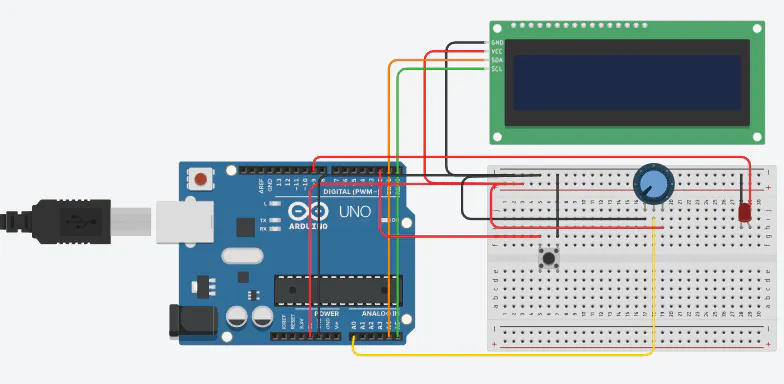
The system is based on an Arduino Uno/Nano that uses the built in timers to generate a variable PWM signal. The operation has three different modes, you can easily change them by press the hardware interrupt / button:
Manual PWM mode (duty cycle controller) In this you get to manually control the duty cycle from 0% to 100% by turning the pot knob. The actual values are mapped in real time and you can see them on the lcd. It is great for running motor drivers or fading leds.
Flasher Mode (Square Wave/Strobe Generator): In this mode a continuous square wave signal is generated. The frequency or blink delay is up-dated live with the potentiometer to generate perfectly timed pulses.
Breathing Mode (Automated Signal Animation): an automation mode where Arduino automatically increments and decrements the PWM value to simulate a "breath" light effect or a smooth wave signal. The pace of the breathing cycles is regulated by a potentiometer.
The system employs the INPUT_PULLUP scheme for the mode button which eliminates the use for external pull-down resistor and reduces the circuit footprint. In addition, the LCD drawing is made more efficiently with some customized character spacing to resume the screen flickering caused by fast state changes.
📈 Upgrades to Future
While the current firmware directly outputs 5V logic signals from the Arduino pin, the PCB layout is made for an add-on board with an N-Channel MOSFET or a transistor driver circuit. This enables the generator to switch high-current/high-voltage loads such as 12V computer fans, large DC motors, or high-power LED strips (safely!), employing the same code.


_3u05Tpwasz.png?auto=compress%2Cformat&w=40&h=40&fit=fillmax&bg=fff&dpr=2)
Comments