



Hardware components | ||||||
 |
| × | 1 | |||
| × | 1 | ||||
 |
| × | 1 | |||
 |
| × | 1 | |||
 |
| × | 1 | |||
 |
| × | 1 | |||
Software apps and online services | ||||||
 |
| |||||
Hand tools and fabrication machines | ||||||
 |
| |||||
 |
| |||||
Modern digital laboratories and classrooms require not only smart devices, but also real-time environmental awareness. Excessive noise levels can reduce concentration, disrupt learning activities, and affect overall productivity.
In this project, we build a real-time wireless noise monitoring system using two ESP32 boards, a MAX4466 microphone amplifier, and a MAX7219 LED matrix display.
But here’s the interesting part — the system works completely without Wi-Fi or internet access.
Using ESP-NOW, a lightweight peer-to-peer wireless communication protocol built into the ESP32, the transmitter node captures sound intensity data and sends it wirelessly to the receiver node in real time.
The receiver then visualizes the sound level using an animated LED bar indicator and automatically displays warning messages such as “NOISE!” or “DANGER” whenever the sound exceeds a configurable threshold.
This project combines embedded systems, analog signal processing, wireless communication, and visual feedback into a compact and practical smart monitoring system suitable for:
Digital laboratories
- Digital laboratories
Smart classrooms
- Smart classrooms
Libraries
- Libraries
Study rooms
- Study rooms
IoT learning environments
- IoT learning environments
Noise awareness systems
- Noise awareness systems
The system is fully offline, responsive, and easy to expand for future smart environment projects.
How It WorksSender ESP32The sender node uses:
ESP32
- ESP32
MAX4466 microphone amplifier
- MAX4466 microphone amplifier
Potentiometer
- Potentiometer
Buzzer
- Buzzer
The MAX4466 captures ambient sound signals as analog voltage data.The ESP32 continuously samples the microphone input and calculates the peak-to-peak amplitude of the audio signal to determine the current noise intensity.
A potentiometer is used to adjust the noise threshold manually in real time.
If the detected sound level exceeds the threshold:
The buzzer activates
- The buzzer activates
Data is transmitted wirelessly using ESP-NOW
- Data is transmitted wirelessly using ESP-NOW
The sender transmits:
Noise amplitude value
- Noise amplitude value
Threshold value
- Threshold value
to the receiver ESP32.
Receiver ESP32-C3The receiver node uses:
ESP32-C3
- ESP32-C3
MAX7219 LED Matrix Display
- MAX7219 LED Matrix Display
The receiver obtains sound data wirelessly via ESP-NOW and visualizes it on the LED matrix.
The display operates in two modes:
1. Real-Time Noise Bar VisualizationThe LED matrix acts like a digital sound level meter by displaying a dynamic horizontal bar indicator based on the current sound amplitude.
2. Smart Alert NotificationWhen the sound level exceeds the configured threshold:
The display shows blinking warning messages
- The display shows blinking warning messages
Examples:
NOISE!
- NOISE!
DANGER
- DANGER
- Examples:NOISE!DANGER
The system also includes:
Hysteresis filtering
- Hysteresis filtering
Cooldown timing
- Cooldown timing
Signal smoothing
- Signal smoothing
to prevent false triggers and unstable readings.
ESP32 Dev Board
- ESP32 Dev Board
MAX4466 Microphone Amplifier
- MAX4466 Microphone Amplifier
Potentiometer
- Potentiometer
Active Buzzer
- Active Buzzer
Breadboard & Jumper Wires
- Breadboard & Jumper Wires
ESP32-C3
- ESP32-C3
MAX7219 LED Matrix Display
- MAX7219 LED Matrix Display
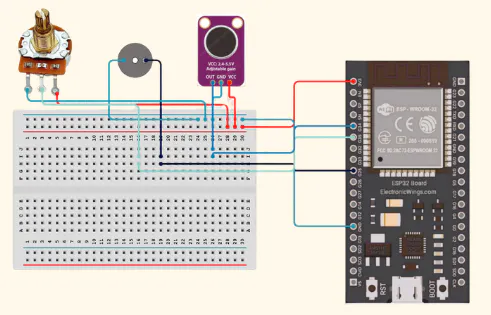
VCC → 3.3V
GND → GND
OUT → GPIO 34
PotentiometerVCC → 3.3V
GND → GND
OUT → GPIO 35
BuzzerPositive → GPIO 25
Negative (-) → GND
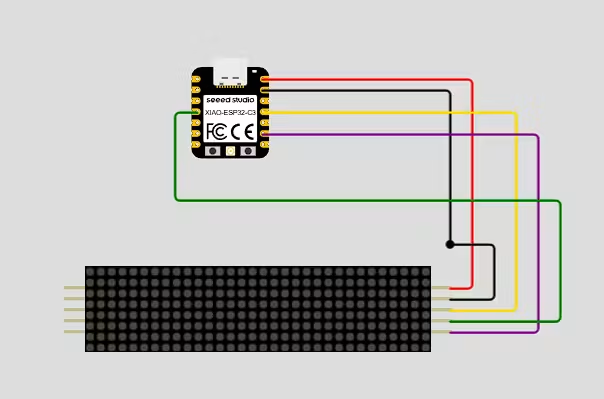
DIN → GPIO 10
CLK → GPIO 8
CS → GPIO 5
VCC → 5V
GND → GND
The system uses ESP-NOW for wireless communication between the ESP32 boards.
Advantages of ESP-NOW:
No router required
- No router required
Low latency
- Low latency
Low power consumption
- Low power consumption
Fast peer-to-peer transmission
- Fast peer-to-peer transmission
Stable for local IoT systems
- Stable for local IoT systems
Make sure to update the receiver MAC address inside the sender code before uploading.
Use the following code to obtain the MAC address of the receiver ESP32:
#include <WiFi.h>
#include <esp_wifi.h>

void readMacAddress(){
  uint8_t baseMac[6];
  esp_err_t ret = esp_wifi_get_mac(WIFI_IF_STA, baseMac);
  if (ret == ESP_OK) {
    Serial.printf("%02x:%02x:%02x:%02x:%02x:%02x\n",
                  baseMac[0], baseMac[1], baseMac[2],
                  baseMac[3], baseMac[4], baseMac[5]);
  } else {
    Serial.println("Failed to read MAC address");
  }
}

void setup(){
  Serial.begin(115200);

  WiFi.mode(WIFI_STA);
  WiFi.STA.begin();

  Serial.print("[DEFAULT] ESP32 Board MAC Address: ");
  readMacAddress();
}

void loop(){

}The LED matrix displays a moving sound level bar based on the ambient noise intensity.
High Noise ConditionWhen the sound exceeds the configured threshold:
The buzzer activates
- The buzzer activates
Warning text appears on the LED matrix
- Warning text appears on the LED matrix
Alert messages blink for better visibility
- Alert messages blink for better visibility
The system automatically returns to normal visualization mode after the alert duration ends.
ConclusionThis project demonstrates how ESP32 and ESP-NOW can be combined to create a responsive and fully wireless environmental monitoring system.
By integrating analog sound sensing, real-time wireless communication, visual LED feedback, and smart threshold alerts, this system becomes an effective solution for noise awareness in digital learning spaces.
It is an excellent project for learning:
Embedded systems
- Embedded systems
Wireless communication
- Wireless communication
Sensor interfacing
- Sensor interfacing
Analog signal processing
- Analog signal processing
Real-time visualization
- Real-time visualization
Smart monitoring systems
- Smart monitoring systems
Whether used for education, research, or IoT experimentation, this project provides a solid foundation for building more advanced smart environment systems in the future.


_1x_bGT19vVAby.png?auto=compress%2Cformat&w=40&h=40&fit=fillmax&bg=fff&dpr=2)

Comments