



Hardware components | ||||||
| × | 1 | ||||
| × | 1 | ||||
| × | 1 | ||||
Software apps and online services | ||||||
 |
| |||||
Crowd Supply prelaunch:
https://www.crowdsupply.com/neuradock/neuradock-eeg-workstation
NeuraDock EEG Workstation is a 7-channel dry-electrode EEG platform designed for BCI researchers, neurotechnology developers, and teams building EEG-based interaction systems.
But NeuraDock is not only a headset. We are building it as an open EEG development stack: hardware, recording software, documentation, Python tools, example workflows, sample EEG datasets, hardware interface notes, and AI Agent workflows for EEG analysis and BCI prototyping.
The goal is simple: make EEG development easier to start, easier to inspect, and easier to reproduce.
This project page introduces the full NeuraDock EEG Workstation stack, including the hardware platform, software tools, open GitHub structure, example workflows, and the AI Agent direction we are developing.
Why We Are Building NeuraDockEEG-based BCI projects often get blocked before the actual experiment begins.
A team may have an interesting paradigm, a promising model, or a clear research question, but still spend most of its time on repetitive engineering work:
- Setting up the hardware
- Checking signal quality
- Recording clean EEG data
- Reading and converting data files
- Testing preprocessing parameters
- Trying different feature extraction methods
- Running repeated analysis scripts
- Documenting results in a reproducible way
For many teams, the hard part is not only collecting EEG data. The hard part is turning EEG hardware, software, data, examples, and analysis code into a workflow that can actually be repeated and modified.
NeuraDock is designed to reduce this gap.
We want to provide a practical dry EEG workstation together with the software and open examples needed to support real BCI development.
Hardware: 7-Channel Dry EEG WorkstationThe NeuraDock EEG Workstation uses a 7-channel dry-electrode EEG setup designed for fast deployment and practical experiments.
The current electrode layout focuses on visual, parietal, and sensorimotor-related regions, supporting common EEG and BCI workflows such as visual stimulation, SSVEP, motor imagery, signal quality checking, and EEG feature analysis.
Key hardware characteristics include:
- 7-channel dry-electrode EEG recording
- No gel required
- ADS1299-based 24-bit EEG acquisition
- USB and BLE data communication
- Portable wearing structure for experimental use
- Designed for researchers, developers, and prototyping teams
- NeuraDock is not intended to be a consumer wellness gadget. It is designed as a workstation for people who want to build, test, and iterate EEG workflows.
A practical EEG workflow starts before the algorithm.
Before running an SSVEP, motor imagery, or visual decoding experiment, users need to wear the device correctly, verify channel status, and confirm that the signal is usable.
NeuraDock provides a step-by-step wearing and setup process, followed by signal quality checking before recording.
This setup process helps users move from hardware preparation to actual EEG recording more smoothly.
For developers, this is important because unstable contact or poor signal quality can easily make downstream analysis meaningless. A BCI pipeline is only useful if the input signal is reliable enough to inspect and process.
Software and Data AcquisitionThe NeuraDock software stack is designed to help users record EEG data and prepare it for analysis.
The recording software supports EEG acquisition and workflow testing, while the GitHub repositories provide documentation and examples for reading and working with the recorded data.
The software side of the stack includes:
- EEG recording software
- Data format documentation
- Python reading tools
- Example notebooks and scripts
- Marker workflow examples
- Sample data for testing
This makes it easier for developers to move from “I recorded EEG data” to “I can inspect, process, and reuse this data in my own pipeline.”
Open GitHub StructureThe NeuraDock GitHub is organized as a set of repositories rather than a single monolithic project.
Each repository has a specific role in the development stack.
This structure is meant to make the project easier to navigate. Instead of asking users to dig through one large repository, we separate the stack into documentation, software, Python tools, examples, sample data, hardware interface notes, and Agent workflows.
Example WorkflowsOne of the most important parts of NeuraDock is the example workflow system.
Examples are not only short demos. They are intended to show how EEG data can move through a complete workflow: from experiment setup, to recording, to data processing, to visualization or classification.
Each example includes step-by-step instructions and runnable code.
Current and planned example workflows include:
- Signal quality checking
- Eyes-open / eyes-closed alpha analysis
- SSVEP workflow
- cVEP workflow
- Marker workflow
- Band power analysis
- Visual reconstruction demo
- Motor imagery workflow
- Real-time alpha monitoring
- EEG file reading examples
The goal is to make BCI workflows easier to inspect, repeat, and modify.
Example: SSVEP WorkflowSSVEP is a classic BCI paradigm where visual stimulation at a specific frequency can produce corresponding frequency components in EEG signals.
In our SSVEP example, NeuraDock records EEG during visual stimulation, and the data is analyzed in both time and frequency domains.
This example demonstrates how NeuraDock can support a complete BCI workflow: stimulation, recording, data reading, spectral analysis, and result visualization.
Example: Motor Imagery WorkflowMotor imagery is another important BCI direction. Instead of relying on external visual frequency stimulation alone, motor imagery workflows explore EEG patterns related to imagined or prepared movement.
In our motor imagery demo, the participant watches a ball-catching preparation task and the system analyzes EEG features related to motor intention.
The demo uses alpha-band activity and inter-channel feature analysis to detect motor intention across trials.
This example is not presented as a medical or clinical system. It is a technical workflow demo showing how NeuraDock can be used to prototype EEG-based interaction and BCI detection pipelines.
Example: Open-Loop Alpha MonitoringNeuraDock can also be used for real-time EEG monitoring workflows.
In one demo, NeuraDock records 7-channel dry EEG while a wearable light stimulation device runs a predefined stimulation script. The system monitors alpha-related EEG trends in real time and supports offline analysis after the session.
This is an open-loop monitoring workflow, not a closed-loop neurofeedback system. The stimulation does not change based on real-time EEG feedback at this stage. Instead, the workflow records how EEG signals change during predefined stimulation conditions.
This kind of workflow can help teams explore EEG features, monitor experiment progress, and prepare data foundations for future closed-loop systems.
Sample EEG DataA major problem in EEG development is that developers often need data before they can even test their code.
NeuraDock is preparing public sample EEG datasets for tutorials and reproducible examples.
Sample data helps developers:
- Test the data reading pipeline
- Run example analysis scripts
- Debug code before collecting new data
- Compare output with expected results
- Learn the workflow without setting up an experiment first
This is especially useful for developers who are new to EEG, or for teams that want to evaluate the software pipeline before using their own recordings.
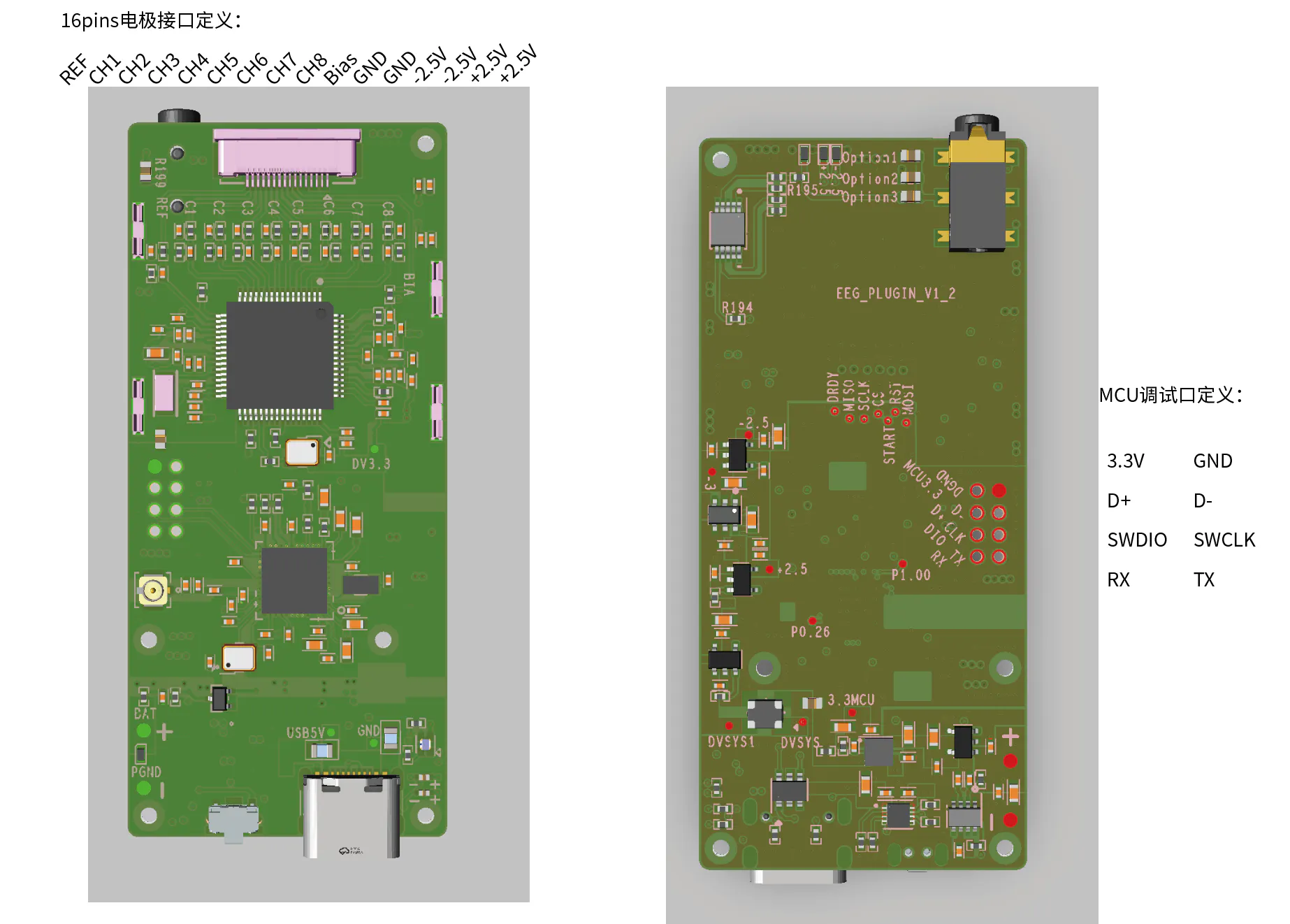
Hardware Interface NotesNeuraDock also includes a hardware interface repository.
This repository is focused on hardware interface and port specifications for third-party integration
This does not mean that the full hardware schematic or PCB design is open. The goal is to document the interface information that external teams need in order to connect NeuraDock with their own systems, prototypes, or experimental setups.
This is useful for:
- Third-party integration
- Custom experimental systems
- External stimulation devices
- BCI interaction prototypes
- Research platforms that need EEG input
By documenting the interface layer, we want to make NeuraDock easier to integrate into broader neurotechnology and interaction workflows.
AI Agent for EEG DevelopmentThe AI Agent direction is one of the core long-term parts of the NeuraDock stack.
EEG development involves many repetitive tasks. These tasks are often necessary, but they can consume a large amount of developer and researcher time.
The NeuraDock AI Agent is being developed to assist with EEG workflow automation and analysis support.
The Agent direction includes:
- Helping users organize EEG analysis workflows
- Assisting with preprocessing pipeline selection
- Supporting feature extraction workflows
- Helping inspect analysis outputs
- Generating reproducible workflow records
- Connecting example code, sample data, and analysis steps
- Reducing repetitive setup and debugging work
The AI Agent is not intended to replace expert interpretation. EEG analysis still requires domain knowledge, careful experiment design, and validation. Instead, the Agent is designed to help users move through common workflow steps more efficiently and make the process easier to inspect and reproduce.
In the current GitHub structure, Agent workflows are under development. We plan to keep expanding this direction as the examples, sample datasets, and analysis pipelines become more complete.
Why an Open EEG Development Stack MattersMany EEG tools focus only on one part of the workflow.
Some tools provide hardware.
Some provide software.
Some provide scripts.
Some provide examples.
Some provide datasets.
But for BCI development, these pieces need to work together.
NeuraDock is being built around the full workflow:
- Wear the device
- Check signal quality
- Record EEG data
- Add markers or run a paradigm
- Read the recorded data
- Process the signal
- Extract features
- Run example workflows
- Compare results with sample data
- Reproduce, modify, and extend the pipeline
- Use AI-assisted tools to support analysis and workflow automation
This is why we describe NeuraDock as an EEG development stack rather than only an EEG headset.
What Makes NeuraDock DifferentNeuraDock combines several layers into one workflow-oriented platform:
- 7-channel dry EEG hardware
- Practical wearing and setup process
- Recording software
- Signal quality checking
- Public documentation
- Python tools
- Example workflows
- Sample EEG datasets
- Hardware interface notes
- AI Agent workflows under development
This combination is designed for people who want to build with EEG, not only view EEG.
The target users include:
- BCI researchers
- Neurotechnology developers
- HCI and interaction designers
- University labs
- Startup teams
- Open-source neurotechnology communities
- Developers exploring EEG-based interfaces
NeuraDock is currently on Crowd Supply prelaunch.
The GitHub repositories are being organized and expanded. Documentation, software notes, Python tools, examples, sample data, hardware interface notes, and Agent workflows will continue to be updated.
We are using the prelaunch stage to collect interest, feedback, and early community support before the campaign launches.
If you are interested in EEG development, BCI workflows, open neurotechnology, or AI-assisted EEG analysis, you can follow the NeuraDock campaign on Crowd Supply.
LinksCrowd Supply prelaunch:
https://www.crowdsupply.com/neuradock/neuradock-eeg-workstation
GitHub:
https://github.com/Neuradock
Website:
https://www.neuradock.com
YouTube:
https://www.youtube.com/@NeuraDock
NeuraDock EEG Workstation is a 7-channel dry EEG platform for BCI prototyping and neurotechnology development.
But the hardware is only one part of the project.
We are building an open EEG development stack around it: documentation, software, Python tools, example workflows, sample EEG datasets, hardware interface notes, and AI Agent workflows.
Our goal is to make EEG development easier to start, easier to inspect, and easier to reproduce.
Follow the NeuraDock Crowd Supply prelaunch campaign to get launch updates and support the development of a more accessible EEG workstation for researchers, developers, and the open neurotechnology community.


Comments