




Hardware components | ||||||
_ztBMuBhMHo.jpg?auto=compress%2Cformat&w=48&h=48&fit=fill&bg=ffffff) |
| × | 1 | |||
 |
| × | 1 | |||
| × | 1 | ||||
| × | 1 | ||||
Algae duck is a small buoy (an anchored float) that monitors the algae blooms and works to reduce them.
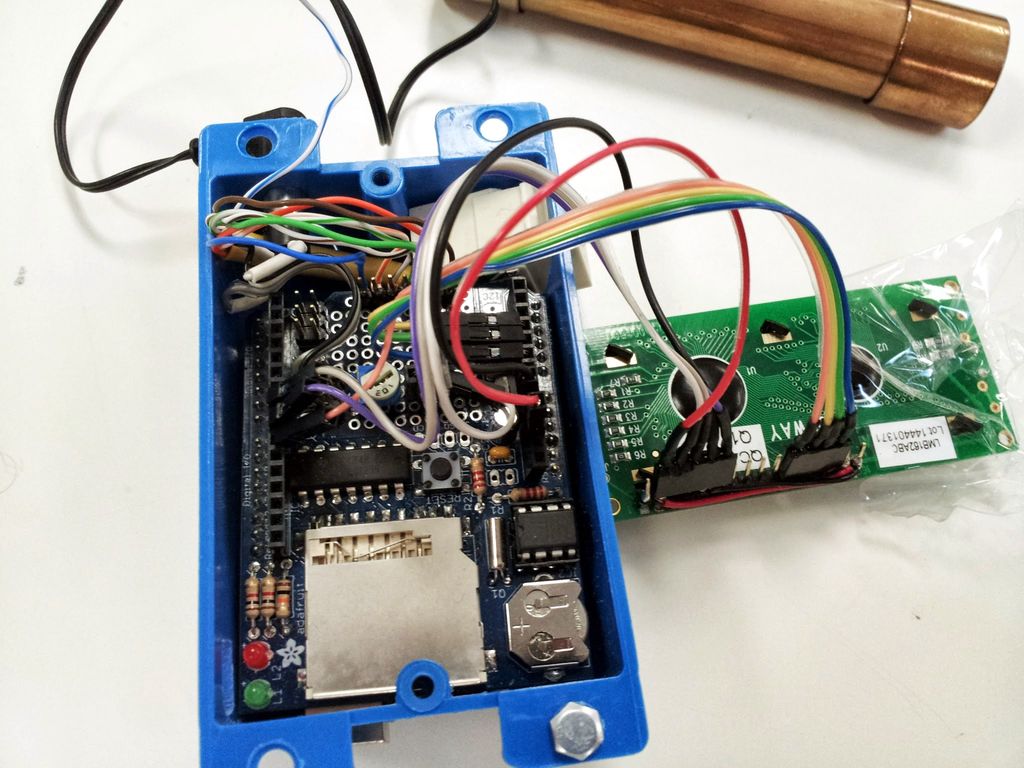
Algae duck has built-in algae sensor that monitors early signs of algae bloom and warns researchers through GPRS data communication. It monitors light intensity and also logs data on SD card
Algae duck also contains cavity with bacteria that can reduce the concentration of alge in water.
In this way the system is both early warning and preventative.
Duck case form factor allows it to blend in the environment. The case can be 3D printed.
// Data logger code based on http://www.ladyada.net/make/logshield/lighttempwalkthru.html
// We're using the Taos TSL237S-LF light-to-frequency sensor: http://www.taosinc.com/getfile.aspx?type=press&file=tsl237-e37.pdf

#include "SD.h"
#include <Wire.h>
#include "RTClib.h"

//These define the pin connections of the Arduino.
//They can be changed but only use digital in 2 or 3 for the Freq pin
#define TSL_FREQ_PIN 2 // output use digital pin2 for interrupt

float fD = 0.1; // Dark frequency
float Re = 2.3; // Irradiance responsivity
float eff475 = 0.113; // Luminous efficiency at 475nm, for dinoflagellate bioluminescence

RTC_DS1307 RTC; // define the Real Time Clock object

#define ECHO_TO_SERIAL   1 // echo data to serial port
#define WAIT_TO_START    0 // Wait for serial input in setup()

// the digital pins that connect to the LEDs
#define redLEDpin 3
#define greenLEDpin 4

// for the data logging shield, we use digital pin 10 for the SD cs line
const int chipSelect = 10;

// the logging file
File logfile;

void error(char *str)
{
  Serial.print("error: ");
  Serial.println(str);

  // red LED indicates error
  digitalWrite(redLEDpin, HIGH);

  while(1);
}

int timing = 1000; // in milliseconds
volatile unsigned long pulse_cnt = 0;
//unsigned long pulse_cnt = 0;

void setup() {

  Serial.begin(9600);
  Serial.println();
  Wire.begin();
  RTC.begin();

#if WAIT_TO_START
  Serial.println("Type any character to start");
  while (!Serial.available());
#endif //WAIT_TO_START

// initialize the SD card
  Serial.print("Initializing SD card...");
  // make sure that the default chip select pin is set to
  // output, even if you don't use it:
  pinMode(10, OUTPUT);

  // see if the card is present and can be initialized:
  if (!SD.begin(chipSelect)) {
    Serial.println("Card failed, or not present");
    // don't do anything more:
    return;
  }
  Serial.println("card initialized.");

  // create a new file
  char filename[] = "LOGGER00.CSV";
  for (uint8_t i = 0; i < 100; i++) {
    filename[6] = i/10 + '0';
    filename[7] = i%10 + '0';
    if (! SD.exists(filename)) {
      // only open a new file if it doesn't exist
      logfile = SD.open(filename, FILE_WRITE);
      break;  // leave the loop!
    }
  }

  if (! logfile) {
    error("couldnt create file");
  }

  Serial.print("Logging to: ");
  Serial.println(filename);

  Wire.begin();
  if (!RTC.begin()) {
    logfile.println("RTC failed");
#if ECHO_TO_SERIAL
    Serial.println("RTC failed");
#endif  //ECHO_TO_SERIAL
  }

  logfile.println("millis1,time1,count,uWattpercm2,millis2,time2");
#if ECHO_TO_SERIAL
  Serial.println("millis1,time1,count,uWattpercm2,millis2,time2");
#endif // attempt to write out the header to the file

  pinMode(redLEDpin, OUTPUT);
  pinMode(greenLEDpin, OUTPUT);

  pinMode(TSL_FREQ_PIN, INPUT);
}

void loop() {


  float Ee;

  // attach interrupt to pin2, send output pin of TSL230R to arduino 2
  // call handler on each rising pulse

  // High light intensity will trigger interrupts faster than the Arduino can handle,
  // which may screw up timing of millis() and delay(), which are also interrupt based.
  // To flag excessive interrupts, we keep track of both millis() and the RTC time
  // before and after our sampling interval.

  pulse_cnt=0;
  uint32_t millis1 = millis();
  DateTime time1 = RTC.now();

  attachInterrupt(0, add_pulse, RISING);
  delay(timing);
  detachInterrupt(0);

  uint32_t millis2 = millis();
  DateTime time2 = RTC.now();
  unsigned long finalcnt=pulse_cnt;

  // Flash green LED at end of sampling interval.
  digitalWrite(greenLEDpin, HIGH);
  delay(500);
  digitalWrite(greenLEDpin, LOW);

  Ee = (finalcnt/(timing/1000.0) - fD)/1000.0/Re; // fO = fD + (Re)(Ee)

  logfile.print(millis1);
  logfile.print(", ");

  logfile.print(time1.year(), DEC);
  logfile.print("/");
  logfile.print(time1.month(), DEC);
  logfile.print("/");
  logfile.print(time1.day(), DEC);
  logfile.print(" ");
  logfile.print(time1.hour(), DEC);
  logfile.print(":");
  logfile.print(time1.minute(), DEC);
  logfile.print(":");
  logfile.print(time1.second(), DEC);
  logfile.print(", ");

  logfile.print(finalcnt, 10);
  logfile.print(", ");

  logfile.print(Ee, 10);
  logfile.print(", ");

  logfile.print(millis2);
  logfile.print(", ");

  logfile.print(time2.year(), DEC);
  logfile.print("/");
  logfile.print(time2.month(), DEC);
  logfile.print("/");
  logfile.print(time2.day(), DEC);
  logfile.print(" ");
  logfile.print(time2.hour(), DEC);
  logfile.print(":");
  logfile.print(time2.minute(), DEC);
  logfile.print(":");
  logfile.print(time2.second(), DEC);
  logfile.println();

#if ECHO_TO_SERIAL
  Serial.print(millis1);
  Serial.print(", ");

  Serial.print(time1.year(), DEC);
  Serial.print("/");
  Serial.print(time1.month(), DEC);
  Serial.print("/");
  Serial.print(time1.day(), DEC);
  Serial.print(" ");
  Serial.print(time1.hour(), DEC);
  Serial.print(":");
  Serial.print(time1.minute(), DEC);
  Serial.print(":");
  Serial.print(time1.second(), DEC);
  Serial.print(", ");

  Serial.print(finalcnt, 10);
  Serial.print(", ");

  Serial.print(Ee, 10);
  Serial.print(", ");

  Serial.print(millis2);
  Serial.print(", ");

  Serial.print(time2.year(), DEC);
  Serial.print("/");
  Serial.print(time2.month(), DEC);
  Serial.print("/");
  Serial.print(time2.day(), DEC);
  Serial.print(" ");
  Serial.print(time2.hour(), DEC);
  Serial.print(":");
  Serial.print(time2.minute(), DEC);
  Serial.print(":");
  Serial.print(time2.second(), DEC);
  Serial.println();
#endif

  delay(0);
}

void add_pulse() {

  // increase pulse count
  pulse_cnt++;
  //Serial.println(pulse_cnt);
  return;
}

Comments