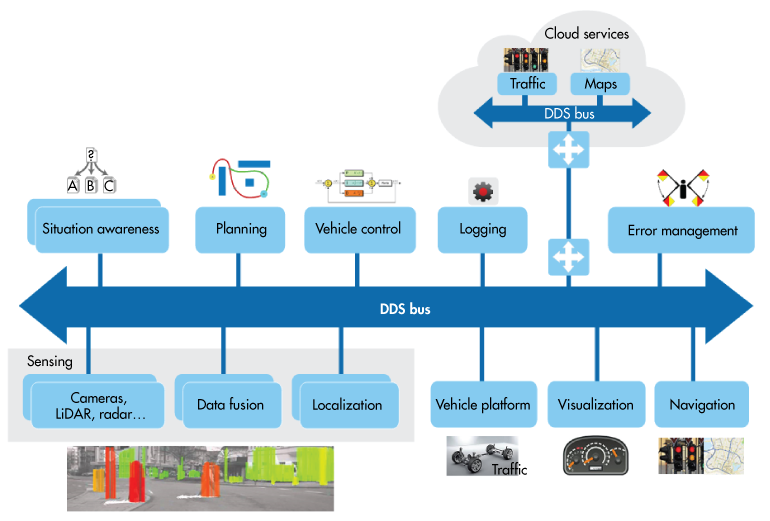
There are over 65,000 buses in Europe and inevitably they will be automated. Our Spanish startup will build and sell hardware and software kits to make existing buses autonomous. Our USA sister company, also founded by our principals, is the prime contractor on the Resilient GPS/INS project for the USA military, and based on this experience our Spanish startup has built prototypes for OEM intelligent vehicle navigation kits for air and ground vehicles with acclaimed public demonstrations. Using current high-quality GPS/INS system prices as a baseline, the size of the autonomous bus control system market alone would be multi-billions of euros and worthy of dedicated focus under the Smart Cities initiative. Our work can also support the DLR's resilient GNSS/high assurance PNT needs. The uniqueness in our navigation systems technology is the ability to blend inertial measurements with different sensors providing position and orientation corrections for multiple streams of PVO estimates and enable the use of the "best" at any moment in time. These are called alternative navigation sensors and systems (ALT-NAV for short) and include standard sensors such as magnetometers, LIDARs, odometers, but also imaging system navigation (IMNAV) based on the analysis of successive frames from an imaging sensor, celestial navigation (CELNAV) using a celestial camera, communications systems-based navigation (COMNAV) using organic communications systems information, and information systems-based navigation (ITNAV) using organic information systems information. In terms of GNSS systems capability our navigation systems are capable of using any available GNSS constellation or combination thereof (Galileo, Glonass, Beidou, QZSS, USA GPS), and by implementing real-time kinematics (RTK) using those signals, achieving centimeter level positional accuracy. Our concept and prototypes also include an implementation for wide area RTK, and deeply integrated GPS/INS algorithms that can work in low signal/dirty signal environments. As such, combined with our ALT-NAV capabilities, our navigation systems can operate in a wider variety of conditions than competitors, whi delivering superior accuracy. Our intelligent, collaborative systems software development kit and execution environment derives from extensive military wargaming, interoperability, and unmanned systems work. Beyond being an exoscale, real-time event processing engine that implements both structured and unstructured data in messages and events, our SDK supports intelligent systems development in three main ways: providing an artificial intelligence (AI) algorithm, integration, and execution engine that orchestrates any AI algorithm execution; supporting the essence of complex cognition in the form of speculative execution at the application level, meaning an intelligent entity has the ability to simulate or inference into the future; permitting system evolution in terms of knowledge and behavior using ontologies that can be exchanged by the cognitive entities. The requirement for AI algorithm integration in intelligent systems can be seen in the example of driving. When we are driving we follow rules of the road as communicated by visual cues, requiring some rule following algorithm. When a ball bounces in front of our car, we must rapidly recognize the event for what it is and to also know that a small child is likely to be following the bouncing ball requiring the capabilities of a machine learning algorithm trained to recognize road hazards. An algorithm to calculate an overall navigation strategy or path requires yet another type of intelligent algorithm to balance our goals and constraints against our desire to follow optimality constraint such as the shortest time. As such, our AI integration engine can integrate a wide variety of AI algorithms and systems. Our ability to support speculative execution of applications is based on the notion of logical time and real-world time and the ability to easily support complex decision algorithms with a time dimension as we experience it in our lives. The key to such capability is to permit every distinct decision-making entity to have its own local clock with which it can work and when one entity interacts with another a rectification in time frames automatically occurs in logical time with an asynchronous real-time execution engine. The engine ensures that a valid decision for the system’s next behavior is calculated, in an easy to program and easy to configure framework. We have implemented relativistic time as it was envisioned by Einstein called the Relativistic Time Synchronization Protocol. The ability to implement adaptive behavior in our SDK is implemented using an ontology framework that permits actions and concepts to be represented, exchanged, and parsed by decision entities. This permits a more natural expression of complex system behaviors and the implementation allows the ontology graph controlling some aspect of system behavior to be dynamically updated, which allows modification of data upon which to operate (knowledge) and behavior. This capability also facilitates AI algorithm integration, using the right algorithm for the task at the moment. While not intelligent systems characteristics, our SDK supports a variety of software component interaction patterns, referred to as the "DNA of complex systems," supporting: the creation of complex, realistic, and scalable networks of component inter-relationships; distributed autonomous controls and monitors; the implementation of complex webs of cause and effect. Intelligent systems built using our SDK can network with each other using as little as a 2G/3G/4G wireless connection, opening the door for vehicle collaboration and centralized monitoring, command, and control. Imagine a future where a transponder-like device broadcasting into an IP network or other appropriate fabric, an intelligent vehicle could then much more accurately avoid collisions using directly communicated local vehicle position as opposed to brute force computer vision, object recognition, or other sensors to physically sense the surrounding environment currently used by autonomous vehicle systems. This is game-changing, in that networked intelligent vehicles can now utilize a wide variety existing geo-spatial information to simply their navigation calculations, avoiding the brute-force methods to discover the world around the vehicle. Such approaches can be easily accommodated in our architecture, but our purpose is to have this path to the future, where all vehicles will be intelligently guided, collaborating whether locally or by some higher-level computation to achieve efficient, safe operations. Our system has been tested running over a billion intelligent entities communicating and collaborating in real time, and as such we can support the future. http://ieeexplore.ieee.org/document/6822304/ http://ieeexplore.ieee.org/document/7881389/
CONDOR Concept of Operation






Comments