


Hardware components | ||||||
 |
| × | 1 | |||
 |
| × | 1 | |||
| × | 1 | ||||
Software apps and online services | ||||||
 |
| |||||
| ||||||
| ||||||
 |
| |||||
| ||||||
Electronics waste and single-use PCBs are a silent disaster in rapid prototyping and recycling. Our project was born from TSPR (Transient Solderless Prototyping and Recovery Ecosystem); a circular hardware framework designed to eliminate toxic e-waste and component destruction.
Instead of traditional high-heat soldering that cooks delicate ICs and ruins boards, TSPR uses 3D-printed parametric substrates held together by a custom water-soluble conductive matrix. To harvest high-value microchips; like BGAs, QFPs, and microcontrollers, you don't blast them with heat guns. You place the board into a 90°C hot-water bath for 7 minutes. The conductive matrix dissolves cleanly, releasing undamaged, pristine components ready for immediate reuse.
[ TSPR Circuit ] ---> [ 90°C Hot-Water Bath ] ---> [ Harvested Pristine Components ]
                                                                │
                                                                ▼
[ Edge AI Optical Sorting Station ]Developing TSPR has been a relentless battle against deadlines, limited physical hardware, missing camera pipelines, and late nights trying to get everything connected.
When hardware access was tight and physical arm deployments weren't immediately feasible for the submission deadline, we refused to abandon the vision. We shifted gears to build a complete Edge AI Control Station and Digital Twin:
We trained an object detection model in Edge Impulse to instantly classify harvested components (BGAs, QFPs, SOPs) after hot-water recovery.
- We trained an object detection model in Edge Impulse to instantly classify harvested components (BGAs, QFPs, SOPs) after hot-water recovery.
We built a custom Flask & App Lab dashboard with live HUDs, fallback stream generators, and dynamic TCP streaming capabilities.
- We built a custom Flask & App Lab dashboard with live HUDs, fallback stream generators, and dynamic TCP streaming capabilities.
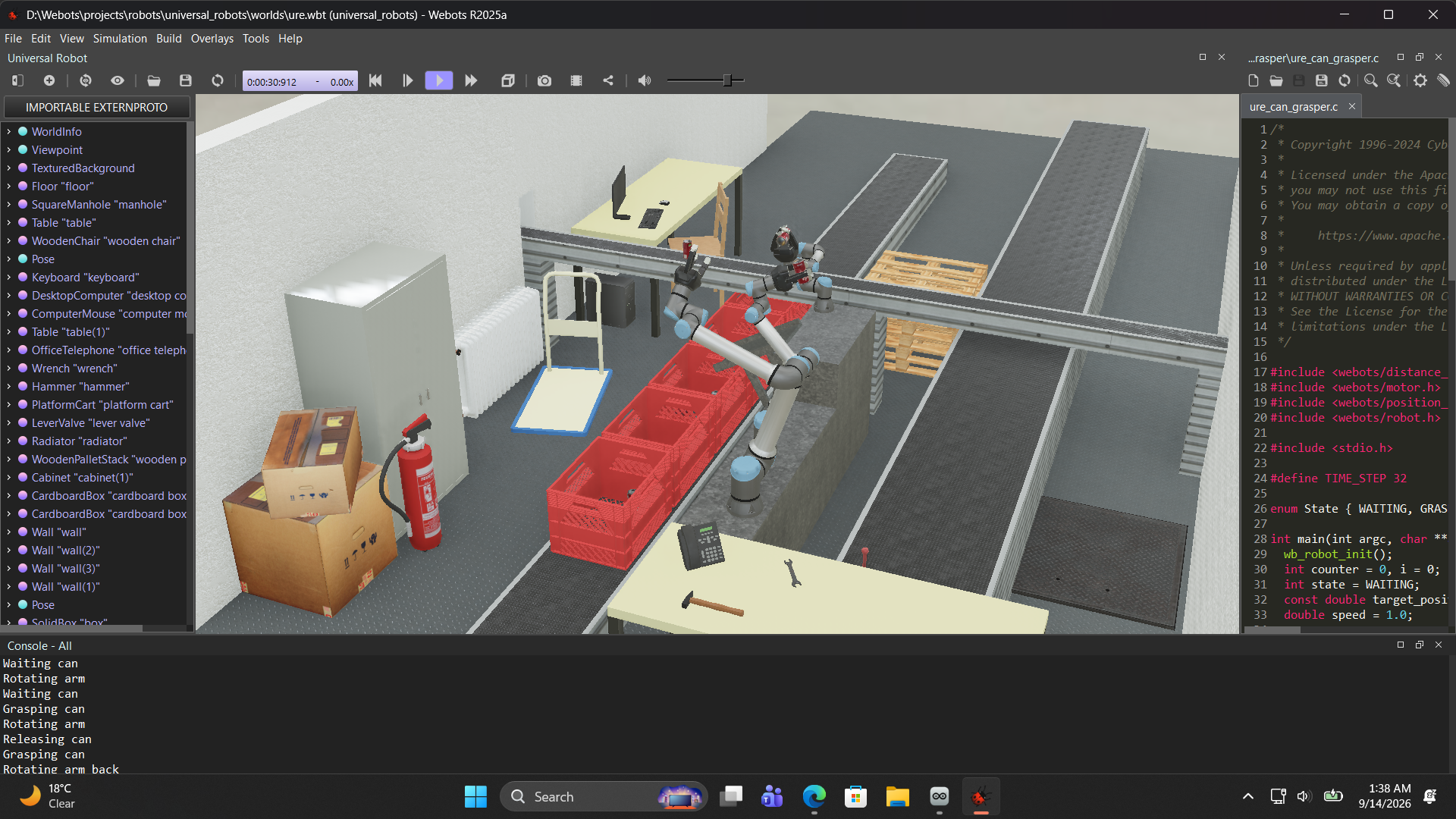
We integrated a Webots 3D Digital Twin, translating vision classification outputs into direct socket payloads (TCP Port 8888) to drive a Universal Robots (UR) pick-and-place simulation.
- We integrated a Webots 3D Digital Twin, translating vision classification outputs into direct socket payloads (TCP Port 8888) to drive a Universal Robots (UR) pick-and-place simulation.
Every line of code and every socket payload in this station was built out of sheer perseverance to prove that sustainable, automated component recovery is not just a dream, it's a working pipeline.
How the Vision WorksHot-Water Component Release: Components are reclaimed via TSPR's 90°C water-bath dissolution process.
- Hot-Water Component Release: Components are reclaimed via TSPR's 90°C water-bath dissolution process.
Edge AI Inspection: The reclaimed parts pass under the inspection feed (USB or RTSP IP camera). The Arduino UNO Q / Qualcomm QRB2210 runs our custom Edge Impulse model to detect package types and measure confidence scores.
- Edge AI Inspection: The reclaimed parts pass under the inspection feed (USB or RTSP IP camera). The Arduino UNO Q / Qualcomm QRB2210 runs our custom Edge Impulse model to detect package types and measure confidence scores.
Automated Quality Control: If the package matches the targeted slot with 70%confidence, the dashboard logs the event and dispatches a JSON trajectory payload over raw TCP.
- Automated Quality Control: If the package matches the targeted slot with 70% confidence, the dashboard logs the event and dispatches a JSON trajectory payload over raw TCP.
Digital Twin Actuation: The Webots UR arm reads the socket event and performs the real-time pick-and-place sequence into designated recovery bins.
- Digital Twin Actuation: The Webots UR arm reads the socket event and performs the real-time pick-and-place sequence into designated recovery bins.
Don't just take our word for it, test our trained Edge Impulse model directly in your browser with your own BGA, QFP, or SMD chip images:
👉 Live Edge Impulse Studio Public Project
Head to the Impulse Design or Model Testing tab in Edge Impulse, upload any PCB chip or BGA package image, and watch the model instantly detect and classify the component package!
Useful Links & Resources- Public Edge Impulse Model & Dataset:
[https://studio.edgeimpulse.com/studio/841776](https://studio.edgeimpulse.com/studio/841776) - Arduino UNO Q System Architecture: Qualcomm QRB2210 Linux MPU + STM32 MCU via internal RPC Bridge.
- Simulation Environment: Cyberbotics Webots R2025a Universal Robots environment.


Comments