



Hardware components | ||||||
 |
| × | 1 | |||
| × | 1 | ||||
| × | 1 | ||||
| × | 1 | ||||
| × | 1 | ||||
 |
| × | 1 | |||
| × | 1 | ||||
 |
| × | 4 | |||
| × | 2 | ||||
| × | 1 | ||||
| × | 1 | ||||
| × | 1 | ||||
| × | 1 | ||||
| × | 1 | ||||
| × | 1 | ||||
| × | 1 | ||||
Software apps and online services | ||||||
 |
| |||||
| ||||||
 |
| |||||
Hand tools and fabrication machines | ||||||
 |
| |||||
 |
| |||||
 |
| |||||
 |
| |||||
Engineering software has become incredibly capable, but the moment we step away from the computer and interact with a physical object, the workflow becomes fragmented again.
I might photograph a part with my phone, measure it with calipers, write dimensions in a notebook, inspect it with another instrument, create a model on my computer, and later try to remember why I made each decision.
I wanted to explore a different interaction:
What if you could point one handheld tool at the physical world and immediately begin engineering with what you see?
That idea became Platypus One.
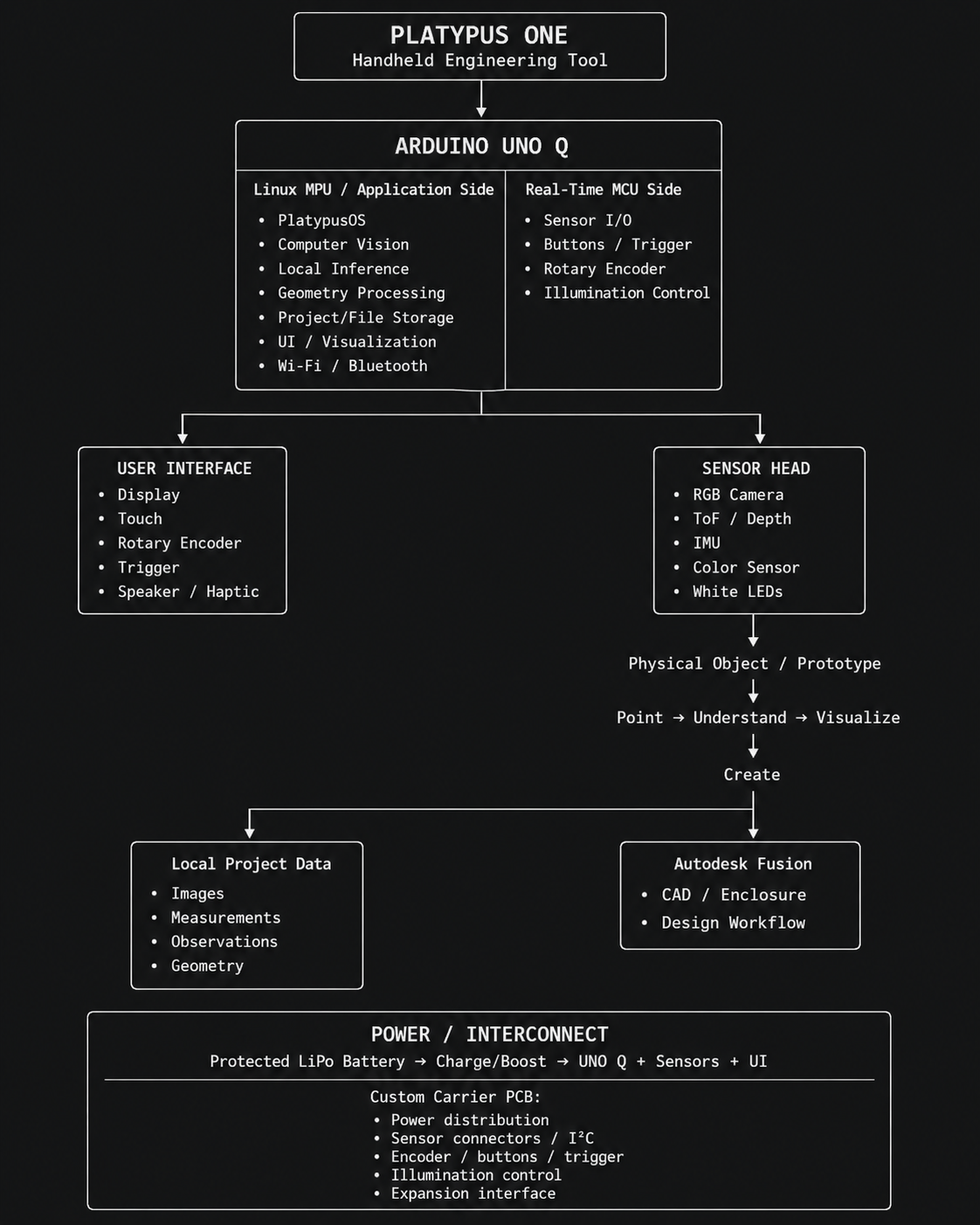
Platypus One is a portable engineering companion built around the Arduino UNO Q. Its goal is not to replace specialized engineering instruments. Instead, it provides a common platform for understanding, measuring, visualizing, documenting, and eventually creating from physical objects.
The guiding idea is simple:
An engineer standing beside you.Point → Understand → Visualize → Create
The device is organized around jobs rather than individual sensors.
If I want to inspect a component, Platypus One can combine camera data, measurements, orientation information, and local software to help describe what is in front of me.
If I want to reverse-engineer something, the same hardware can capture reference imagery and geometry information and pass it into visualization and CAD-oriented workflows (Fusion!).
If I want to document a prototype, the device can keep observations, images, measurements, and engineering context together instead of scattering them across several tools.
The first prototype is being developed as a collection of apps running on a shared hardware and software platform.
Planned applications include:
- Engineering Scout for identifying, measuring, and documenting components
- ShadowScan for physical-to-digital geometry workflows
- Interactive 3D model viewing
- Measurement and orientation tools
- Inspection and documentation utilities
- Context-aware engineering references
The important part is that these applications share the same sensors, project data, renderer, and user interface rather than behaving like unrelated gadgets.
Why the Arduino UNO Q?Platypus One needs two very different kinds of computing.
The Linux side of the UNO Q can handle higher-level tasks such as camera capture, computer vision, lightweight local inference, geometry processing, file management, networking, and the application environment.
The STM32 side can handle deterministic interaction with physical hardware such as buttons, the rotary encoder, illumination, sensor sampling, and future peripherals.
That division maps naturally onto the architecture I am building.
Rather than treating the UNO Q as a conventional Arduino with extra processing power, Platypus One is being designed around its hybrid architecture.
The First Working CapabilityOne of the first workflows under development is Engineering Scout.
The current software pipeline can take a captured scene containing a mechanical component and a known reference, derive measurements from the image, make limited component classifications, record the evidence used to reach those conclusions, and display the result.
An important design rule is that Platypus One should distinguish between:
Observed — what the sensors actually saw
Derived — values calculated from those observations
Inferred — conclusions made from the evidence
Unresolved — things the device does not yet know
I want the tool to be useful without pretending to know more than it does.
The host-side validation suite currently exercises this pipeline against synthetic components at different sizes and rotations. That lets the algorithms improve before the final camera and enclosure are complete.
A major goal of Platypus One is shortening the path between a physical object and useful digital engineering information. Autodesk Fusion is therefore not simply being used to draw an enclosure. Fusion is part of the product workflow.
For the prototype, I am using Fusion to develop:
- the handheld enclosure,
- internal component packaging,
- sensor positioning,
- rotary-controller ergonomics,
- camera and illumination openings,
- battery packaging,
- and eventually the custom carrier PCB through Fusion Electronics.
Over time, geometry captured by Platypus One can also become reference material for modification and creation inside Fusion.Designing the Physical Tool
I want Platypus One to feel like professional equipment rather than a development board inside a box.
The current industrial-design direction uses a substantial handheld body with:
- a display,
- forward-facing perception area,
- thumb-operated rotary encoder,
- physical trigger,
- internal battery,
- USB-C,
- and room for future modular sensing.
The enclosure will be designed in Autodesk Fusion and prototyped through PCBWay.
The design is intentionally serviceable and modular because this first device is meant to evolve as we learn which sensing technologies provide the most engineering value.
Building a Platform, Not a Single ScannerScanning is useful, but it is only one capability.
The larger idea behind Platypus One is that the same handheld platform can become useful in many situations simply by changing the active application.
A maker might use it to understand a replacement part.
A student might use it to investigate a mechanism.
A designer might collect references before opening Fusion.
An engineer might use it to inspect and document a prototype.
Eventually, specialized modules could add capabilities such as thermal inspection, machine-health sensing, structured-light capture, or other engineering measurements.
For this first version, though, the goal is deliberately simpler:
Build a handheld device that can look at the physical world, extract useful engineering information from it, and give the user an immediate next action.
If I can make that experience useful, fast, and approachable, Platypus One will already have accomplished something meaningful.


Comments