Marko Nihon
Created September 26, 2025

MARLIN: An Edge-AI AR fusion for Marine Ecosystem Monitoring

Underwater AI analyzes coral, fish, and sounds in real time; AR overlays deliver marine health insights, even in remote oceans.

6
MARLIN: An Edge-AI AR fusion for Marine Ecosystem Monitoring

Things used in this project

Hardware components

Camera Module
Raspberry Pi Camera Module
×1
DepthEye 3D visual TOF Depth Camera
Seeed Studio DepthEye 3D visual TOF Depth Camera
×1
Raspberry Pi Camera Mount
Pimoroni Raspberry Pi Camera Mount
×1
Pi NoIR Camera V2
Raspberry Pi Pi NoIR Camera V2
×1
Gravity™ Analog pH Sensor Kit
Atlas Scientific Gravity™ Analog pH Sensor Kit
×1
Gravity: Analog Sound Sensor For Arduino
DFRobot Gravity: Analog Sound Sensor For Arduino
×1
Bench Power Supply, DC
×1
Metal Enclosure, Component Case
×1
Flick Large Case
Pi Supply Flick Large Case
×1
Solderless Breadboard Full Size
×1
NVIDIA Jetson Nano Developer Kit
×1
hydrophones
×1
Raspberry Pi 5
Raspberry Pi 5
×1

Software apps and online services

MARLIN
An android app wll be developed to showcase the AR GEO Overlay with functions

Story

Read more

Custom parts and enclosures

Marlin cad (sample)

This is a sample and will be built upon properly

Schematics

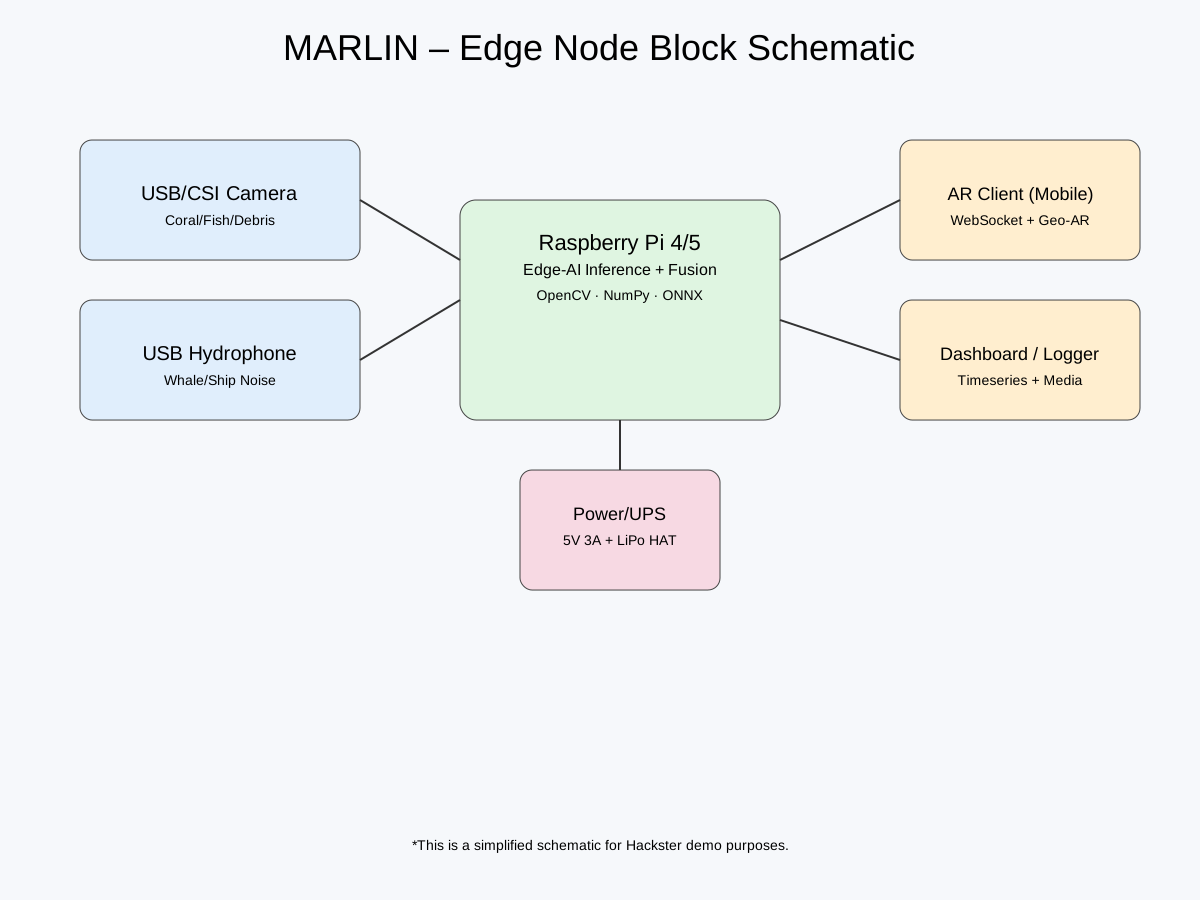
Marlin schema flowchart

schematic

Marlin circuit

circuit

Code

marlin_edge_node.py

Python
MARLIN Edge Node (sample code)
- Captures frames from a USB/CSI camera
- Records short audio windows from a USB hydrophone (via PyAudio)
- Runs placeholder inference (replace with your models)
- Streams results over a local WebSocket and also saves to disk
"""
MARLIN Edge Node (sample code)
- Captures frames from a USB/CSI camera
- Records short audio windows from a USB hydrophone (via PyAudio)
- Runs placeholder inference (replace with your models)
- Streams results over a local WebSocket and also saves to disk
Tested on Raspberry Pi 4/5 (or Jetson Nano) with Python 3.10+
Dependencies: opencv-python, numpy, sounddevice, websockets, onnxruntime (optional)
"""

import asyncio
import base64
import json
import time
from collections import deque
from dataclasses import dataclass
from typing import Deque, Dict, Any

import cv2
import numpy as np
import sounddevice as sd
import websockets

# ---- Config ----
CAMERA_INDEX = 0              # 0 for default camera
AUDIO_SAMPLE_RATE = 48000     # hydrophone / USB audio
AUDIO_WINDOW_SEC = 2.0        # seconds per analysis window
SERVER_WS = "ws://127.0.0.1:8765"  # local WebSocket server (see marlin_ws_server.py)
SEND_PREVIEW_EVERY = 5        # send a small preview frame every N frames
PREVIEW_WIDTH = 320

# Replace with real model calls
def analyze_frame(frame: np.ndarray) -> Dict[str, Any]:
    """Dummy coral/fish/debris detector. Replace with your model inference."""
    h, w = frame.shape[:2]
    # toy heuristic: estimate "fish density" by counting edges
    edges = cv2.Canny(cv2.cvtColor(frame, cv2.COLOR_BGR2GRAY), 60, 120)
    density = float(np.count_nonzero(edges)) / (w * h)
    result = {
        "coral_health": max(0.0, 1.0 - 2.5 * density),  # fake score
        "fish_index": 5.0 * density,                    # fake index
        "debris_prob": min(1.0, 3.0 * density),         # fake probability
    }
    return result

def analyze_audio(audio_block: np.ndarray, sr: int) -> Dict[str, Any]:
    """Dummy whale/ship noise index using simple spectral energy bands."""
    # Compute magnitude spectrum
    fft = np.fft.rfft(audio_block * np.hanning(len(audio_block)))
    mag = np.abs(fft)
    freqs = np.fft.rfftfreq(len(audio_block), d=1.0/sr)

    def band_energy(lo, hi):
        idx = (freqs >= lo) & (freqs < hi)
        return float(np.mean(mag[idx]) if np.any(idx) else 0.0)

    whale_band = band_energy(15, 80)     # rough baleen whale band (very approximate)
    ship_band  = band_energy(80, 300)    # rough engine/prop noise band (very approximate)
    ambient    = band_energy(300, 2000)

    # Normalize
    total = whale_band + ship_band + ambient + 1e-9
    return {
        "whale_index": whale_band / total,
        "ship_noise_index": ship_band / total,
        "ambient_index": ambient / total
    }

@dataclass
class AudioRing:
    maxlen: int
    sr: int
    buf: Deque[float]

    def __init__(self, seconds: float, sr: int):
        self.sr = sr
        self.maxlen = int(seconds * sr)
        self.buf = deque(maxlen=self.maxlen)

    def extend(self, samples: np.ndarray):
        self.buf.extend(samples.tolist())

    def window(self) -> np.ndarray:
        if len(self.buf) < self.maxlen // 2:
            return None
        arr = np.array(self.buf, dtype=np.float32)
        return arr[-self.maxlen:]

async def run():
    # Camera
    cap = cv2.VideoCapture(CAMERA_INDEX)
    if not cap.isOpened():
        raise RuntimeError("Camera not found")

    # Audio
    ring = AudioRing(seconds=AUDIO_WINDOW_SEC, sr=AUDIO_SAMPLE_RATE)
    sd.default.samplerate = AUDIO_SAMPLE_RATE
    sd.default.channels = 1

    def audio_cb(indata, frames, time_info, status):
        if status:
            print("Audio status:", status)
        ring.extend(indata[:, 0])

    stream = sd.InputStream(callback=audio_cb)
    stream.start()

    # WebSocket
    ws = await websockets.connect(SERVER_WS)
    print("Connected to:", SERVER_WS)

    frame_count = 0
    try:
        while True:
            ok, frame = cap.read()
            if not ok:
                await asyncio.sleep(0.01)
                continue

            vision = analyze_frame(frame)
            audio_window = ring.window()
            audio = analyze_audio(audio_window, AUDIO_SAMPLE_RATE) if audio_window is not None else None

            payload = {
                "ts": time.time(),
                "vision": vision,
                "audio": audio,
            }

            # Occasionally attach a preview image (base64)
            if frame_count % SEND_PREVIEW_EVERY == 0:
                preview = cv2.resize(frame, (PREVIEW_WIDTH, int(frame.shape[0] * PREVIEW_WIDTH / frame.shape[1])))
                _, jpg = cv2.imencode('.jpg', preview, [int(cv2.IMWRITE_JPEG_QUALITY), 70])
                payload["preview_jpeg_b64"] = base64.b64encode(jpg.tobytes()).decode('ascii')

            await ws.send(json.dumps(payload))
            frame_count += 1
    finally:
        stream.stop()
        cap.release()
        await ws.close()

if __name__ == "__main__":
    asyncio.run(run())

marlin_ws_server.py

Python
Sample draft py code, websoc server to receive JSON payload
"""
MARLIN local WebSocket server
- Receives JSON payloads from marlin_edge_node.py
- Prints them and writes a rolling log for quick testing
Run: python marlin_ws_server.py
"""
import asyncio
import json
from datetime import datetime
import websockets

LOG_PATH = "marlin_edge_log.jsonl"

async def handle(ws, path):
    async for message in ws:
        try:
            data = json.loads(message)
        except json.JSONDecodeError:
            continue

        # Console preview
        ts = datetime.utcfromtimestamp(data.get("ts", 0)).isoformat()
        vision = data.get("vision", {})
        audio = data.get("audio", {})
        print(f"[{ts}] coral={vision.get('coral_health'):.2f} fish={vision.get('fish_index'):.2f} debris={vision.get('debris_prob'):.2f}", end="")
        if audio:
            print(f" | whale={audio.get('whale_index'):.2f} ship={audio.get('ship_noise_index'):.2f}")
        else:
            print(" | audio=warming-up")

        # Log
        with open(LOG_PATH, "a") as f:
            f.write(json.dumps(data) + "\n")

async def main():
    async with websockets.serve(handle, "0.0.0.0", 8765):
        print("MARLIN WS server listening on ws://0.0.0.0:8765")
        await asyncio.Future()

if __name__ == "__main__":
    asyncio.run(main())

Credits

Marko Nihon
1 project • 0 followers

Comments