



Hardware components | ||||||
 |
| × | 1 | |||
 |
| × | 1 | |||
Software apps and online services | ||||||
 |
| |||||
 |
| |||||
The Need for Intelligent Security in Today's World 🔒🛡️
In an era of rapid technological progress, personal and public safety remains a fundamental concern. While overall violent crime rates have shown declines in many regions in recent years, incidents like home invasions, armed robberies, and targeted threats continue to occur. Traditional security systems—reliant on passive recording and fixed detection categories—often fall short when it matters most. They generate excessive false alarms from everyday objects or animals, miss novel threats they weren't explicitly trained to recognize, and frequently require constant human monitoring.
Families and small businesses need more than just cameras that record events after they happen. They need proactive, intelligent systems that can understand context, adapt instantly, respond in real-time, and above all, respect privacy.
Why This Project Is Necessary? 👀
Modern cloud-based security solutions come with serious limitations:
- Rigid Detection: Most systems only recognize predefined classes (person, dog, car). They remain “blind” to anything outside their training data — such as specific weapons, masked individuals, or custom scenarios.
- High False Positives & Negatives: Random movements or background objects trigger unnecessary alerts, while real threats can go unnoticed.
- Serious Privacy Concerns: Most commercial systems continuously send video feeds to the cloud. This means your private moments with family and friends — intimate conversations, daily routines, and personal activities — are often recorded and stored on third-party servers, raising significant risks of data breaches, misuse, or unauthorized access.
- Latency & Dependency: Cloud processing introduces delays and makes the system dependent on internet connectivity.
This project envisioned to solve these problems by running entirely locally on the high performance Edge AI development board like Jetson Orin Nano Super. The system is expected/should deliver powerful open-vocabulary (zero-shot) detection using Vision Transformers, while keeping all video processing on-device. You can describe any threat or object in plain English at runtime — no cloud, no data leaving your home, and complete privacy.
What We Can Do withNexGen AI Sentinel? 🚨
This project transforms a standard security camera into a truly smart, adaptive, and private sentinel:
- Real-time Threat Detection: Uses hierarchical "Tree Detection" logic — first identifying a person, then scanning specifically for weapons (guns, knives, machetes), masks, or suspicious items.
- Precision with Segmentation: Combines NanoOWL with NanoSAM for accurate instance segmentation, helping distinguish between harmless objects and real threats.
- Instant Private Alerts: High-confidence detections trigger immediate Telegram notifications with annotated snapshots — all processed locally.
- Infinite Customization: Change detection targets on the fly (e.g., “Swiggy delivery person” or “blue logo delivery truck”) via a simple REST API.
- Full Edge Intelligence: No recurring cloud costs, no privacy leaks, and lightning-fast response times.
In a world where both security threats and privacy risks are increasing, NexGen AI Sentinel offers the next generation of protection — intelligent, adaptive, and truly private.
Project Introduction: NexGen AI SentinelNexGen AI Sentinel is an intelligent, fully local edge security system built on the Jetson Orin Nano Super. It leverages Vision Transformers to enable real-time, open-world threat detection using natural language prompts instead of fixed object labels.
Unlike traditional CCTV systems that can only detect predefined classes (person, dog, car, etc.) and remain blind to anything outside their training data, this system supports zero-shot, open-vocabulary detection. This means it can identify any object or scenario you describe — without requiring additional training.
Core Capabilities: 🎯
- Hierarchical Tree Detection logic: First detects a person, then performs a focused scan for threats such as weapons (guns, knives, machetes), masks, or suspicious items.
- Combines NanoOWL (Open World Localization) for detection and NanoSAM for precise instance segmentation to better distinguish between harmless objects (like phones) and real threats based on shape.
- Runs entirely locally in 25W MAXN mode for maximum privacy and low latency.
- Sends instant Telegram alerts with annotated snapshots when a high-confidence threat is detected over multiple consecutive frames.
The system is highly customizable via a REST API, allowing users to dynamically change detection targets at runtime. For example, it can be configured to alert only for:
- A person carrying a weapon
- A delivery executive in a specific uniform (Swiggy, Zomato, etc.)
- A blue-logo delivery truck, etc.
This makes NexGen AI Sentinel not just a powerful security guard, but a versatile smart monitoring system for homes, offices, and businesses.
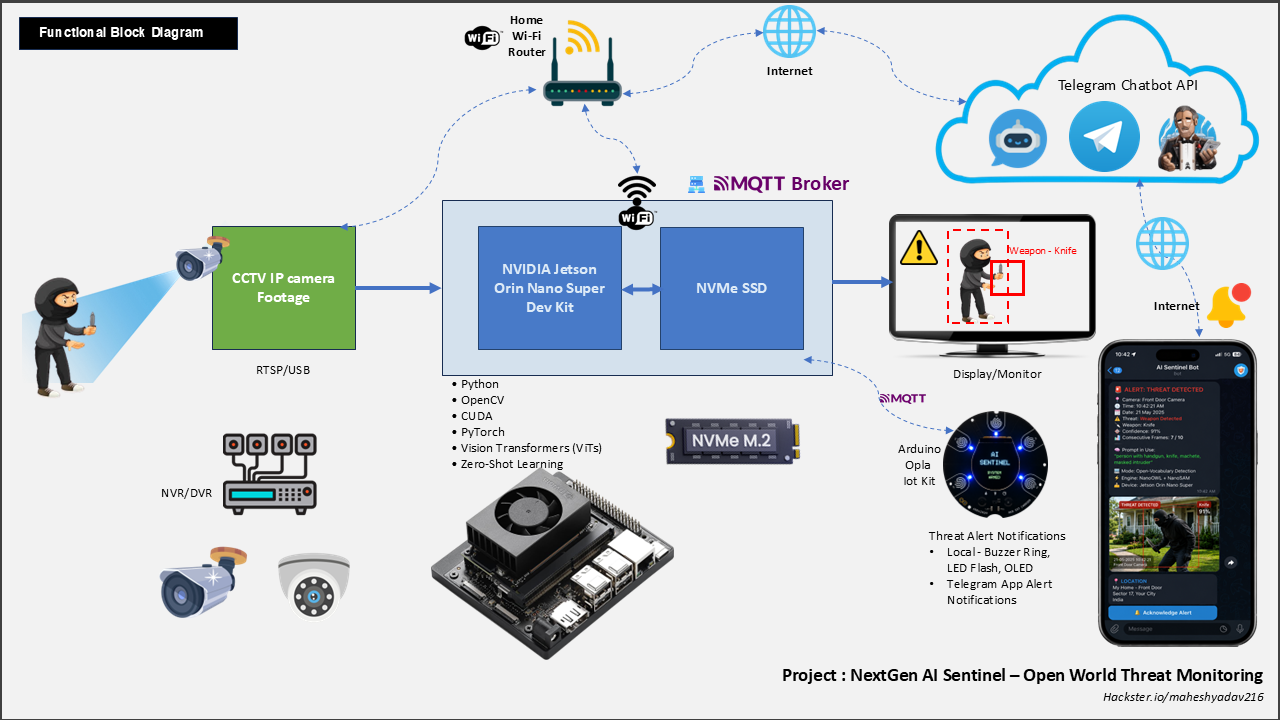
How the System Works?The following image provides an overview of the project's functional block diagram and its components.
The Jetson Orin Nano Super processes live CCTV footage (or recorded test videos) through a local Python pipeline. Using Tree Detection:
- The system first scans for any "person" in the frame.
- Upon detection, it immediately runs a targeted analysis on that region for threats using custom natural language prompts.
- Once the threat verification counter crosses a predefined threshold, the system enters the “THREAT CONFIRMED” state and automatically triggers the complete alert pipeline.
- This includes sending a Telegram alert with an evidence screenshot, saving the annotated image locally on the Jetson device, and publishing an MQTT alert message to the Arduino Oplà IoT Kit.
- The Oplà device then acts as a local emergency alert console by activating pulsing red LEDs, displaying warning messages on the OLED screen, and triggering an audible buzzer alarm. 🚨
- After the alert sequence, the system automatically returns back to monitoring mode and continues processing incoming CCTV frames in real time.
Everything runs locally on-device in real time, ensuring complete data privacy with zero cloud dependency.
Main Hardware - Jetson Orin Nano Super SBCThe Jetson Orin Nano Super is NVIDIA’s powerful and compact edge AI developer kit, delivering up to 67 TOPS of AI performance (1.7× higher than the previous Orin Nano). It features an NVIDIA Ampere GPU with 1024 CUDA cores and 32 Tensor cores, a 6-core Arm Cortex-A78AE CPU, and 8GB of 128-bit LPDDR5 memory with 102 GB/s bandwidth.
Designed for demanding real-time AI workloads, it excels at running Vision Transformers, generative AI models, and multimodal applications efficiently at the edge in 10–25W power modes, making it an ideal platform for advanced robotics, smart vision systems, and privacy-focused applications like NexGen AI Sentinel.
💕 Thank You Hackster and DevKit HQ for organizing and hosting this amazing "Best of 2025 Competition". I feel very grateful for supporting my project idea with $150 BOM fund.Getting Started with Jetson Orin Nano
Before diving into the project's software, the first step is to properly set up your Jetson Orin Nano Super developer kit. Setting up the device is relatively straightforward and well-documented by NVIDIA.
I highly recommend following these two excellent official guides:
Additionally, you can watch the official NVIDIA setup videos on YouTube for a visual walkthrough. Once your Jetson is flashed with the latest JetPack, connected to the internet, and running in 25W (MAXN) power mode, you’ll be ready to install the necessary AI tools (NanoOWL, NanoSAM, etc.) for the project.
Camera/Video Input for TestingFor developing and evaluating the NexGen AI Sentinel, we need diverse CCTV-style video footage. Since real-world threat footage is scarce and often restricted, we are using a combination of sources:
- Custom Recorded Footage: Real bullet cameras from a residential NVR setup. A friend will record controlled test scenarios (wearing masks and holding toy weapons such as machetes, knives, and guns) at different times of the day and distances. This provides highly realistic testing conditions matching actual deployment.
- Public & Online Videos: YouTube videos and open-source CCTV footage for general person detection and varied environments.
- Synthetic Datasets: Supplementary synthetic weapon detection datasets (e.g., Simuletic CCTV Weapon Dataset) to increase variety and edge cases without privacy or legal concerns.
This hybrid approach allows thorough testing of the Tree Detection logic, false positive reduction, and open-vocabulary performance across different lighting, angles, and scenarios.
SecondImportant Hardware in the Project : Arduino Opla IoT Kit 📣
The Arduino Oplà IoT Kit is a plug-and-play prototyping platform that simplifies building smart home devices without soldering. It features an Arduino MKR WiFi 1010 board and a carrier equipped with a color LCD screen, touch buttons, and built-in sensors for light, temperature, humidity, and proximity.
In our project the Arduino Opla IoT kit act as "Emergency Alert Console" or you can say "Threat Alert Interface". Shows notifications about threat on (Display, LED's and Buzzer) 🚨
In our project the Arduino Opla IoT kit act as "Emergency Alert Console" or you can say "Threat Alert Interface". Shows notifications about threat on (Display, LED's and Buzzer)
This flowchart explains the role of the Arduino Oplà IoT Kit in the AI Sentinel system as a physical IoT-based emergency alert console.
- The workflow begins when the Oplà kit powers on and connects to the local Wi-Fi network. After establishing network connectivity, it connects to the MQTT broker running on the Jetson Orin Nano system and continuously listens for alert messages on a subscribed MQTT topic. During normal operation, the device remains in monitoring mode and waits passively for incoming threat notifications from the AI system.
- When the Jetson Orin Nano confirms a threat, such as a detected weapon, it publishes an MQTT alert message which is immediately received by the Arduino Oplà IoT Kit. Upon receiving the alert, the Oplà triggers a complete local emergency response sequence.
- All onboard RGB LEDs begin pulsing red to provide a strong visual warning, the OLED display switches to an emergency warning screen showing the threat status, and the onboard piezo buzzer activates to generate an audible alarm. After the alert cycle, the device returns back to listening mode and waits for future threat notifications, allowing it to function as a real-time smart emergency alert interface for the AI Sentinel system.
The core of NexGen AI Sentinel Project is built around a modular, efficient, and highly customizable software pipeline designed to run locally on the Jetson Orin Nano Super.
High-Level System Flow
The system processes live video through a multi-stage pipeline:
- Video Input & Preprocessing Live feed from CCTV/IP cameras (RTSP) or recorded footage is captured using OpenCV and GStreamer with CUDA acceleration. Frames are resized and optimized for efficient inference.
- Stage 1: Person Detection Using NanoOWL (Open-Vocabulary Vision Transformer), the system first scans for any "person" in the frame. Only when a person is detected does the pipeline proceed to the next stage. This hierarchical approach significantly reduces unnecessary computation.
- Stage 2: Threat Detection The system performs a focused open-vocabulary scan on the person’s Region of Interest (ROI) using dynamic natural language prompts such as "handgun", "knife", "machete", "person wearing mask", etc. A multi-frame verification engine ensures the threat appears with high confidence across consecutive frames before proceeding.
- Stage 3: NanoSAM Segmentation For high-confidence detections, NanoSAM generates pixel-level segmentation masks. This helps accurately differentiate between real threats (e.g., actual weapon shape) and false positives like phones or tools.
Alert & Logging Engine Once a threat is confirmed, the system:
- Saves an annotated snapshot to SSD
- Generates rich event metadata (timestamp, confidence, label, camera ID)
- Sends instant notification via Telegram Bot with the image and details
- Alert & Logging Engine Once a threat is confirmed, the system:Saves an annotated snapshot to SSDGenerates rich event metadata (timestamp, confidence, label, camera ID)Sends instant notification via Telegram Bot with the image and details
Key FeaturesofSoftware Architecture
- Dynamic Prompt System: A FastAPI-based REST interface allows real-time updating of detection targets without restarting the system (e.g., switching from weapon detection to “Swiggy delivery person” mode).
- Fully Local Processing: All inference runs on-device, ensuring complete privacy and minimal latency.
- Power Mode: The Jetson runs in 25W MAXN mode to deliver real-time performance.
This modular architecture makes the NexGen AI Sentinel both powerful and flexible — capable of serving as a robust security system as well as a smart, context-aware monitoring solution.
Implementation (Current)
The project code is mainly divided into two interconnected modules:
- The AI Edge Detection System running on the NVIDIA Jetson Orin Nano and
- The IoT Emergency Alert System running on the Arduino Oplà IoT Kit.
==> The Jetson-side Python code uses OpenCV, NanoOWL, and Vision Transformer–based Open-Vocabulary Detection to process CCTV video frames in real time and identify threat objects using natural language prompts.
Open-Vocabulary Detection
The project uses Open-Vocabulary Detection, where the AI model identifies objects based on natural language prompts instead of fixed trained classes. These prompts, also referred to as vocabulary text, define which objects the Vision Transformer model should search for within the CCTV video feed.
In this project, prompts such as “person, ” “rifle, ” “gun, ” “weapon, ” and “knife” were used to dynamically detect potential threats in real time without training a custom dataset. This approach makes the system highly flexible and scalable, since new threat categories can be added simply by changing or extending the vocabulary prompts rather than retraining the entire AI model.
==> A custom temporal verification logic : confirms detections across multiple consecutive frames to reduce false alarms before triggering the “THREAT CONFIRMED” state. Once confirmed, the system automatically captures evidence screenshots, sends Telegram alerts with images, and publishes MQTT alert messages locally through the Mosquitto MQTT broker.
==> The Arduino-side code is written using the Arduino framework and MQTT communication libraries. The Arduino Oplà IoT Kit continuously listens for MQTT threat messages from the Jetson system over Wi-Fi. When a threat alert is received, the device activates pulsing red RGB LEDs, displays emergency warning messages on the OLED screen, and triggers the onboard piezo buzzer alarm. Together, both code modules create a complete real-time Edge AI and IoT-based smart threat monitoring and response system.
DemoIn the demo, the AI Sentinel system processes live CCTV-style surveillance footage on the NVIDIA Jetson Orin Nano using NanoOWL-based Open-Vocabulary Detection.
Two different test scenarios were used to evaluate the system:
- the first (test) video contains a person carrying a rifle, while the second video contains a person carrying a knife.
- The AI continuously analyzes each frame using natural language prompts and applies temporal verification logic across multiple consecutive frames to reduce false alarms before confirming a real threat.
- Once a threat is confirmed, the system automatically triggers the complete emergency response pipeline by sending a Telegram alert with an evidence screenshot, saving the annotated image locally, and publishing an MQTT alert to the Arduino Oplà IoT Kit.
- The Oplà device then activates pulsing red LEDs, displays a warning message on the OLED screen, and triggers an audible buzzer alarm, demonstrating a complete real-time Edge AI and IoT-based smart threat monitoring and response workflow.
What I have implemented
✅ NanoOWL Open-Vocabulary Detection
✅ Threat Verification Logic
✅ Telegram Alerts
✅ MQTT IoT Alert System
✅ Arduino Oplà Emergency Console
- The current prototype successfully implements the core Open-Vocabulary Threat Detection and IoT Alert Pipeline.
Additional modules such as NanoSAM-based segmentation and REST API–based dynamic prompt updates are included in the planned extended architecture and partially integrated into the system design for future scalability.
NanoSAM integration is proposed for future instance-level segmentation to further improve object boundary accuracy and reduce false positives.Future Improvements 🔮
- NanoSAM Integration for Instance Segmentation
- TensorRT Optimization
- Multi-Camera Support
- RTSP CCTV Integration
- REST API Prompt Updates
- Cloud Dashboard
- Threat Logging Database
- Face Recognition Module
This project is fully open source: GitHub Repository. You'll find: Complete source codes, project files, Wiring diagrams, Setup instructions
What I'd Love to See : Suggestions about this Tutorial/Project design, Circuits, code modifications, Optimization, Errors/Bugs findings and queries are most welcomed. Feel free to raise you queries, suggest your opinions and point out any errors or bugs.Credits 💞
Thank you Hackster, DevKit HQand all other peoples, websites and entities who helped me (directly/indirectly) for creating this project/article




Comments