


Hardware components | ||||||
| × | 1 | ||||
| × | 1 | ||||
Software apps and online services | ||||||
 |
| |||||
Sometimes a project starts with a serious technical problem.
This one started with a baguette.
French Baguette was originally designed as a slightly absurd tactile controller built around the Chili Pepper ESP32-S3 audio platform. The idea was simple: make a playable PCB covered with French clichés, connect it to a board capable of handling touch sensing and audio, and see how far I could push the concept.
It quickly became much more than a MIDI controller.
Today, French Baguette is becoming a standalone sampler and synthesizer, with an SD-card-based sample system and a collection of real-time effects ranging from conventional reverb to deliberately broken granular textures.
And yes, it is still shaped like a baguette.
Miette FX and synthesizer engine on the test bench :
A sampler that doesn't need a sample managerOne thing I wanted to avoid was requiring a dedicated desktop application just to put sounds into the instrument.
The sampler works directly from a microSD card.
On first boot, the firmware automatically creates the folder structure required by the instrument, with a dedicated folder for each sample pad.
The workflow is intentionally simple:
Insert the SD card into French Baguette and boot it once.
- Insert the SD card into French Baguette and boot it once.
The firmware creates the sample folders automatically.
- The firmware creates the sample folders automatically.
Remove the SD card and connect it to a computer.
- Remove the SD card and connect it to a computer.
Drag your .wav files into the folders corresponding to the pads you want to use.
- Drag your
.wavfiles into the folders corresponding to the pads you want to use.
Put the card back into the instrument.
- Put the card back into the instrument.
That's it.
The folders effectively become the mapping system, so samples can be organized manually without configuration software, databases or proprietary file formats.
Want a kick on one pad, a field recording on another, a vocal fragment somewhere else and a badly recorded kitchen noise next to it?
Just move the WAV files around.
For me, this is much closer to how a small hardware sampler should work.
But it is also a synthesizerI didn't want French Baguette to depend entirely on prerecorded material.
The same ESP32-S3 platform can also generate sound internally, so the firmware is evolving into a hybrid sampler + synthesizer.
That makes the tactile interface much more interesting. A pad doesn't necessarily have to mean "play this WAV file." It can trigger or control generated sounds as well.
The goal isn't to reproduce a traditional keyboard synthesizer on a strange-looking PCB. It is to use the touch surface as its own type of musical interface and build sound engines around it.
Then I started adding effects...This is probably where the project became slightly unreasonable.
French Baguette now includes several effects that can radically transform both samples and synthesized sounds.
There is a reverb for turning short sounds into much larger spaces.
There is an overdrive for when those spaces are too polite.
There is an echo / loop effect that can grab fragments of audio and turn them into repeating rhythmic material.
And then there is Miette.
MietteMiette means crumb in French.
It is the granular glitch effect of French Baguette.
Instead of treating the incoming sound as one continuous recording, Miette breaks it into tiny pieces — crumbs — that can be repeated, displaced and reorganized into new textures.
A normal sample can quickly become a cloud, a stutter, a frozen texture or something that barely resembles the original recording.
Naming a granular processor after bread crumbs was also too obvious an opportunity to ignore.
The whole effects section is designed around this idea of taking very simple source material and pushing it somewhere unexpected.
A few WAV files on an SD card can become something completely different once they start going through loops, distortion, reverb and granular processing.
Why build this around the ESP32-S3?French Baguette is part of a larger system I have been developing around my Chili Pepper board.
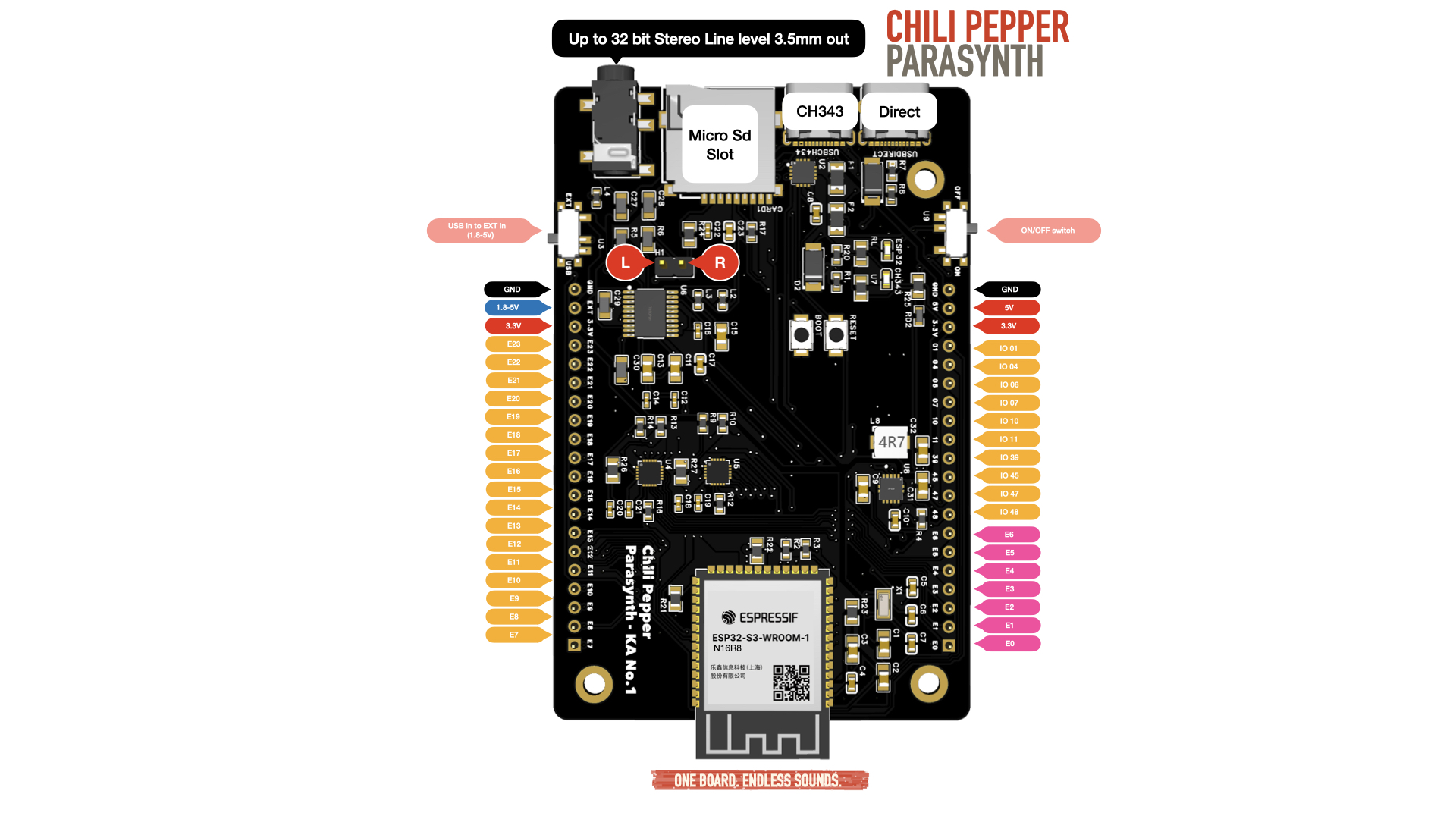
Chili Pepper is an ESP32-S3 N16R8-based development board designed specifically for musical projects, with audio output, capacitive-touch connectivity, microSD storage and the interfaces I kept needing while developing electronic instruments.
Instead of rebuilding the same ESP32 + DAC + SD + touch-sensing architecture for every new instrument, I wanted one reusable platform.
French Baguette became one of the more ridiculous demonstrations of what that platform can do.
The hardware may look like a joke, but the underlying idea is quite serious: make it easier to prototype unusual standalone electronic instruments without starting the audio hardware from scratch every time.
Open sourceThe project is open source, and the firmware is available on GitHub:
github.com/korallumatelierno1/French-Baguette-Chili-Pepper-ESP32-tactile-sampler
That is also part of the reason for keeping things like the SD-card structure straightforward. I want the project to remain understandable and hackable.
Changing samples should be easy.
Changing the code should be possible.
And using the platform as the starting point for something that has absolutely nothing to do with baguettes is perfectly acceptable too.
A change of plans: from Kickstarter to Crowd SupplyI originally prepared French Baguette for a Kickstarter campaign, and a preview page was created for the project:
French Baguette — Kickstarter preview
However, that Kickstarter campaign will not launch.
Since preparing it, I have signed with Crowd Supply, part of Mouser Electronics, to bring my hardware projects to market through their platform and distribution network.
French Baguette will therefore be offered exclusively through Crowd Supply rather than Kickstarter.
I didn't want people who had already followed the Kickstarter preview to simply lose track of the project, so Kickstarter followers will receive a notification when the Crowd Supply preview page becomes available.
At that point, development updates and information about availability will continue there.
Where the project is goingThe interesting part for me is no longer simply making a funny PCB that produces sound.
French Baguette has become an experiment in how little infrastructure a standalone musical instrument really needs.
A microSD card can be the sample manager.
Folders can be the mapping interface.
Touch pads can replace a conventional keyboard.
And an inexpensive microcontroller can simultaneously handle sampling, synthesis and effects that would have required much more specialized hardware not that long ago.
The fact that all of this happens inside an electronic baguette is mostly a bonus.
More information about the hardware:
French Baguette — Korallum Atelier No.1
🥖


Comments