



Hardware components | ||||||
 |
| × | 1 | |||
| × | 1 | ||||
| × | 1 | ||||
Hand tools and fabrication machines | ||||||
 |
| |||||
This project was developed during the "Makeathon TDI 2016" which is an event that brings together people from different disciplines, such as engineers, artists, designers and developers in order to create multidisciplinary projects that solve a real problem in just 48 hours.
Our project looking to solve a problem for people with visual disabilities, they have difficulty sensing the environment, especially when navigating in urban areas with presence of multiple obstacles. The stick is the device more common for orientation, however, only the stick does not provide information on obstacles above ground level.
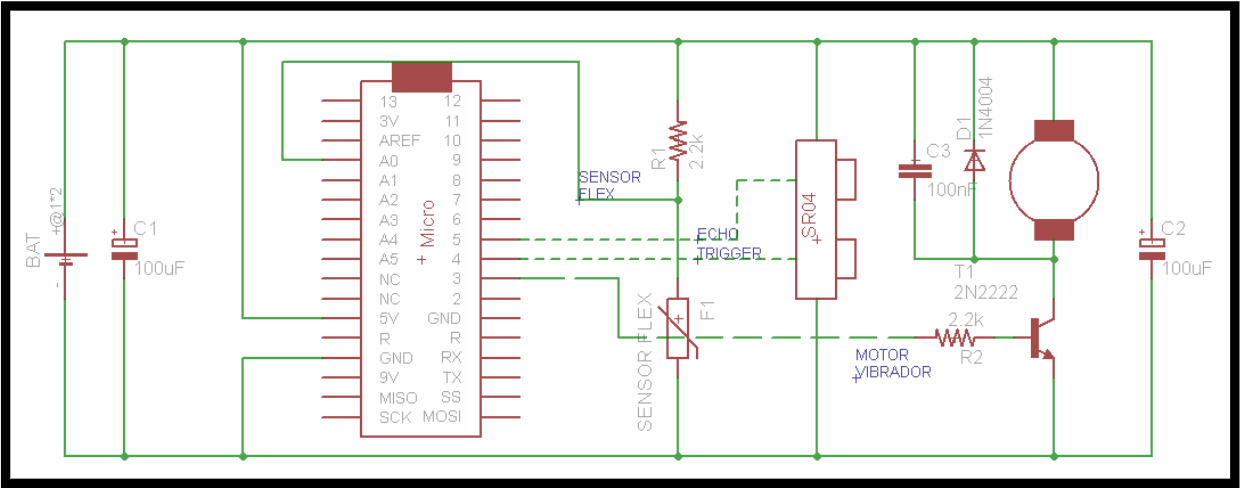
The project L.E.O system has a set of proximity sensors with a haptic interface to alert the user to the presence of objects around which are outside the normal scope of a white cane. The lateral haptic module will be used on the left arm of the user and allow you to detect any object that points to extend his arm.
The front haptic module has a design similar to a lens, so that the user can use them comfortably and detect any object in front of him, up to his face.
The haptic interface modules both vibration intensity will vary depending on the proximity of different objects or obstacles are in the path followed user. Thus, an intense vibration state that is close to an obstacle, vibration levels are reduced as it moves away from the obstacles on the way. Finally, when the module does not vibrate it means that the way is clear and the user can circulate.



Comments