Today microprocessors tend to dominate many of the electronic projects that are built today. They reduce component counts and are becoming even more versatile. Even the new tinyAVR® microprocessors now have programmable user circuits built in. 40 years ago when microprocessors were limited and quite expensive, many projects involved a number of discrete components and basic integrated circuits.
Going back through an archive of old electronic magazines, the following "Rock, Paper Scissors" game looked an interesting build.
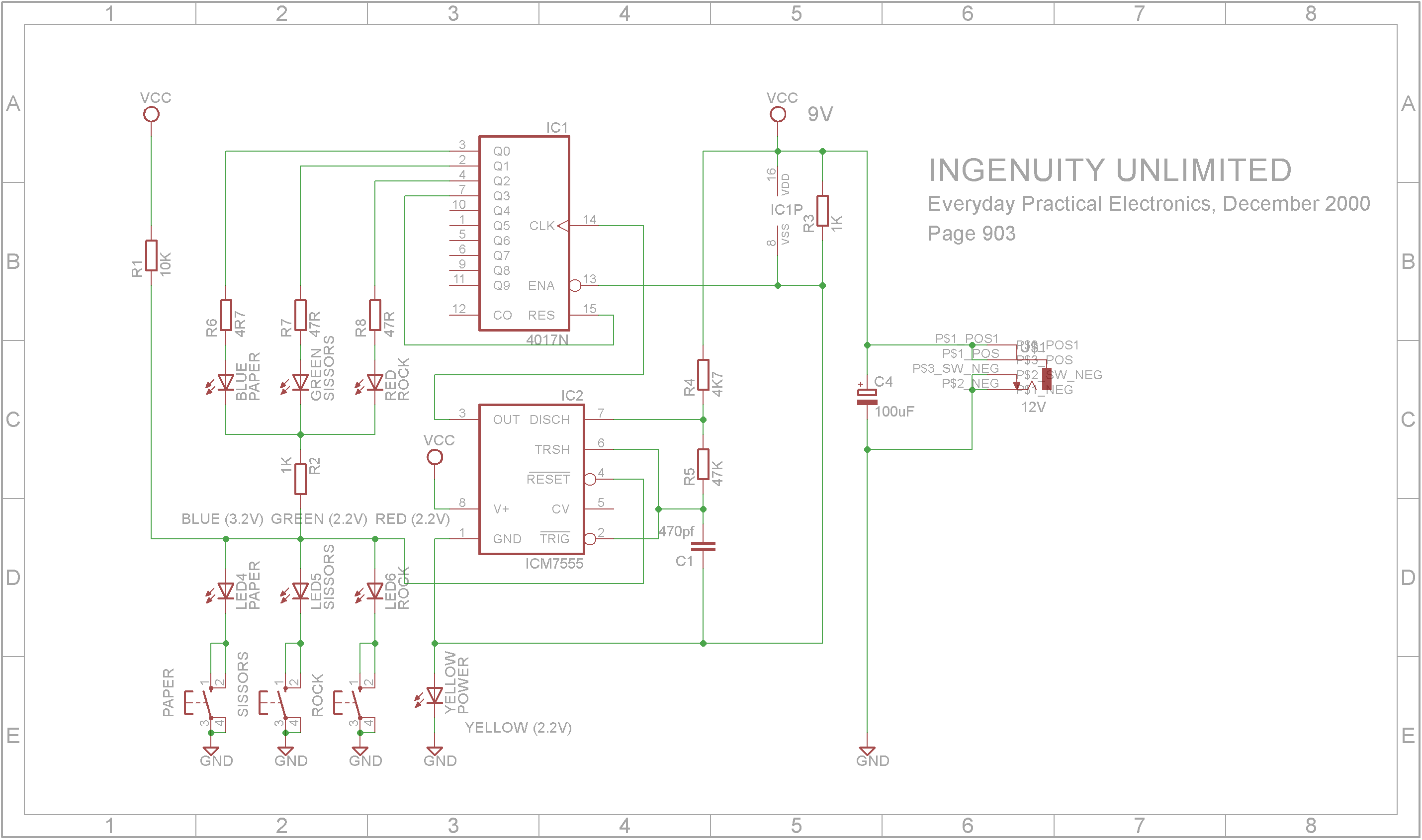
Full circuit for "Rock, Paper, Scissors" game
At first the circuit might seem quite complicated, but if you break it down into its logical parts, it is actually quite simple.
The oscillator uses the good old 555 timer configured as an astable multivibrator. The output (pin 3) generates a square wave whose frequency is determined by C1, R5 and R4. The RESET line is held at VCC by R1 thus allowing the circuit to oscillate.
The only non-standard part of the circuit is the yellow LED and R3. These are designed to create a virtual ground. Normally the RESET line needs to be at 0V to reset the 555 timer. By placing having the yellow LED present, the RESET line only needs to be at 2.2V (the forward voltage drop of a yellow LED) to RESET or stop the oscillator. We will see why in the next section. Because LEDs won't conduct without power, R3 provides the LED its power. It allows it to perform a secondary purpose by showing the user that the power is on.
Every LED has a forward voltage drop so when the player presses either the Rock, Paper or Scissors button, the forward voltage drop of the associated LED will stop the RESET line from going to GROUND. However since there is now a VIRTUAL GROUND of 2.2V, the RESET line goes low enough as to stop the 555 from oscillating while any of the switches are pressed.
The output from the oscillator clocks a 4017 decade counter. On the 4th clock cycle, Q3 goes HIGH and since this is tied to the RESET line of the decade counter, it will force the count back to 0 and Q0 will go HIGH. This repeats ad infinitum. When the player presses a button, the RESET line will go LOW and the clock stops. The LED associated with the active 4017 output pin will light up showing the machine's selection.
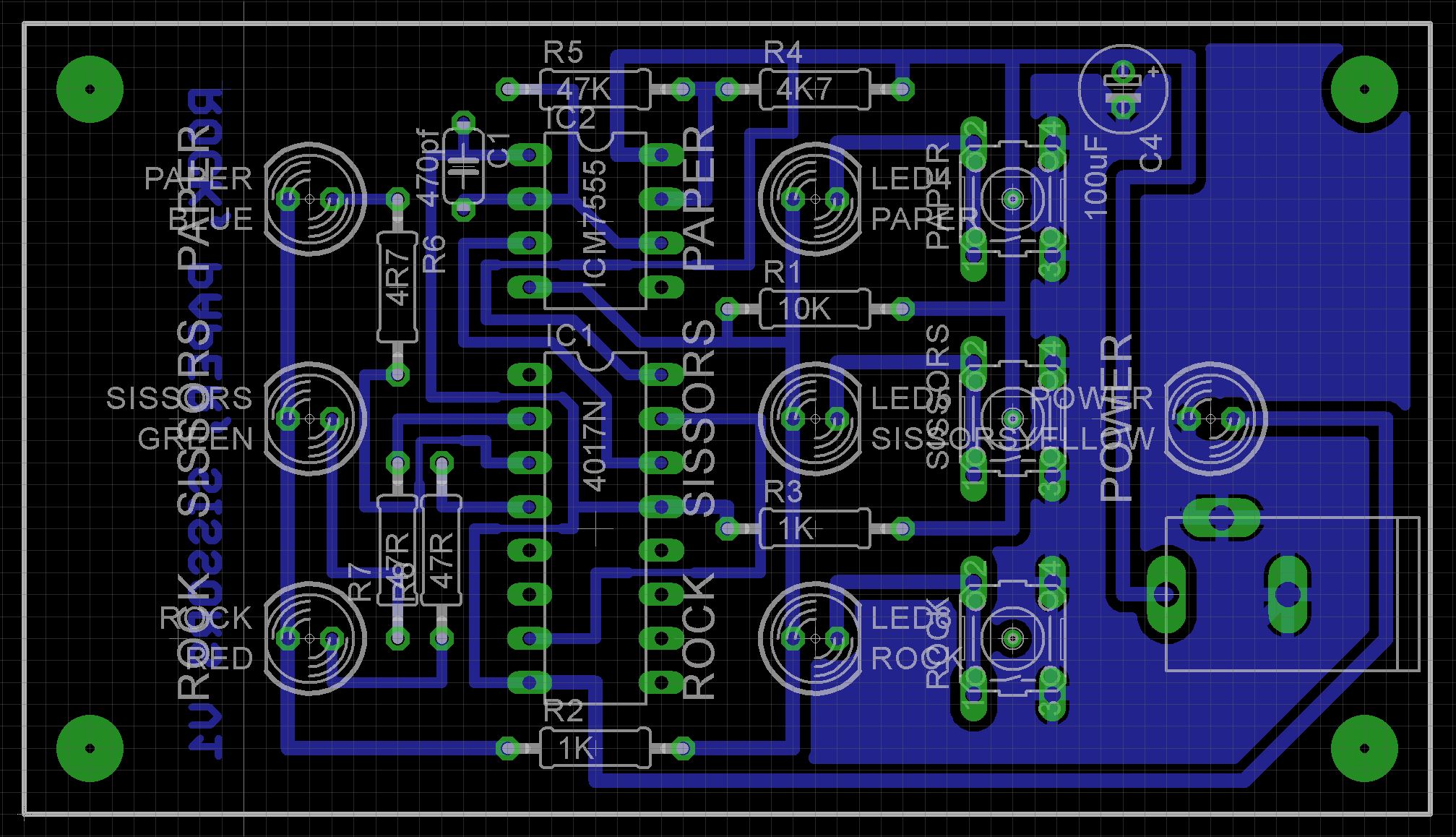
BuildI have a number of cheap 85mmx50mmx20mm cases which I bought a while ago on eBay. They were less than a $1 each.
Fits into a cheap 85mmx50mmx20mm case
The Eagle files for the PCB have been included should you wish to get them commercially made or you can choose to make them yourself.
I used the Toner method to make mine.
VideoConclusionDiscreet electronics without microprocessors is still fun. It's a pity in some-ways that it is a dying art but if you are interested in looking at old electronic magazines, the best source that I have found is https://worldradiohistory.com/








Comments