


A bath marinates the body. Skincare seasons it. Dressing plates it for the context it is heading into. The sleeping station is the emancipation and optimisation of the body's dormant state: the unconscious, largely physical behaviours that operate outside intellectual agency while we are awake. Whether we are aware of it or not, the body works 24 hours a day. Within the 8 hours of sleep, it inhabits a liminal experience: alive but not present, entirely absorbed and oblivious to what lies beyond its borders.
'Masocarism' reaches material form as a proof of concept: that bondage, domination, submission and masochism can be reframed through a lens of care and self-development.
A moment inside a pore-sealing latex suit, for instance, can be as rich in self-reflection and bodily concentration as it is potentially nourishing for the skin's surface — fed by its own sweat. The experience echoes deep diving, where attention to biological metrics becomes essential: heartbeat, oxygen flow, muscle inertia. Just as a deep-tissue massage releases tension through pressure, painful in itself, while a profound sense of relaxation can feel paradoxical. Yet one is precisely the result of the other.
This station uses sensorial and textural amplification to create a vacuum moment: mindfulness through isolation.
IntentionsThe intentions of this artefact were clear from the outset: to intersect human and somatic intelligences stored in tissue, muscle and nervous system with chemical, physical and analogue phenomena. Those phenomena are themselves a response to the sensing of organisms that coexist within the artefact — organisms that change, adapt and make demands according to their own wellbeing. 'Masocarism' is experimental to its fullest extent, holding its value in the exploration of craftsmanship and interspecies fabrication.
The ideation emerged from two opposing poles within the cluster brief: a Regenerative Station and a Fetish Dungeon = Regenerative Dungeon with Fetish Totems.
Fabrication ProcessThe primary medium is SCOBY (Symbiotic Culture of Bacteria and Yeast) from kombucha brewing, cultivated in a batch started one month before the artefact's assembly. The key conditions for a soft, even cellulose canvas are: consistent dilution of the sugar-and-green-tea feeding infusion, a homogeneous heat source, and indirect light.
Bacterial cellulose must lose mass before use — it can shed up to 80% of its weight through drying and rinsing. To preserve malleability and resistance during this process, the surface was then coated with a blend of glycerin, mineral water and eucalyptus oil, chosen for its soothing properties for both Skin, SCOBY and Spirit.
Shaping followed an intuitive process. Once the pattern was resolved, the pillow section was hand-sewn in cross-stitch with silk thread. The X-stitch provides stability and grip in preparation for the filling. Future iterations would explore: alginate thread as an alternative material for hand sewing; a coat of alginate or bioresin to fuse the layers; or — given more time — a second brew in which cut pieces float in fresh culture liquid, allowing the bacteria to bridge the seams with new cellulose growth.
The filling, chosen for accessibility and proof of concept, consists of sterilised sand blended with flaxseeds and dried lavender. Depending on the wearer's skin type and intended use, the filling logic can be adjusted: sand adds sculpting mass for the neck; moistened oats release a milk that soothes the skin; soaked flaxseeds form a cooling gel that benefits muscle relaxation and reduces inflammation. The SCOBY itself contains amino acids and lactic acid — compounds commonly used in chemical exfoliation — making skin contact an active, not merely passive, interaction.
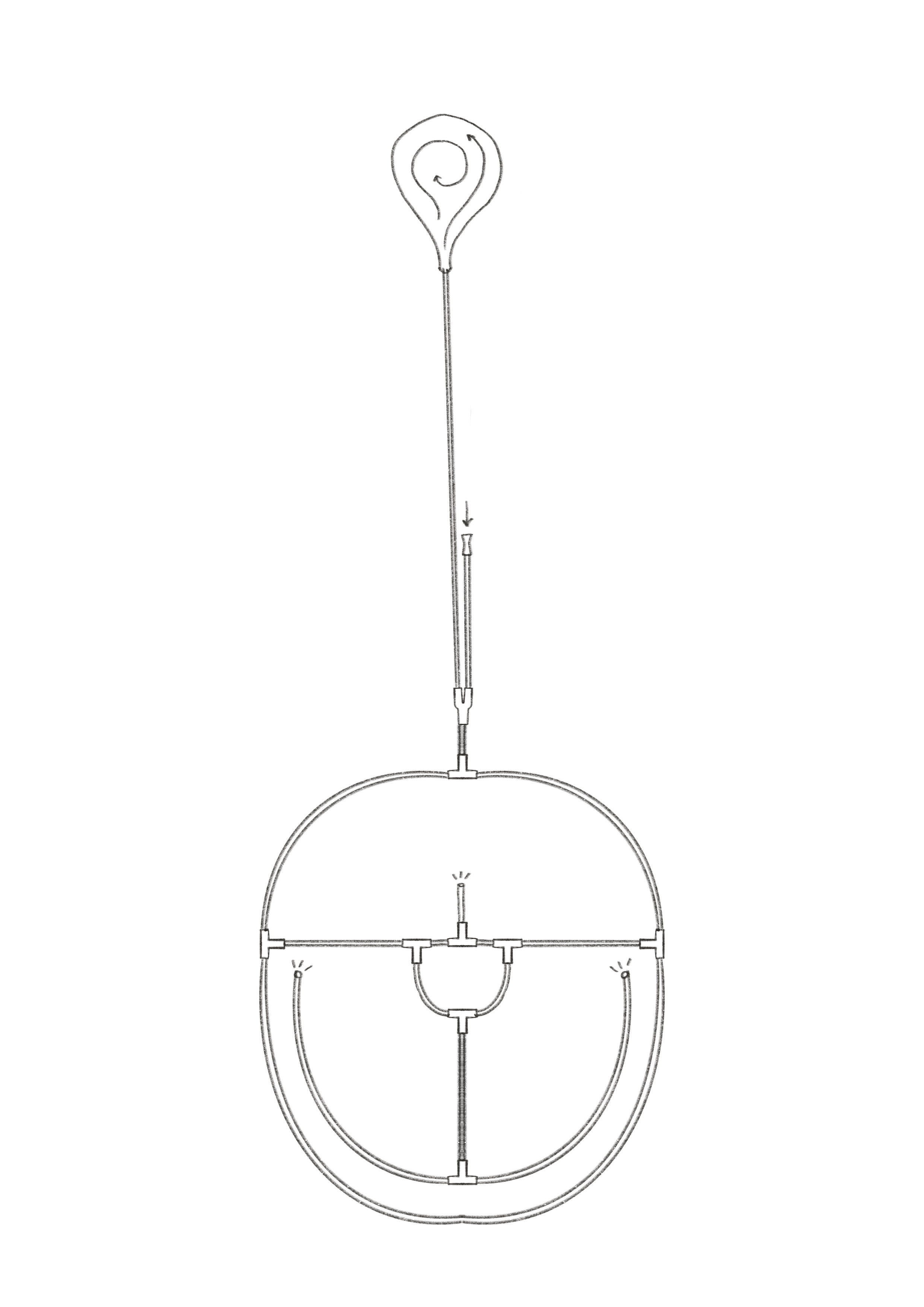
In order to emphasise the mindfullness aspect of the breathing, the mask holds a pneumatic system which the individual breaths create a sonic air circulation
The artefact is stored refrigerated or in a cool environment. An additional external coating could improve durability for repeated use.
Further testing will determine circularity, frequency of use and maintenance protocols — specifically, whether 'Masocarism' is best understood as a single-use treatment or as a micro-environment that can be cleaned, rebalanced and sustained with ongoing care.
Future DevelopmentPriorities for the next iteration:
- Develop seamless cellulose joining without foreign fibre;
- Test filling variations mapped to specific therapeutic or cosmetic outcomes;
- Establish maintenance and longevity protocols;
- Explore the artefact as a wearable piece alongside its function as a sleeping station;
- Investigate the SCOBY's lactic acid activity as an intentional skincare mechanism.
Without relying in biomimicry, A conscious decision was made to minimise the use of avoidable digital interfaces throughout fabrication. The intention was for the artefact to operate at the intersection of intelligences: sensing and making in a purely physical register. Even when that meant outputs that are immaterial or imperceptible to the human eye in real time. The lab practice was kept analogue, with music as the only technological accompaniment.
AI was used exclusively in post-process documentation: syntax, translation and proofreading of the written material above.


Comments