This project is specifically designed to monitor and protect wildlife in deep forest environments. I developed it out of a strong passion for building intelligent systems that can operate in remote areas where human presence is limited, and still communicate reliably over long distances.
The core of the system is a Raspberry Pi 5 (2GB version), which acts as the brain of the device. It runs lightweight YOLO-based object detection models to analyze live camera feeds in real time. This allows the system to detect unusual activity, such as the presence of humans in restricted wildlife zones, and generate instant alerts based on what it observes.
For vision, I used a Raspberry Pi Camera Module 3 (NoIR version) with wide-angle support. This enables the system to capture clear images both during the day and in low-light conditions. Since external IR illumination increases power consumption, I optimized the setup using an IR cut filter approach to balance daytime clarity and nighttime usability depending on lighting conditions.
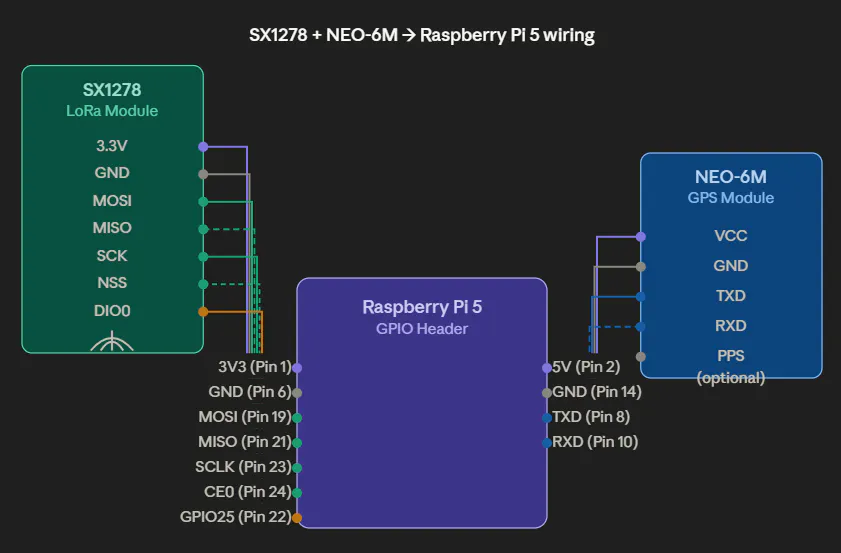
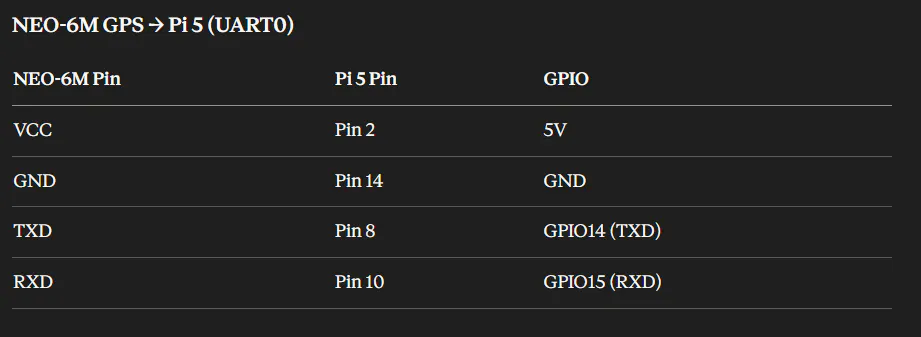
For location tracking, a NEO-6M GPS module is integrated into the system. It continuously provides accurate latitude and longitude coordinates, ensuring that every detected event can be precisely mapped to a real-world location.
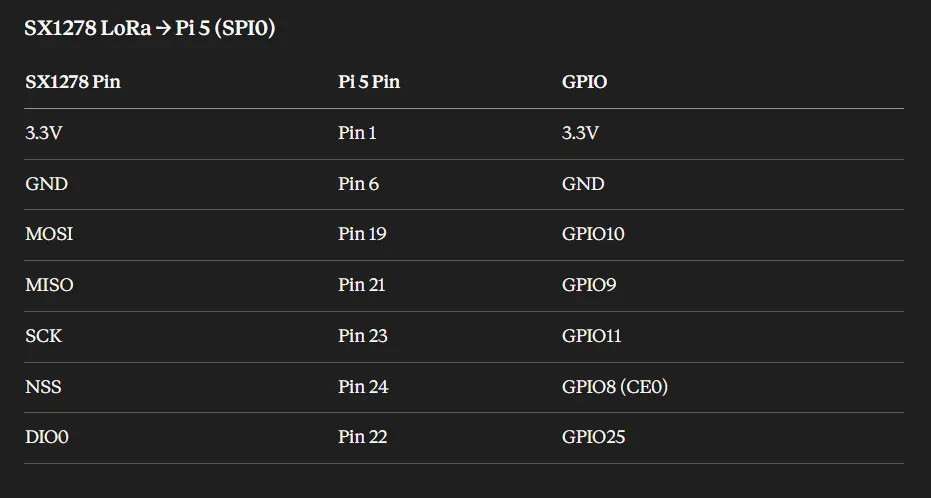
Communication between the remote device and the base station is handled using two SX1278 LoRa modules. This low-power, long-range communication technology was chosen because it is cost-effective and capable of transmitting data over approximately 5–7 km under suitable environmental conditions. It is ideal for deep forest deployments where cellular networks are unavailable.
The base station is built using a Seeed Studio XIAO ESP32-C3, another SX1278 LoRa module, a 1Ah Li-ion battery, and a Wi-Fi antenna. The ESP32-C3 receives incoming data from the field device via LoRa, processes it, and forwards it through Wi-Fi to a web dashboard for real-time monitoring and visualization.
For the enclosure, a generic ABS plastic case was used during the initial prototype phase. However, since it is not waterproof, I am currently working on designing a more robust, weatherproof enclosure to improve durability and ensure long-term outdoor deployment.
After what felt like a decade of debugging, rewiring, testing, and questioning every single connection, I finally managed to bring everything together into a working system 😄
For power supply, I am using a 2S3P Li-ion battery configuration. This setup consists of two cells in series and three cells in parallel, providing a balanced combination of higher voltage and increased capacity. The 2S arrangement ensures a stable output voltage suitable for powering the Raspberry Pi 5 and associated modules, while the 3P configuration increases the overall battery capacity, allowing longer operating time in remote environments.
This battery system is designed to support continuous operation of the device, including the camera, GPS module, LoRa communication, and AI-based processing. Since the system is deployed in a wildlife monitoring scenario where frequent maintenance is not possible, energy efficiency and stable power delivery are critical considerations.
The CAD designs for the improved waterproof enclosure, hardware integration, and the ML model and software components are currently under development and will be updated in the future.
I would also like to thank Avnet for selecting my project as one of the funded projects and for supporting its completion






Comments