



Hardware components | ||||||
| × | 1 | ||||
| × | 1 | ||||
| × | 1 | ||||
Software apps and online services | ||||||
 |
| |||||
The Internet of Things is entering its next phase of growth. Industry forecasts estimate that the number of connected IoT devices will increase from 17.7 billion in 2024 to more than 40 billion by 2034, driven by rapid adoption across industrial automation, agriculture, utilities, environmental monitoring, logistics, and smart infrastructure. As these deployments expand into remote and off-grid environments, efficient energy harvesting becomes a critical design requirement rather than an optional feature.
Many of these systems rely on compact solar panels and battery storage, where every additional watt harvested directly translates into longer uptime, improved reliability, and reduced maintenance costs. While Maximum Power Point Tracking (MPPT) is the industry standard for maximizing solar energy extraction, most commercially available MPPT controllers are designed for residential or rooftop solar installations, making them oversized, costly, or impractical for compact embedded electronics.
VIDYUT was developed to bridge this gap. It is a production-ready, compact MPPT solar charge controller engineered specifically for autonomous edge devices, remote IoT deployments, custom battery-powered systems, and embedded hardware that demand industrial-grade efficiency in a small form factor.
What Is VIDYUT?VIDYUT is a compact, highly efficient synchronous buck MPPT solar charge controller engineered specifically to keep remote IoT nodes, agricultural sensors, and heavy-duty field hardware powered 24/7. Designed around the Texas Instruments BQ24650 solar charging IC, it delivers high-accuracy, industrial-grade efficiency without the bulk. By tracking the true maximum power point in a field-ready form factor, VIDYUT eliminates the 30% energy waste of standard PWMs, ensuring your deployments stay online around the clock.
Key Capabilities
- Multi-Chemistry Battery Support: Built to handle any field deployment strategy, VIDYUT natively supports highly customizable charging profiles for Li-Ion, LiFePO4, and Sealed Lead-Acid (SLA) battery chemistries.
- High-Power 24/7 Load Driving: Unlike delicate, low-power sensor nodes, VIDYUT's synchronous buck topology is optimized for heavy field infrastructure, safely driving and sustaining continuous system loads of up to 210W in grueling, round-the-clock remote environments.
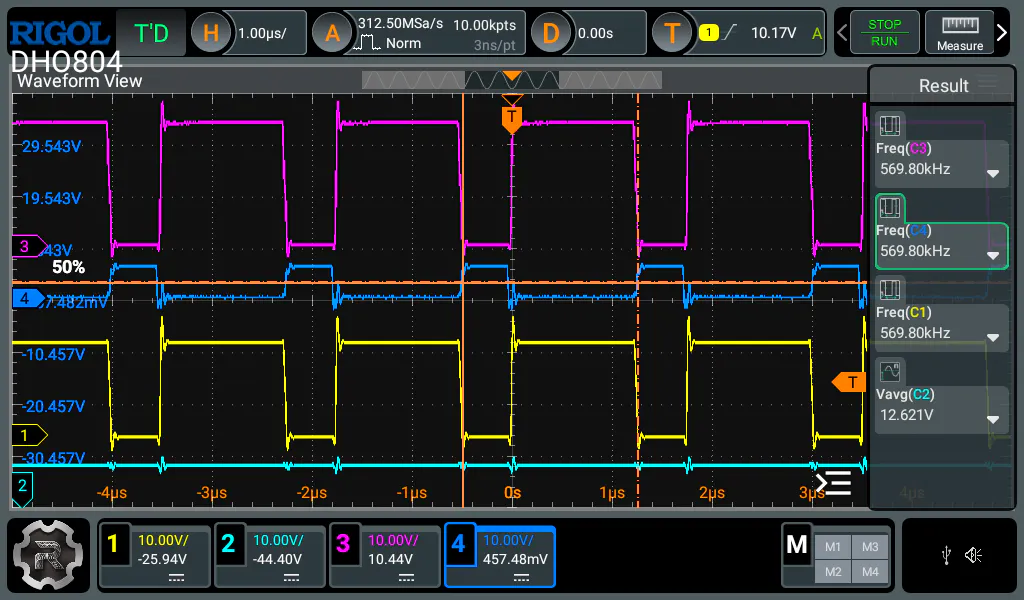
The BQ24650 uses a fractional VOC MPPT approach. On power-up, the IC briefly disconnects the panel to measure open-circuit voltage (VOC), then sets the MPPT regulation point at a programmable ratio of VOC — typically 76–80% for crystalline silicon panels, or 80–85% for thin-film.
This means the input voltage is continuously regulate to that fraction of VOC, keeping the panel operating near its maximum power point under varying irradiance and temperature. The MPPSET ratio is set entirely by an external resistor divider — no firmware, no microcontroller
Charge State Machine of BQ Chip -The IC handles the full multi-stage charge algorithm automatically:
- Pre-Charge — VBAT < 2.8 V → charges at 10% of ISET to safely recover deeply discharged cells
- Constant Current (CC) — bulk charging at full programmed ISET (up to 10 A)
- Constant Voltage (CV) — holds regulation voltage; current tapers to zero
- Charge Complete — terminates when ICHG < 10% of ISET for 1 ms
- Standby / Recharge — re-enters CC automatically if VBAT drops 150 mV below regulation
Chemistry selection and all voltage/current setpoints are configured purely through the external resistor network — the VFB divider, ISET resistor, and MPPSET divider. Swapping between LiFePO₄ ,Li-Ion, and Lead Acid is a resistor change, not a firmware flash.
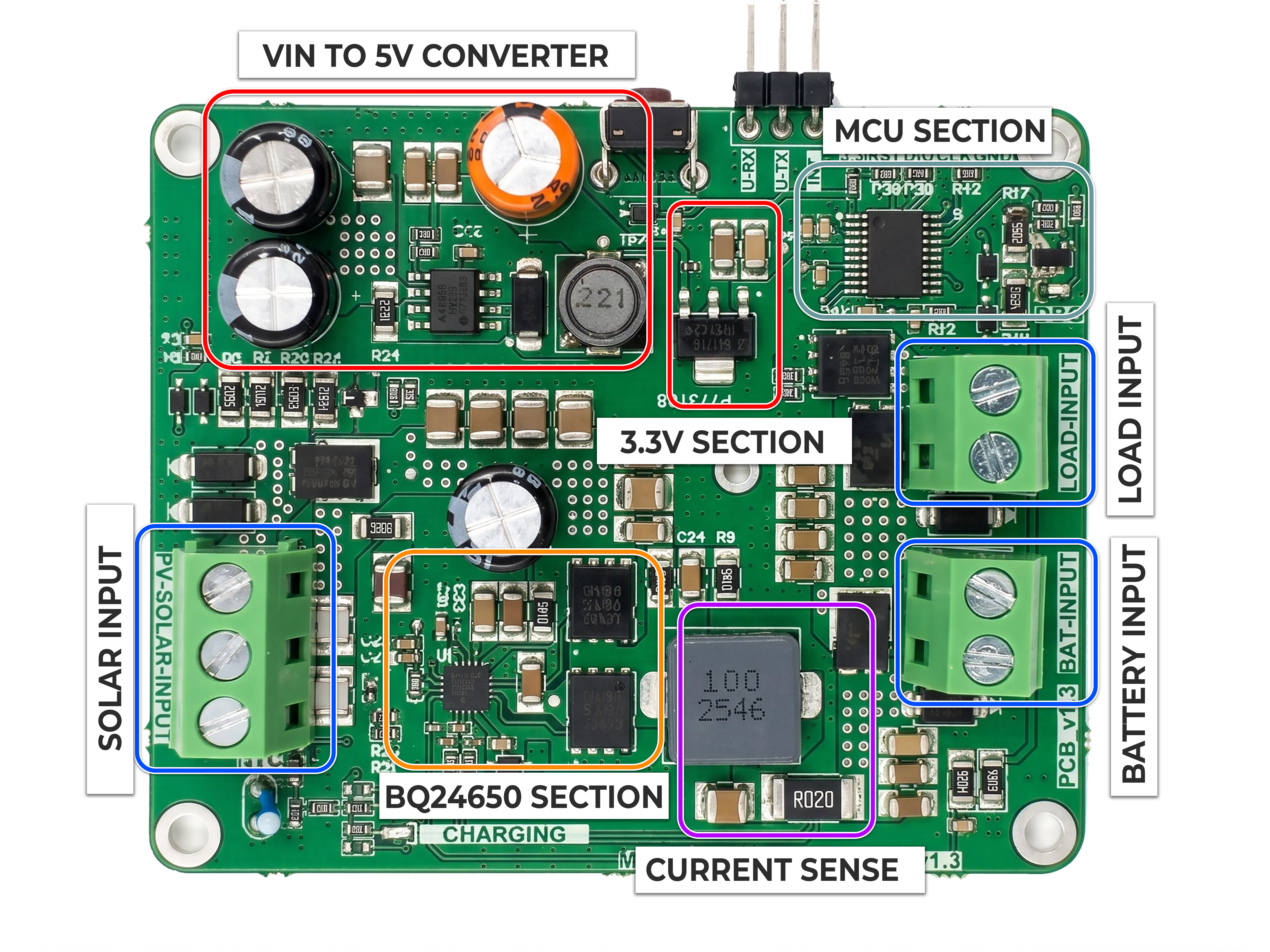
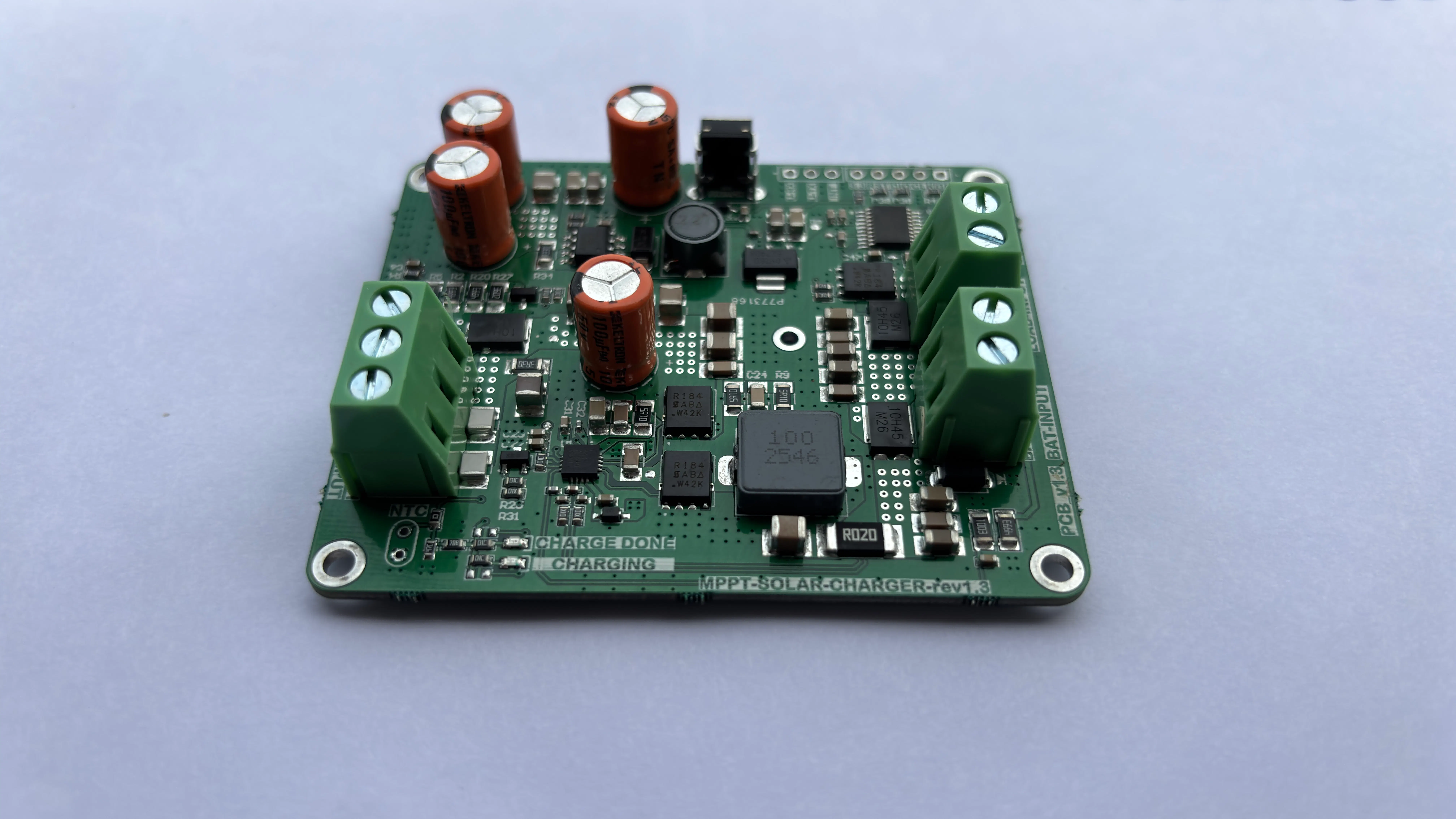
PCB Design Around The Texas Instruments IC -Top Layer - All the components are placed on the TOP SIDE of the PCBA.
Internal Layer L1 (GND) - Solid Unbroken GND plane ensuring low impedance return path
Internal VCC Power Plane (PWR)
Bottom Layer (GND + SIGNAL)
Every component in VIDYUT was selected for production-grade reliability, not just prototype availability:
- BQ24650 (Texas Instruments) - The core MPPT solar charger IC. Provides gate drive for both external MOSFETs, MPPT voltage regulation, charge current control, protection functions, and the STAT open-drain output for charge status indication.
- PCB Layout (BQ24650 Placement) -
- SIR184DP-T1-RE3 (Vishay) - N-channel power MOSFETs, 20.7A/ 73A (continuous/pulsed), in PPAK package. Two are used — one high-side, one low-side — forming the synchronous buck converter switch cell.
- SRP1038CC-100M (Bourns) — 10µH SMD power inductor, 8.5A rated, 32mΩ DCR. The energy storage element of the buck converter; physically large enough to handle full 5A ripple current without saturation.
- Current Sense Resistor Placement -
- CRA2512-FZ-R020ELF (Bourns) - 20mΩ, 1%, 3W current sense resistor in 2512 package. The precision shunt that the BQ24650 uses for charge current regulation and termination detection.
- STM32G030FCPCTR (STMicroelectronics) - ARM Cortex-M0+ microcontroller handling data logging, UART transmission, load section control, and peripheral monitoring. Runs alongside the BQ24G50 — the analog charging is handled entirely by the TI IC; the STM32 is the supervisory brain.
- Remote WSN / IoT Edge Nodes Environmental monitoring stations, long-range LoRa telemetry hubs, and edge-computing nodes where power interruption is not acceptable. VIDYUT's MPPT efficiency and compact footprint make it a natural fit for custom solar-powered enclosures.
- Field Agriculture & Precision Farming Localized weather tracking, automated irrigation valve controllers, and soil monitoring nodes — all of which need reliable charging without access to mains power.
- Smart Solar Street Lights & Surveillance Non-stop camera and lighting loads demand an MPPT controller with robust protection. VIDYUT includes overvoltage, short circuit, and over-temperature protection natively.
- High-Load Remote Deployments Remote communication relays, field radio equipment, and motorized camera pan-tilts — up to 210W of load drive capability via the dedicated MOSFET control path.


Comments