



Industrial equipment such as PLCs, energy meters, sensors, and controllers often use Modbus RTU or Modbus TCP for communication.
However, most modern IoT platforms are based on MQTT, HTTP, or cloud APIs. Connecting existing industrial devices to these platforms requires a bridge between field protocols and cloud communication.
In this project, we will use the EM300 Edge Gateway to build a simple industrial data acquisition system:
- Collect data from Modbus RTU/TCP devices
- Process industrial data at the edge
- Convert Modbus data into MQTT messages
- Send device data to an IoT platform
The gateway works as the communication bridge between industrial equipment and modern IoT systems.
Hardware RequiredWhat is Modbus?Modbus is one of the most widely used industrial communication protocols.
It was originally developed for PLC communication and has been widely adopted in industrial automation systems.
Today, Modbus can be found in:
- PLCs
- Power meters
- Temperature controllers
- Water meters
- Sensors
- Industrial instruments
Why is Modbus still popular after decades?
OpenModbus is an open protocol. Manufacturers can implement it without licensing fees.
SimpleThe register-based communication model makes it easy to configure and troubleshoot.
CompatibleA large number of industrial devices support Modbus, making it one of the most practical protocols for industrial integration.
Modbus RTU vs Modbus TCPModbus is mainly used in two communication modes:
In real industrial projects, both protocols often exist together.
For example:
- Energy meters may use Modbus RTU over RS485
- PLCs may use Modbus TCP over Ethernet
An industrial gateway allows these devices to connect to the same IoT system.
How EM300 Works as a Modbus IoT GatewayThe EM300 performs three main tasks:
1. Collect Modbus DataThe gateway reads data from field devices according to the configured register map.
Example:
Energy meter registers:
Voltage
Current
Power
Energy Consumption
PLC registers:
Machine Status
Production Data
Alarm Information
Raw Modbus registers are converted into meaningful engineering values.
For example:
Register Value

        ↓

Data Parsing

        ↓

220.5 V
5.2 A
1146 W
The gateway handles data conversion before sending information to cloud systems.
3. Upload Data Through MQTTAfter processing, the gateway publishes standardized data through MQTT.
Example MQTT message:
{
    "device": "energy_meter_01",
    "voltage": 220.5,
    "current": 5.2,
    "power": 1146
}
The IoT platform can then visualize, analyze, and manage industrial equipment remotely.
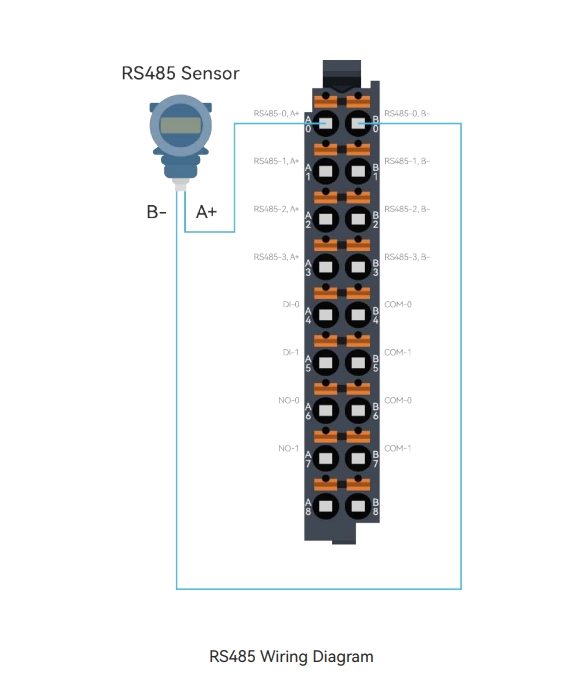
Hardware ConnectionModbus RTU ConnectionConnect the RS485 interface:
Modbus Device          EG8200

A / D+     ----------   RS485 A+

B / D-     ----------   RS485 B-

GND        ----------   GND
Make sure:
- RS485 polarity is correct
- Device address is configured correctly
- Baud rate matches both sides
Prepare the device communication parameters:
Example:
Slave ID: 1

Baud Rate: 9600

Data Format:
8 Data Bits
No Parity
1 Stop Bit
Configure the registers that need to be collected.
Example:
The gateway reads these registers periodically.
Step 3: Configure MQTT CommunicationSet MQTT connection parameters:
MQTT Broker Address

Client ID

Topic

Username / Password
The gateway will publish collected industrial data to the MQTT server.
Industrial ApplicationsSmart FactoryFactories often contain many PLCs and controllers from different manufacturers.
A Modbus gateway can collect:
- Machine status
- Production information
- Alarm records
and send data to MES or IoT platforms.
Energy MonitoringPower meters commonly use Modbus RTU.
The gateway can collect:
- Voltage
- Current
- Power factor
- Energy consumption
and upload the data to an energy management system.
Building AutomationSmart buildings use many devices:
- HVAC controllers
- Power meters
- Sensors
- Lighting systems
A gateway provides unified communication between field devices and BMS or cloud platforms.
Power AutomationSome power systems require IEC 60870-5-104 communication.
A gateway can convert Modbus device data into utility protocols for SCADA integration.
Why Use an Industrial Modbus Gateway Instead of Replacing Devices?Many industrial systems have equipment that has been running for years.
Replacing existing PLCs, meters, and controllers can cause:
- Production downtime
- High engineering cost
- System re-validation
A Modbus IoT gateway provides a simpler approach:
Existing Equipment

        +

Industrial Gateway

        +

IoT Platform
The original equipment can continue operating while gaining modern IoT connectivity.
Choosing a Modbus IoT GatewayImportant features include:
Support Multiple Modbus ModesA practical gateway should support:
- Modbus RTU
- Modbus TCP
because real projects often contain both types of devices.
Industrial Communication InterfacesIndustrial environments require:
- Isolated RS485
- Reliable Ethernet
- Stable power design
to ensure long-term operation.
Cloud ConnectivityModern industrial gateways should support:
- MQTT
- HTTP
- Industrial protocols
for easy integration with IoT platforms.
Edge Processing CapabilityEdge computing allows the gateway to:
- Filter unnecessary data
- Process information locally
- Reduce cloud traffic
- Improve response time
Yes.
An industrial gateway converts Modbus data into MQTT or HTTP messages, allowing existing industrial devices to connect to cloud platforms.
Do I need to replace my PLCs for IoT integration?No.
A gateway can collect data from existing PLCs without changing the PLC program.
What is the difference between a Modbus gateway and a protocol converter?A protocol converter usually performs simple protocol translation.
An industrial IoT gateway provides more functions:
- Data acquisition
- Edge processing
- MQTT communication
- Remote monitoring
- Industrial protocol integration
Yes.
Many industrial gateways support both RS485 Modbus RTU devices and Ethernet Modbus TCP devices in the same system.
ConclusionModbus remains one of the most important industrial communication protocols because millions of PLCs, meters, and sensors are already deployed worldwide.
The challenge is not replacing these devices, but connecting them to modern IoT platforms.
With an industrial gateway such as EM300, existing Modbus equipment can be connected to MQTT-based IoT systems, enabling remote monitoring, data analysis, and smart industrial applications.
Modbus connects field devices.MQTT connects tothe cloud.The industrial gateway connects them.


Comments