



Hardware components | ||||||
 |
| × | 1 | |||
 |
| × | 1 | |||
 |
| × | 1 | |||
 |
| × | 1 | |||
Software apps and online services | ||||||
 |
| |||||
Hand tools and fabrication machines | ||||||
 |
| |||||
The Guardian Grip is a non-invasive, low-power wearable device built around the Raspberry Pi Pico (RP2040) microcontroller. Unlike typical fitness trackers that just collect and log data, the Guardian Grip's purpose is simple and life-critical: it continuously monitors Blood Oxygen Saturation (SpO2) and actively intervenes to promote user safety and recovery.
Designed to be worn during periods of vulnerability, such as sleep or stressful, high-altitude activities, it serves as a robust, real-time guardian against a dangerous condition known as Nocturnal Hypoxia.
Why Did You Decide to Make It?The primary motivation behind the Guardian Grip is to address the risk of Nocturnal Hypoxia—a condition where blood oxygen levels drop critically low during sleep. This is often associated with sleep apnea, but can also be triggered by high altitude, certain medications, or respiratory illness.
We recognized two major shortcomings in existing personal monitors:
Passive Monitoring: Most devices simply record data. If a user experiences a critical oxygen drop in the middle of the night, the log file won't help them in that moment.
- Passive Monitoring: Most devices simply record data. If a user experiences a critical oxygen drop in the middle of the night, the log file won't help them in that moment.
The Need for Active Safety: The Guardian Grip is built for active intervention. By integrating the RP2040’s serial output with a Smart Home warning system, we can trigger immediate safety actions. This goes beyond a simple local alarm—it can turn on lights, adjust the thermostat, or send alerts to caregivers. The device’s local buzzer is the first line of defense, but the digital signal is the link to broader safety protocols.
- The Need for Active Safety: The Guardian Grip is built for active intervention. By integrating the RP2040’s serial output with a Smart Home warning system, we can trigger immediate safety actions. This goes beyond a simple local alarm—it can turn on lights, adjust the thermostat, or send alerts to caregivers. The device’s local buzzer is the first line of defense, but the digital signal is the link to broader safety protocols.
The system is a tight integration of a powerful microcontroller and specialized sensors.
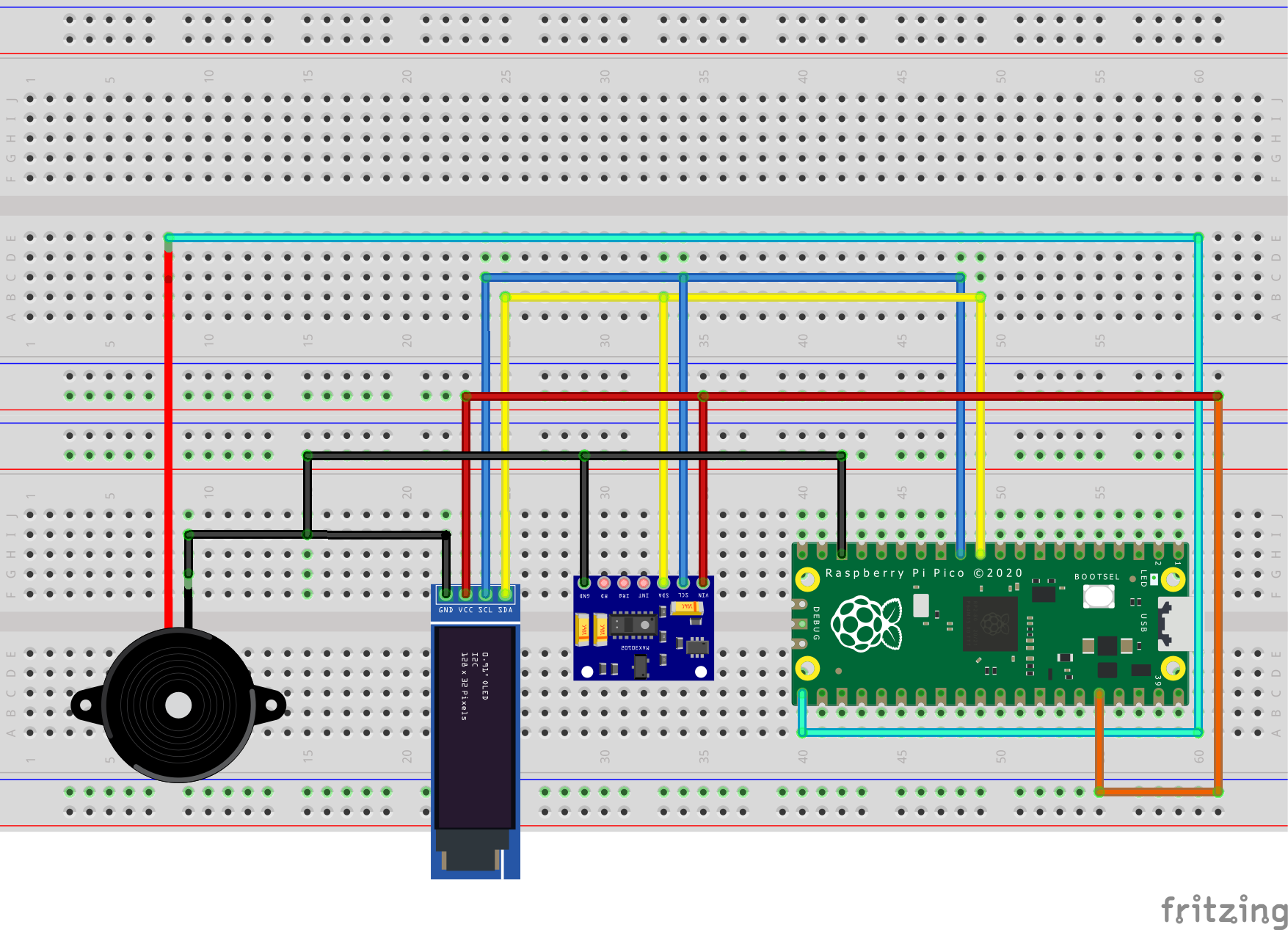
The Hardware AssemblyThe entire system relies on three main components connected via the RP2040.
The Brain (RP2040): The Raspberry Pi Pico is fast and energy-efficient. It runs the core logic, which involves signal processing and filtering.
- The Brain (RP2040): The Raspberry Pi Pico is fast and energy-efficient. It runs the core logic, which involves signal processing and filtering.
The Sensor (MAX30102): This module uses photoplethysmography (PPG) to measure SpO2. It shines red and infrared light into the tissue (like a fingertip) and measures how much light is absorbed. The ratio of red-to-infrared absorption tells us the oxygen saturation level.
- The Sensor (MAX30102): This module uses photoplethysmography (PPG) to measure SpO2. It shines red and infrared light into the tissue (like a fingertip) and measures how much light is absorbed. The ratio of red-to-infrared absorption tells us the oxygen saturation level.
The Interface (OLED and Buzzer): A small 128x32 SSD1306 OLED display shows real-time data (SpO2, Heart Rate, and a live waveform). A simple buzzer provides an immediate, localized audible alarm if needed.
- The Interface (OLED and Buzzer): A small 128x32 SSD1306 OLED display shows real-time data (SpO2, Heart Rate, and a live waveform). A simple buzzer provides an immediate, localized audible alarm if needed.
The real power is in the software, which is far more complex than a basic data logger. The code includes several robust features to ensure reliability:
1. Robust Contact and Validity ChecksThe device doesn't just display a number when you put your finger on it. It ensures stable contact for several seconds and validates the signal quality (checking the AC and DC signal components) before it begins recording. If the finger slips or the reading becomes statistically invalid (e.g., SpO2 below 70%), the device halts recording and triggers a warning, preventing false alarms.
2. Alert HysteresisWe avoid momentary false alarms. The code implements a sustained low timer (ALARM_DELAY_MS). If the SpO2 drops below the warning threshold (e.g., 90%) for a sustained period (like 5 seconds), only then does the full alarm sequence begin. This activates the buzzer and, crucially, sends the real-time safety event.
The RP2040 communicates critical events over its serial port using structured JSON data. This is the key to integration:
{"event":"SPO2_ALERT","state":"ON","spo2":89,"hr":55}A companion system (like a small single-board computer or gateway) listens to this JSON data, allowing us to immediately trigger smart plugs, voice alerts, or other safety routines in the surrounding environment.
4. Display Rotation and StatsThe OLED display automatically rotates between pages showing the current SpO2, Heart Rate, a live waveform, and summary statistics of the current session (min/max/average SpO2).
The Future of InterventionThe Guardian Grip moves SpO2 monitoring from being a diagnostic tool to an active safety device. By focusing on real-time signal validation and immediate external alerting, we ensure the user is protected not just with data, but with intervention when it matters most.


_1x_bGT19vVAby.png?auto=compress%2Cformat&w=40&h=40&fit=fillmax&bg=fff&dpr=2)


Comments