


Hardware components | ||||||
| × | 1 | ||||
 |
| × | 2 | |||
| × | 1 | ||||
 |
| × | 1 | |||
Software apps and online services | ||||||
| ||||||
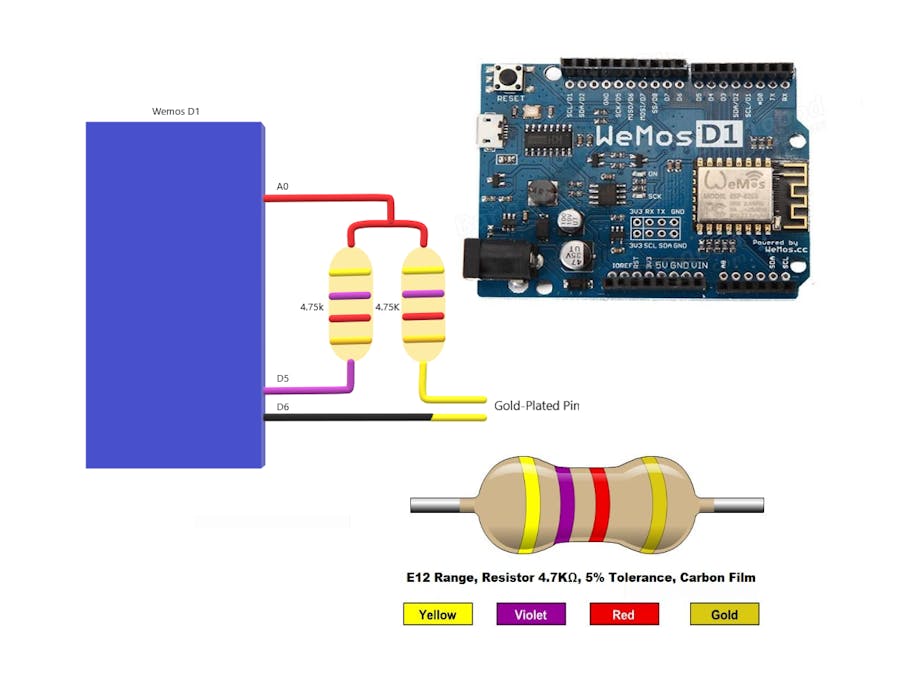
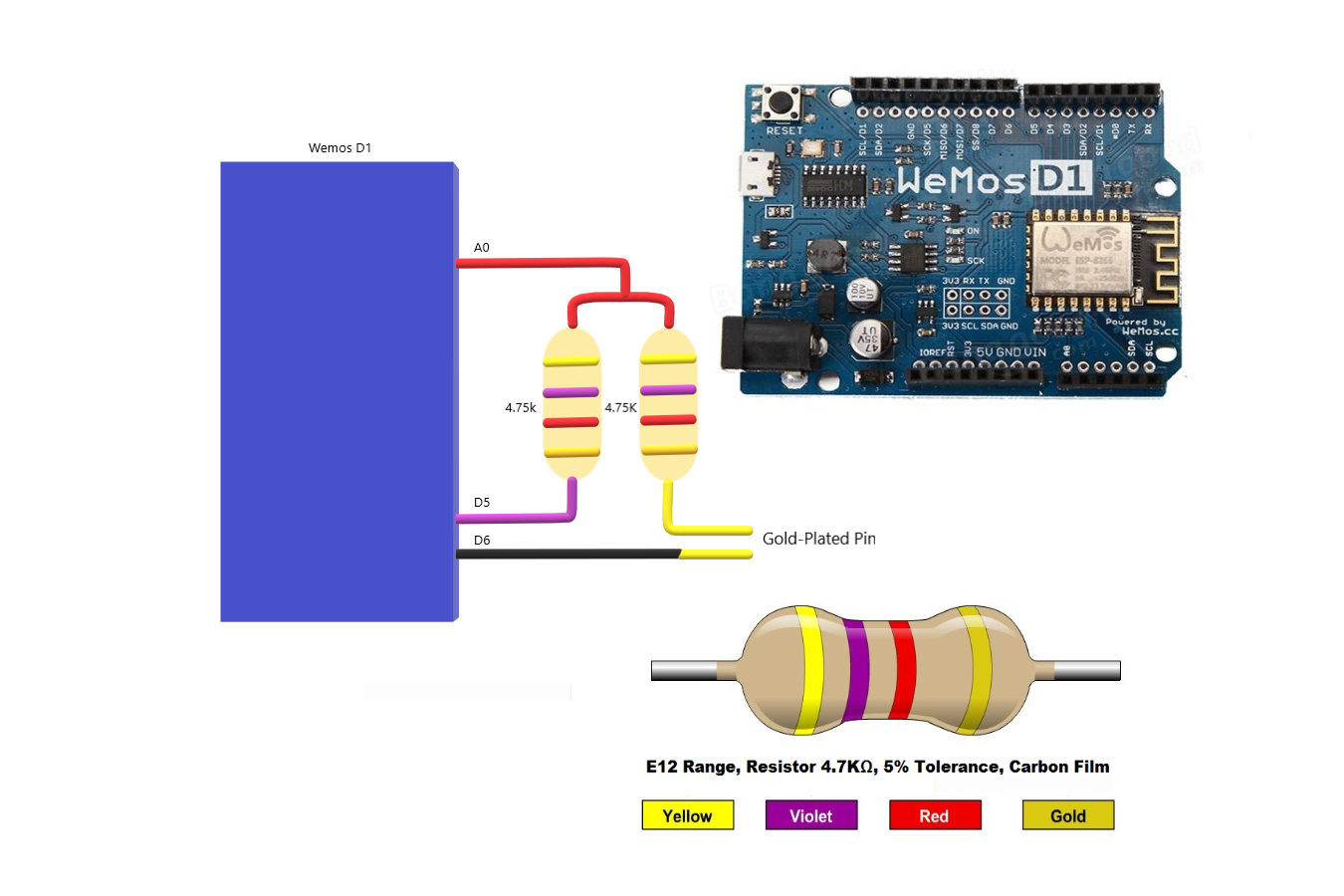
Here we are using gold-plated pins, 4.75K ohm 2 resistors and Wemos D1 microcontroller.
- 11 digital input/output pins, all pins have interrupt/pwm/I2C/one-wire supported(except for D0)
- 1 analog input(3.2V max input)
- Micro USB connection
- Power jack, 9-24V power input.
- Compatible with Arduino
- Compatible with nodemcu
Microcontroller --> ESP-8266EX
Operating Voltage --> 3.3V
Digital I/O Pins --> 11
Analog Input Pins --> 1(Max input: 3.2V)
Clock Speed --> 80MHz/160MHz
Flash --> 4M bytes
Length --> 68.6mm
Width --> 53.4mm
Weight --> 25g
PinsPin | Function | ESP-8266
TX | TXD | TXD
RX | RXD | RXD
A0 | Analog input, max 3.3V input | A0
D0 | IO | GPIO16
D1 | IO, SCL | GPIO5
D2 | IO, SDA | GPIO4
D3 | IO, 10k Pull-up | GPIO0
D4 | IO, 10k Pull-up, BUILTIN_LED | GPIO2
D5 | IO, SCK | GPIO14
D6 | IO, MISO | GPIO12
D7 | IO, MOSI | GPIO13
D8 | IO, 10k Pull-down, SS | GPIO15
G | Ground | GND
5V | 5V | -
3V3 | 3.3V | 3.3V
RST | Reset | RST

#include <SoftwareSerial.h>
SoftwareSerial mySerial(12, 13); // RX, TX

#include <ESP8266WiFi.h>          //https://github.com/esp8266/Arduino
#include <DNSServer.h>
#include <ESP8266WebServer.h>
#include "WiFiManager.h"          //https://github.com/tzapu/WiFiManager
#include <WiFiClientSecure.h>

int count=0,i,m,j,k;

#define sensorPin A0
#define port1 D5
#define port2 D6

int sensorValue1,sensorValue2,sensorValue3,sensorValue4;
int delaytime = 1000;

//////////////////////////////////////// ALL DECLARATIONS for CLOUD //////////////////////////////
const char* host = "api.thingsai.io";                                 // OR host = devapi2.thethingscloud.com
const char* post_url = "/devices/deviceData";       // OR /api/v2/thingscloud2/_table/data_ac
const char* time_server = "baas.thethingscloud.com";             //this is to convert timestamp
const int httpPort = 80;
const int httpsPort = 443;
const char*  server = "api.thingsai.io";  // Server URL

char timestamp[10];

WiFiClient client;


/////////////////////////////////////////////////////////////////////////////////////////////////////////
void configModeCallback (WiFiManager *myWiFiManager)
{
  Serial.println("Entered config mode");             //*-*-*-*-*-*-*-*-*-*-*-*-*-*if control enters this function then net is not connected
  Serial.println(WiFi.softAPIP());                  // "WiFi.softAPIP() is for AP" , "WiFi.localIP() is for STA",

  Serial.println(myWiFiManager->getConfigPortalSSID());             //if you used auto generated SSID, print it
}
/////////////////////////////////////// TIMESTAMP CALCULATION function///////////////////////////////////////
int GiveMeTimestamp()
{
  unsigned long timeout = millis();

  while (client.available() == 0)
  {
    if (millis() - timeout > 50000)
    {
      client.stop();
      return 0;
    }
  }

while (client.available())
      {
        String line = client.readStringUntil('\r');                    //indexOf() is a funtion to search for smthng , it returns -1 if not found
        int pos = line.indexOf("\"timestamp\"");                       //search for "\"timestamp\"" from beginning of response got and copy all data after that , it'll be your timestamp
        if (pos >= 0)
        {
          int j = 0;
          for(j=0;j<10;j++)
          {
            timestamp[j] = line[pos + 12 + j];
          }
        }
      }
}
////////////////////////////////////////////////////////////////////////////////////////////////////////

void setup()
{
  Serial.begin(115200);     //(19200,SERIAL_8E1) - data size = 8 bits , parity = Even , stop bit =  1bit
  mySerial.begin(115200);
  WiFiManager wifiManager;

  wifiManager.setAPCallback(configModeCallback);

  if(!wifiManager.autoConnect("DDIK Makadia","kidd123456789"))                   //wifiManager.autoConnect("AP-NAME", "AP-PASSWORD"); (OR) wifiManager.autoConnect("AP-NAME"); only ID no password (OR) wifiManager.autoConnect(); this will generate a ID by itself
  {
    Serial.println("failed to connect and hit timeout");     //control comes here after long time of creating Access point "NodeMCU" by NodeMCU and still it has not connected
    //reset and try again, or maybe put it to deep sleep
    ESP.reset();
    delay(1000);
  }

  //if you come here you have connected to the WiFi
  Serial.println("connected...");

  pinMode(port1,OUTPUT);
  pinMode(port2,OUTPUT);
}

void loop()
{


/////////////////////////////////////// SEND THE QUERY AND RECEIVE THE RESPONSE///////////////////////
    // start
   digitalWrite(LED_BUILTIN, HIGH);
   //port LL
   digitalWrite(port1, LOW);
   digitalWrite(port2, LOW);
   sensorValue1 = analogRead(sensorPin);
   delay(delaytime);
   //port LH
   digitalWrite(port1, LOW);
   digitalWrite(port2, HIGH);
   sensorValue2 = analogRead(sensorPin);
   delay(delaytime);
   digitalWrite(LED_BUILTIN, LOW);
   //port HH
   digitalWrite(port1, HIGH);
   digitalWrite(port2, HIGH);
   sensorValue3 = analogRead(sensorPin);
   delay(delaytime);
   //port HL
   digitalWrite(port1, HIGH);
   digitalWrite(port2, LOW);
   sensorValue4 = analogRead(sensorPin);
   delay(delaytime);
   Serial.print(sensorValue1);
   Serial.print(",");
   Serial.print(sensorValue2);
   Serial.print(",");
   Serial.print(sensorValue3);
   Serial.print(",");
   Serial.print(sensorValue4);
   Serial.println();

   Serial.print("connecting to ");
   Serial.println(host);                          //defined upside :- host = devapi2.thethingscloud.com or 139.59.26.117

///////////////////////////////////// TIMESTAMP CODE SNIPPET /////////////////////////
  Serial.println("inside get timestamp\n");
  if (!client.connect(time_server, httpPort))
  {
    return;                                                        //*-*-*-*-*-*-*-*-*-*
  }

  client.println("GET /api/timestamp HTTP/1.1");                            //Whats this part doing, i didnt get
  client.println("Host: baas.thethingscloud.com");
  client.println("Cache-Control: no-cache");
  client.println("Postman-Token: ea3c18c6-09ba-d049-ccf3-369a22a284b8");
  client.println();

GiveMeTimestamp();                        //it'll call the function which will get the timestamp response from the server
Serial.println("timestamp receieved");
Serial.println(timestamp);
///////////////////////////////////////////////////////////////////////////////

  Serial.println("inside ThingsCloudPost");


  String PostValue = "{\"device_id\":  61121696034, \"slave_id\": 2";
         PostValue = PostValue + ",\"dts\":" +timestamp;
   PostValue = PostValue +",\"data\":{\"SensorValue1\":" + sensorValue1 +",\"SensorValue2\":" + sensorValue2 +",\"SensorValue3\":" + sensorValue3 +",\"SensorValue4\":" + sensorValue4 +"}"+"}";


  Serial.println(PostValue);

/* create an instance of WiFiClientSecure */
    WiFiClientSecure client;

    Serial.println("Connect to server via port 443");
    if (!client.connect(server, 443)){
        Serial.println("Connection failed!");
    } else {
        Serial.println("Connected to server!");
        /* create HTTP request */

        client.println("POST /devices/deviceData HTTP/1.1");
        client.println("Host: api.thingsai.io");
        //client.println("Connection: close");
        client.println("Content-Type: application/json");
        client.println("cache-control: no-cache");
        client.println("Authorization: Bearer eyJ0eXAiOiJKV1QiLCJhbGciOiJIUzI1NiJ9.IjVhMzBkZDFkN2QwYjNhNGQzODkwYzQ4OSI.kaY6OMj5cYlWNqC2PNTkXs9PKy6_m9tdW5AG7ajfVlY");
        client.print("Content-Length: ");
        client.println(PostValue.length());
        client.println();
        client.println(PostValue);
//////////////////////////////////POSTING the data on to the cloud is done and now get the response form cloud server//////////////////
 Serial.print("Waiting for response ");
        while (!client.available()){
            delay(50); //
            Serial.print(".");
        }
        /* if data is available then receive and print to Terminal */
        while (client.available()) {
            char c = client.read();
            Serial.write(c);
        }

        /* if the server disconnected, stop the client */
        if (!client.connected()) {
            Serial.println();
            Serial.println("Server disconnected");
            client.stop();
        }
    }
Serial.println("//////////////////////    THE END     /////////////////////");
delay(3000);
}



Comments