


Hardware components | ||||||
 |
| × | 1 | |||
 |
| × | 1 | |||
 |
| × | 1 | |||
| × | 1 | ||||
| × | 1 | ||||
Software apps and online services | ||||||
 |
| |||||
 |
| |||||
Every restaurant has the same doorway moment.
You arrive, look inside, and wonder:
Is there actually a table available?
You might look around, ask a staff member, or simply walk away if the restaurant looks full.
A sign saying OPEN doesn't tell you much. A sign saying FULL helps a little.
But what if the restaurant could tell you what is available right now, and when an occupied table might become free?
That's the idea behind NEXORA.
What is NEXORA?NEXORA transforms traditional restaurant signage into an intelligent, connected system that understands the current state of the seating area and communicates it to customers and restaurant staff.
For this prototype, I deployed NEXORA at Auntyno-Z-Pizza, where customers order at the front counter while the seating area is further inside.
A Seeed reTerminal E1002 ePaper display is placed at the counter to provide a quick overview of the seating situation.
It can show:
- Available and occupied tables
- Current seating duration
- Estimated time until a table becomes free
- Availability of other branches
- Restaurant information such as today's special
The goal is simple:
Give customers useful information before they have to ask for it.
It Doesn't Just Report — It PredictsA basic occupancy system can tell you:
"Table 4 is occupied."
NEXORA tries to answer the more useful question:
"When is Table 4 likely to become available?"
Each occupied table generates a session containing its start time and eventual end time. As historical data accumulates, NEXORA learns the typical dwell time of different seating configurations.
The prediction is based on the observed history rather than an assumed distribution.
For a table that has already been occupied for a certain amount of time, the system looks only at previous sessions that lasted at least that long and estimates the probability of the table becoming free within the next few minutes.
This makes the prediction change naturally as the current session gets longer.
More importantly, NEXORA is designed not to pretend when it doesn't have enough evidence.
If there are too few comparable historical sessions, no probability is shown. The displayed confidence is also capped rather than presenting false certainty.
A prediction is only useful if people can trust it.
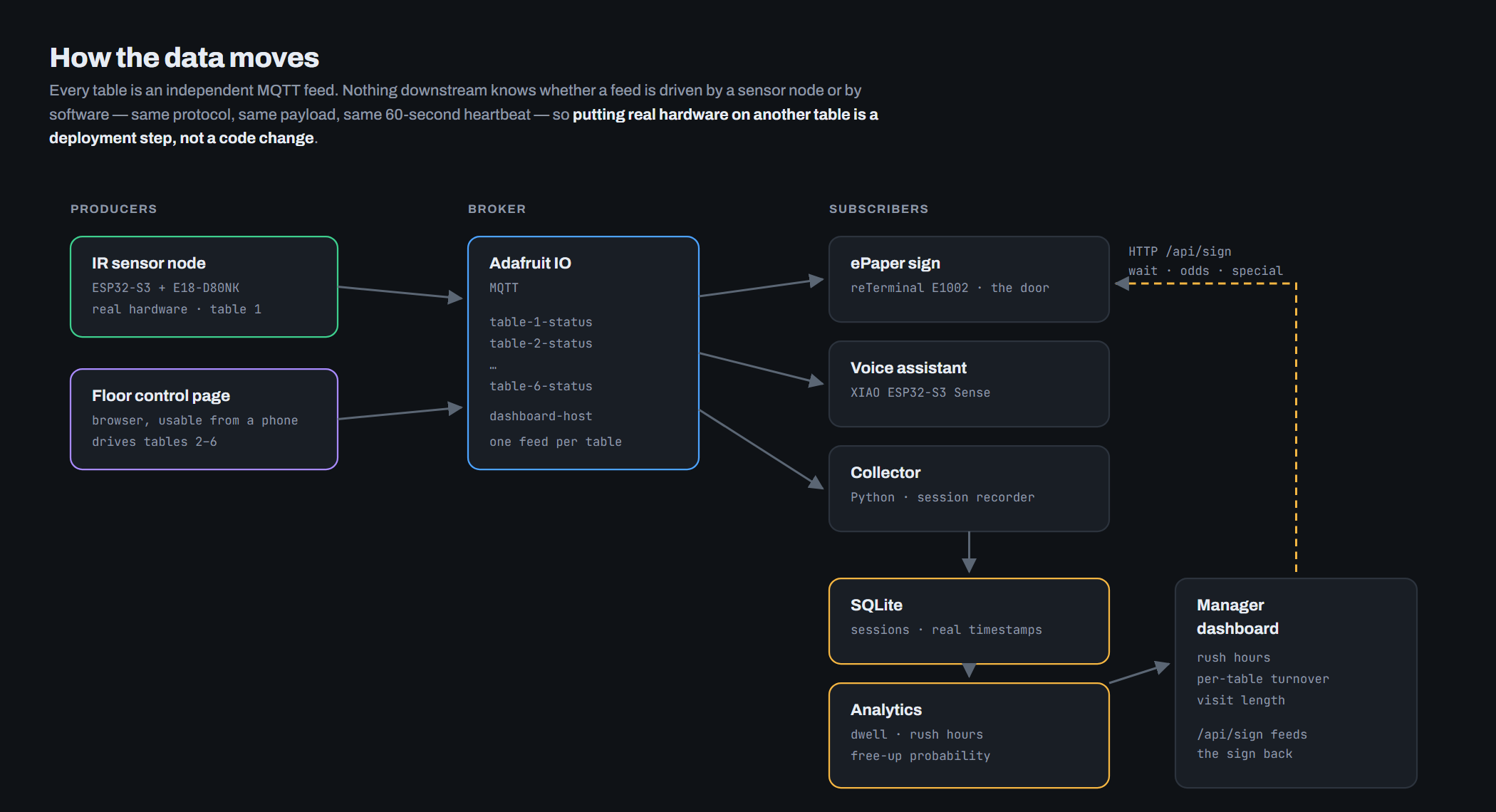
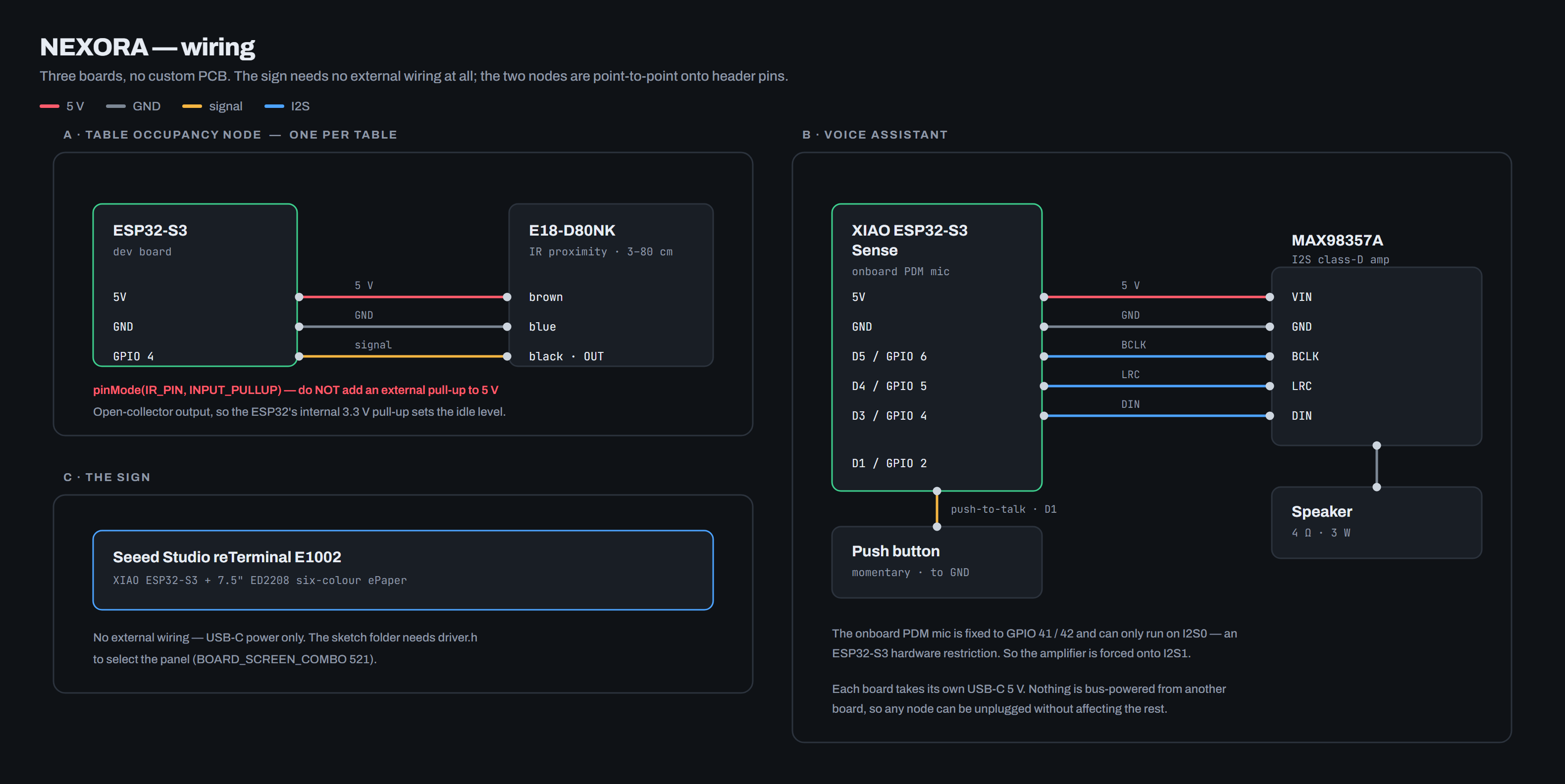
How It WorksEach table is monitored using an ESP32-S3 and an E18-D80NK infrared proximity sensor.
When a customer sits down:
Sensor → ESP32-S3 → MQTT → NEXORA
The table status is published through Adafruit IO MQTT, allowing the same live information to reach multiple parts of the system.
This means the ePaper display and voice assistant are working from the same live restaurant state.
The ePaper display provides information visually, but customers can also interact with NEXORA using voice.
A second XIAO ESP32-S3 Sense acts as the voice interface.
A customer can ask:
"Is table three occupied?"
The system identifies the request, checks the current table state, and responds using the live data.
This is important because the voice assistant isn't simply guessing an answer.
It is connected to the same restaurant data that drives the display.
So if the display says Table 3 — Occupied, the voice assistant should never tell the customer that it is free.
From Live Data to Restaurant IntelligenceThe same information that helps customers can also help the restaurant.
Occupancy events can be stored as historical data and used to understand:
- Average customer stay
- Peak hours
- Table utilization
- Weekday vs weekend patterns
- Table turnover
- Seating-area popularity
Instead of only asking:
"How busy are we right now?"
the restaurant can start answering:
"How is our space actually being used?"
This can help managers make better decisions about staffing, seating arrangements, and customer flow.
Why Interactive Signage?Traditional signage displays information.
NEXORA understands information about the physical space and communicates it back to people.
The sensors observe the environment.
MQTT connects the system.
The ePaper informs customers.
The voice assistant lets them interact.
And the historical data creates insights for the restaurant.
The result is not just a digital sign.
It is an interactive interface between people and the physical space around them.
Beyond RestaurantsAlthough NEXORA currently focuses on restaurant seating, the underlying idea can be applied to many other environments.
Libraries could show available study spaces.
Coworking spaces could show available desks.
Hospitals could communicate waiting-area availability.
Airports and public venues could provide real-time information about available spaces.
The core idea remains the same:
Sense → Connect → Understand → Communicate.


Comments