


Hardware components | ||||||
 |
| × | 80 | |||
 |
| × | 80 | |||
 |
| × | 80 | |||
 |
| × | 1 | |||
 |
| × | 1 | |||
 |
| × | 1 | |||
| × | 1 | ||||
| × | 1 | ||||
 |
| × | 1 | |||
| × | 5 | ||||
| × | 5 | ||||
| × | 1 | ||||
| × | 2 | ||||
 |
| × | 1 | |||
| × | 1 | ||||
 |
| × | 1 | |||
 |
| × | 1 | |||
| × | 1 | ||||
| × | 1 | ||||
 |
| × | 1 | |||
 |
| × | 1 | |||
 |
| × | 1 | |||
| × | 1 | ||||
 |
| × | 1 | |||
| × | 30 | ||||
| × | 1 | ||||
| × | 1 | ||||
Software apps and online services | ||||||
 |
| |||||
Hand tools and fabrication machines | ||||||
 |
| |||||
I have always been fascinated by the moment when theory stops being abstract and starts blinking, beeping, and streaming real data. That moment is where real learning happens. As a maker from Brazil, deeply passionate about computing, hardware, and space systems, I wanted to create something that could bring orbital thinking down to the classroom bench.
That idea eventually became SALGSAT - STEM Applied Learning Ground Satellite, a one unit educational CubeSat designed not to fly into orbit, but to do something just as powerful. It lets students interact with the core concepts behind real satellites using hardware they can actually touch, rotate, measure, and question.
The project started with a simple observation. Space education is often either too theoretical or too expensive. Many students learn about satellites through slides and diagrams but never experience telemetry, attitude sensing, or onboard data systems in a hands on way. At the same time, real space hardware is far beyond the budget and safety envelope of most schools and labs.
SALGSAT was designed to sit exactly in that gap.
At its core, this is a fully self contained one unit CubeSat platform built around an ESP8266 microcontroller. It operates as its own WiFi access point, hosts a local web interface, and continuously reads a suite of environmental and inertial sensors. While it remains safely on the ground, the system behavior mirrors many of the data flows and operational patterns you would find in an actual small satellite mission.
⚙️ Why on Earth an ESP8266 in 2026?Yes, I know. Somewhere out there an ESP32 just felt personally offended.
The choice of the ESP8266 for V1 is very intentional. From a functional standpoint, it already does everything this little CubeSat-inspired platform actually needs: solid Wi-Fi telemetry, reliable sensor polling, and clean duty-cycled operation. No drama required.
More importantly, the ESP8266 comes with something that is increasingly rare in modern hardware: useful constraints. With less headroom and fewer peripherals to hide behind, it forces you to think carefully about timing, memory, data flow, and overall software efficiency. For an educational platform, that is pure gold.
There is also a boots-on-the-ground reality. Here in Brazil, ESP8266 boards are still widely available at roughly half the price of most ESP32 variants. Neither chip is expensive in absolute terms, but that price gap matters when the goal is to build something students and makers can actually replicate without wincing at the parts list.
Will there be an ESP32 version? Yes!!! When V2 starts pushing more peripherals, BLE, or heavier onboard processing, the ESP32 family is the obvious next step.
But for V1, the humble ESP8266 hits a very nice sweet spot: capable, cheap, well understood, and just constrained enough to keep us honest.
The goal was never to build a toy. The goal was to build something approachable but technically honest.
When students pick it up and rotate the structure, they are not watching a canned animation. They are seeing live fused sensor data. When they connect to the onboard web interface, they are not opening a mock dashboard. They are interacting with a real embedded web server running on the device itself.
This distinction matters.
Because once the hardware becomes real, the questions become real too. Why does the heading drift near metal objects. Why does calibration matter. What happens to acceleration readings when the unit is inverted. Why does light distribution across the faces change the panel readings.
Those are the moments where curiosity turns into engineering thinking.
Why the CubeSat Format Changed EverythingLong before SALGSAT existed on my workbench, the CubeSat standard had already reshaped how people enter the space world. What started as an academic initiative in the late nineteen nineties quietly became one of the most important democratizing forces in modern aerospace.
The idea behind CubeSat was beautifully simple. Instead of every university or small team inventing their own satellite form factor, the community agreed on a modular cube. One unit, or 1U, measures ten centimeters on each side. From that baseline, larger spacecraft can be built by stacking units together while still remaining compatible with standardized deployers.
That single decision removed enormous friction from the ecosystem.
Before CubeSat, access to space hardware development required significant funding, custom mechanical design, and complex launch integration. With CubeSat, universities, research groups, and even advanced high school programs suddenly had a realistic entry point. The barrier shifted from mechanical compatibility to systems engineering and mission design, which is exactly where the educational value lives.
But something interesting happened along the way.
As CubeSats became more common in orbit, they also became powerful teaching tools on the ground. Educators realized that the physical format itself carries pedagogical weight. When students hold a ten centimeter cube that mirrors real flight hardware proportions, the experience becomes tangible in a way that slides and simulations cannot match.
That insight heavily influenced SALGSAT.
The decision to stay within the 1U envelope was not only about authenticity. It was about constraints. A ten centimeter cube forces careful thinking about power distribution, sensor placement, thermal behavior, and wiring discipline. These are the same tradeoffs that real small satellite teams deal with, just at a classroom friendly scale.
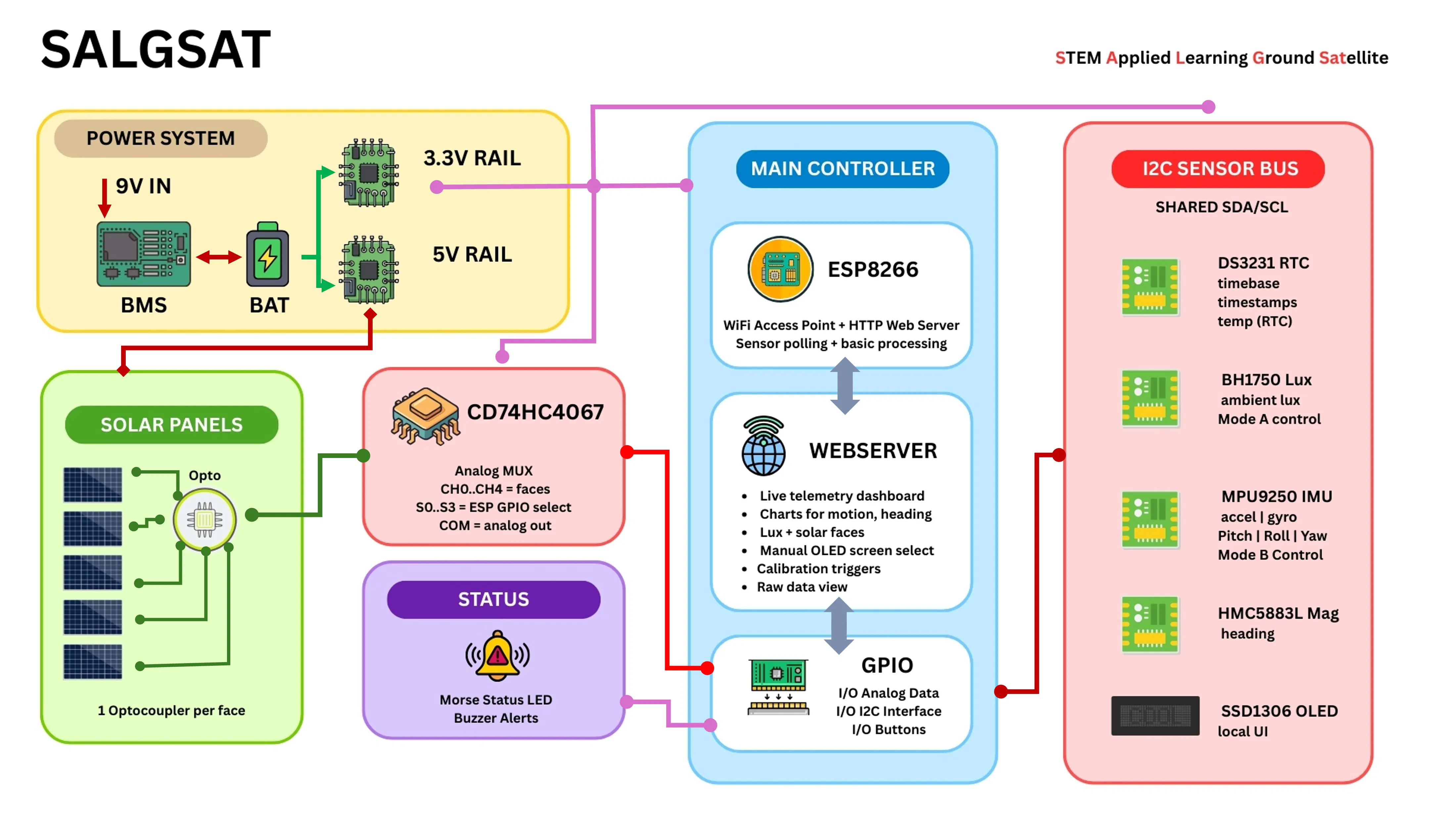
Inside SALGSAT, the architecture reflects this philosophy. The system integrates inertial sensing, magnetic field measurement, light detection, timekeeping, and onboard processing within the tight spatial budget of the 1U structure. The ESP8266 acts as both the central processor and the communications hub, running a lightweight web server while maintaining continuous sensor acquisition.
Another important constraint of the 1U CubeSat standard is mass. A typical 1U CubeSat is limited to about 2 kilograms under the widely adopted CubeSat Design Specification, which forces teams to treat weight as a first class design parameter alongside volume and power. While SALGSAT operates safely on the ground at roughly 590 grams, well below the orbital limit, the project intentionally respects the spirit of that constraint. Keeping the mass low reinforces the same engineering discipline used in real missions, where every gram affects launch compatibility, structural margins, and system tradeoffs. Even in an educational platform, designing with weight awareness helps students and makers think more like spacecraft engineers.
From an educational standpoint, this compact integration is where the magic happens.
Students are not looking at isolated breakout boards spread across a table. They are interacting with a constrained embedded system where mechanical layout, power management, and data flow all intersect. That systems level thinking is exactly what makes CubeSat programs so effective in universities and research labs.
Of course, SALGSAT is not intended for flight. It is a ground based educational platform. But the design intentionally preserves many of the conceptual boundaries that real CubeSat teams must respect. Limited volume. Shared buses. Sensor calibration. Environmental sensitivity. Real time telemetry.
Inside the System ArchitectureOnce the external form factor was locked to the 1U CubeSat envelope, the next challenge was deciding what kind of brain and nervous system would bring SALGSAT to life.
From the beginning, I wanted the platform to be self contained, portable, and frictionless in the classroom. That requirement quickly ruled out designs that depend on USB tethering or external software installations. If students needed drivers, special tools, or network access just to see telemetry, the learning curve would start in the wrong place.
That is why the project is built around the ESP8266.
The ESP8266 hits a very interesting sweet spot for educational embedded systems. It is inexpensive, widely available, well documented, and most importantly, it can operate as a standalone WiFi access point while running an onboard web server. That capability fundamentally changes the user experience.
When SALGSAT powers on, it becomes its own small network in the room. Any phone, tablet, or laptop can connect directly to it and open the mission interface in a standard browser. No internet required. No app installation. No middleware.
For classrooms and labs, that simplicity is extremely powerful.
The internal architecture is organized around a shared I2C sensor bus. Hanging from that bus are the core environmental and inertial sensors that give the platform its telemetry depth. The inertial measurement unit provides acceleration and angular rate data across three axes. A dedicated magnetometer measures the local magnetic field vector, enabling heading estimation and compass demonstrations. A digital light sensor captures ambient illumination levels, while a temperature compensated real time clock provides accurate timestamps for all measurements.
Each of these devices contributes a piece of the overall situational picture.
The firmware running on the ESP8266 continuously polls the sensor suite, performs basic processing, and streams the results both to the onboard OLED and to the embedded web interface. The goal was to maintain a responsive system that feels alive in the user’s hands. When the CubeSat is rotated, the numbers move immediately. When light hits one face, the readings reflect the change in real time.
There is also an intentional architectural decision worth mentioning.
The platform was designed around the ESP8266, but the software structure keeps the door open for migration to ESP32 class hardware. The sensor abstraction and web serving model are portable, which means educators and makers who want additional headroom, Bluetooth capability, or more processing margin can adapt the design without rewriting the entire stack.
Power management inside the unit follows the same practical philosophy. The system can operate from internal lithium ion cells or from an external supply, with onboard protection and monitoring. This allows the device to behave more like a field instrument than a fragile bench prototype.
From the outside, SALGSAT looks compact and simple. Internally, however, it behaves very much like a small embedded telemetry platform. That duality is intentional. The device needs to be approachable for students but technically honest enough to support meaningful experimentation.
The SensorsA CubeSat without telemetry is just a box. What makes SALGSAT interesting in the classroom is the sensor stack and how each piece maps to real spacecraft behavior.
At the heart of the system is a nine axis inertial and motion sensing approach. The IMU provides linear acceleration and angular rate, which allows students to observe how orientation and movement affect onboard measurements. When the unit is tilted, inverted, or rotated, the response is immediate and measurable. This is often the moment when abstract concepts like attitude suddenly click.
Complementing the inertial data is a dedicated three axis magnetometer. This enables heading estimation and introduces an important real world lesson. Magnetic measurements are sensitive. Nearby metal, power supplies, and even desks can influence the readings. That sensitivity becomes a teaching opportunity around calibration, interference, and environmental awareness.
Light sensing is handled in two ways.A digital lux sensor measures ambient illumination, while multiple small solar panels act as directional light inputs. Together they allow students to explore how satellites infer sun direction and why panel orientation matters for energy harvesting in orbit.
Timekeeping is provided by a temperature compensated real time clock, which ensures that telemetry can be properly timestamped. This may sound simple, but it opens the door to time series analysis and longer experiments that mirror real mission workflows.
Individually, each sensor is familiar to most makers. What changes the experience is the integration inside a constrained 1U platform with live streaming telemetry. The system stops feeling like a collection of breakout boards and starts behaving like a small spacecraft bus.
⚠️ Friendly Hardware DisclaimerYou may notice that this build uses a so-called “9-axis” MPU together with a separate external magnetometer. Yes, that is intentional… and yes, there is a story behind it.
Like many makers sourcing parts from the wild west of the component market, I was fortunate enough to receive one of the legendary “mystery” MPU-9250 boards where the internal magnetometer is, let us say, spiritually present but electrically unavailable. In practice, the device behaves perfectly as a 6-axis IMU (accelerometer + gyroscope), while the embedded magnetometer either does not respond reliably or is not actually populated.
Rather than treat this as a setback, I am leaning into it for educational value. For this V1 platform the attitude solution is therefore implemented as:
- 6 axes from the MPU (MPU-9250 / MPU-9150 class device
- 3 axes from a dedicated external magnetometer
For V2 the firmware will include support for:
- true integrated 9-axis MPUs (when the magnetometer is genuinely there)
- modular 6-axis + external MAG configurations (like this build)
So whether you received a pristine genuine chip or one of the more… "spiritual" variants, you will be covered. ;)
Mission Control in Your BrowserOne of the most deliberate design choices in SALGSAT was to make the interface live where the hardware lives. Instead of relying on external software, the ESP8266 runs a lightweight web server and exposes the entire telemetry dashboard through a standard browser.
When the unit powers up, it creates its own WiFi network. Connect to it, open the local address, and you are inside the control panel. That simple flow removes a surprising amount of friction in classrooms and workshops.
The web interface is not just a status page. It streams live sensor data, plots motion and orientation, and allows basic control over the display behavior. Students can rotate the CubeSat in their hands and immediately see the graphs respond. That tight feedback loop is where engagement spikes.
There is also an important systems lesson hidden here. Because the device operates in access point mode and does not depend on the internet, the entire telemetry path is local and deterministic. It becomes much easier to explain data flow, latency, and embedded networking concepts without cloud complexity getting in the way.
For more advanced users, the interface also exposes raw data views and calibration triggers. This encourages experimentation beyond the default visualizations and supports deeper discussions about sensor bias, drift, and environmental effects.
Where It Comes Alive in the ClassroomSALGSAT was never meant to sit quietly on a lab shelf. The real value shows up when students start touching it, rotating it, and asking why the numbers move the way they do.
In a typical classroom flow, the first interaction is physical. A student tilts the CubeSat and watches Pitch and Roll respond in real time. That immediate feedback bridges the gap between motion in their hands and data on the screen. Concepts like gravity vectors and orientation stop being abstract formulas and start behaving like measurable phenomena.
The light sensing experiments are another strong entry point. By shining a phone flashlight across different faces, students can observe how directional illumination affects the readings. This naturally leads into discussions about sun sensing, power optimization, and why satellite orientation matters for energy balance in orbit.
For more advanced groups, the magnetometer opens the door to environmental effects. Students quickly discover that heading is not perfectly stable near metal objects or power supplies. That moment creates a natural pathway into calibration procedures, magnetic interference, and the realities of operating sensors in the real world.
Because the platform hosts its own web interface, the workflow scales easily from a single student to a full classroom. One group can focus on motion analysis while another explores light behavior or timestamped telemetry. The device becomes a shared investigation tool rather than a single user gadget.
What I have consistently observed is that once the hardware starts producing live data, the questions change. Students move from asking what the sensor does to asking why the readings behave the way they do. That shift from passive observation to active investigation is exactly the outcome SALGSAT was designed to encourage.What the CubeSat Is Really Doing in Real Time
Once SALGSAT is powered on and calibrated, the device settles into what I like to call its live awareness state. At this point it is continuously sensing, interpreting, and presenting the environment through both the OLED and the web interface. This is where the platform stops feeling like a project and starts behaving like an instrument.
Let’s start with the onboard OLED.
The display is intentionally treated as the primary local window into the system. Even with no browser connected, SALGSAT cycles through key telemetry views so the unit remains fully usable in standalone mode. The default screen is the digital compass view driven by the magnetometer. It shows heading in degrees along with the corresponding cardinal direction, which gives immediate orientation feedback as the CubeSat is rotated on the desk.
From a teaching standpoint, this is often the first moment of engagement. Students instinctively rotate the unit and watch the heading change. What follows naturally is the deeper question. Why does the value drift near metal objects. Why does calibration improve stability. Why does the reading behave differently in different parts of the room.
Behind that simple display is continuous magnetic vector sampling and normalization. The system is not just detecting direction. It is interpreting a three dimensional field and projecting it into something human readable.
The motion domain adds another layer of richness
SALGSAT uses a hybrid operating model that blends continuous telemetry with simple physical triggers to shift context. By default, the system runs in automatic mode, cycling through key telemetry views while continuously sampling all sensors in the background.
However, the device is also aware of how it is being handled. If the unit is held inverted for a few seconds, the firmware detects the sustained orientation change and prioritizes the inertial analysis screens, bringing acceleration, angular rate, and attitude data to the front.
Likewise, sustained exposure to strong light is interpreted as an environmental cue, automatically switching the display focus to the solar panel and lux monitoring views.
For structured demonstrations, a manual override is available through the web interface, allowing the OLED to be locked to a specific screen.
Using the inertial sensors, SALGSAT computes Pitch and Roll angles that describe how the body is tilted relative to gravity. Pitch reflects forward and backward inclination, while Roll represents lateral tilt. When the unit is inverted and held steady, the system also recognizes the change in orientation state and updates the display logic accordingly.
Yaw is handled differently. Rather than being derived purely from the gyroscope, it is stabilized using the magnetometer heading. This mirrors a simplified version of real small satellite attitude reasoning, where inertial data alone is not sufficient for long term directional awareness.
For educators and engineers, this creates a valuable teaching moment. Students can observe that angular rate and absolute heading are not the same thing. One describes motion. The other describes orientation relative to the environment.
The platform also exposes raw acceleration across the three axes. When the CubeSat is resting on a table, the resultant magnitude sits close to one g, representing gravity. If the unit is moved quickly or gently shaken, the transient response becomes visible in both the numeric data and the live graphs. This makes it easy to demonstrate concepts like vector magnitude, dynamic motion, and even free fall behavior in a controlled setting.
Light sensing introduces a different kind of interaction
The lux sensor provides calibrated ambient light measurements, which are useful for repeatable experiments. But the more interesting behavior often comes from the distributed solar faces. When a directional light source moves around the CubeSat, the relative response across faces changes in a very visual way. Students quickly understand that orientation in space is tightly coupled to energy capture.
What makes this particularly effective is the event driven behavior built into the firmware. Certain modes can be triggered by environmental conditions rather than just button presses. Sustained bright light, for example, can push the system into the solar and lux observation mode. Physically inverting the unit for a few seconds shifts the focus toward the inertial domain. These small interaction patterns encourage exploration without requiring constant instructor intervention.
Time awareness
Every telemetry update is anchored by the real time clock, which maintains stable time even when the main system is powered down. For classroom work this enables longer experiments where students can compare behavior across different times of day or lighting conditions. For engineers, it reinforces the importance of temporal context in any meaningful telemetry pipeline.
The hardware is simple enough to understand, but the behavior is rich enough to provoke real technical questions.
Final ConsiderationsBy the time most people finish their first interaction with SALGSAT, the same question usually appears. What else can this platform do. That question is exactly where the project was meant to lead.
Although the baseline unit is fully functional as an educational CubeSat, the architecture was intentionally left open for expansion. Builders who want more processing headroom can migrate the firmware to an ESP32 class device with minimal restructuring. The sensor bus is already organized in a way that supports additional I2C peripherals, which makes it straightforward to experiment with environmental sensors, storage modules, or even simple radio telemetry extensions for ground station style exercises.
Some ideias I have for V2:
- RF Telemetry Link Between Two Stations: Add a low power RF module to enable real over the air communication between the CubeSat and a ground station. This introduces packet handling, link reliability, and basic space communications concepts. It was intentionally left out of the base design to keep the learning curve gentle.
- Bidirectional Command and Messaging System: Extend the firmware to support command uplink and telemetry downlink between the web interface and the CubeSat. This turns the platform into a true command and control exercise where users can send instructions and receive structured responses in real time
- True Solar Charging Power Path: Rework the solar panels from light sensors into an actual energy harvesting system with a proper charge controller and power management stage. This adds valuable lessons around power budgeting, efficiency, and orbital energy constraints, but requires tighter electrical and mechanical design.
- Onboard Data Logging and Mission Playback: Add SPI flash or microSD storage to record telemetry over time and replay mission sessions through the web dashboard. This enables longer experiments, post analysis, and introduces students to real mission data workflows.
- true integrated 9-axis MPUs (when the magnetometer is genuinely there) OR
- modular 6-axis + external MAG configurations (like this build)
From a classroom perspective, this flexibility allows SALGSAT to scale with the audience. For younger students it can remain a guided instrument focused on orientation and light behavior. For technical programs and engineering courses, the same hardware can become a platform for firmware modification, sensor fusion experiments, data logging strategies, or network behavior analysis. The goal was never to freeze the device into a single fixed use case, but to provide a stable core that invites deeper exploration.
There is also a broader reason this kind of platform matters.
Space systems are becoming more accessible, but the conceptual gap between theory and real hardware is still significant in many learning environments. When students can physically manipulate a device that behaves like a constrained telemetry platform, the learning curve changes. They begin to think in terms of signals, noise, timing, power, and environmental effects rather than just abstract diagrams.
For educators, SALGSAT offers a repeatable and classroom safe way to introduce real spacecraft concepts without requiring specialized infrastructure. For makers and engineers, it provides a compact sandbox for exploring embedded telemetry, sensor behavior, and local web based control architectures inside a realistic volume envelope.
What started on my bench as a curiosity driven build has steadily evolved into something more intentional. Not a satellite that goes to orbit, but a system that brings orbital thinking down to the desk where more people can experiment with it.
If you build one, modify one, or deploy it in a classroom, I would genuinely love to see where you take it next.
Additional sourcesOfficial guides and specs - https://www.cubesat.org
NASA CubeSat Launch Initiative (CSLI) - https://www.nasa.gov/kennedy/launch-services-program/cubesat-launch-initiative/
ESA – European Space Agency CubeSat Office - https://www.esa.int/Enabling_Support/Preparing_for_the_Future/Discovery_and_Preparation/CubeSats
CubeSat Design Specification (CDS) - https://static1.squarespace.com/static/5418c831e4b0fa4ecac1bacd/t/62193b7fc9e72e0053f00910/1645820809779/CDS%2BREV14_1%2B2022-02-09.pdf


_3u05Tpwasz.png?auto=compress%2Cformat&w=40&h=40&fit=fillmax&bg=fff&dpr=2)

Comments