


We design and manufacture flight controllers at DADA Technology. Every week, integrators and builders ask us the same question: "Should I go with an F405, an F722, or an H743?" The honest answer surprises most of them. All three boards share the same 30.5mm mounting pattern and eight motor outputs, so almost any frame will physically accept any of them. What actually differs is computing headroom, sensor configuration, and flight-data logging.
So we built this project as a spec-driven comparison of our D-F405 V3, D-F722 V2, and D-H743 — with a simple decision rule for each frame type at the end. No marketing, just datasheets.
All three boards run STM32 processors from different performance tiers. The F405 V3 uses an STM32F405RGT6 (Cortex-M4), the F722 V2 an STM32F722RET6 (Cortex-M7), and the H743 an STM32H743VIH6 (Cortex-M7, the top tier). Think of it as a ladder: value, then performance, then maximum headroom.
The D-F405 V3 pairs its STM32F405RGT6 with an ICM42688P gyro and an SPL06 barometer. It carries onboard OSD, a 16MB BlackBox on microSD, and Bluetooth for wireless tuning — a small thing that saves real time on the bench.
Digital FPV pilots get extra convenience: the board supports DJI Vista and camera switching directly, plus a Type-C port for quick firmware updates. Receiver support spans ELRS, CRSF, S.BUS, FrSky, Futaba, FlySky, TBS Crossfire, and DSMX. At 9.6g and 36×36mm, it is the simplest route to a clean 3–5 inch freestyle or cinewhoop build.
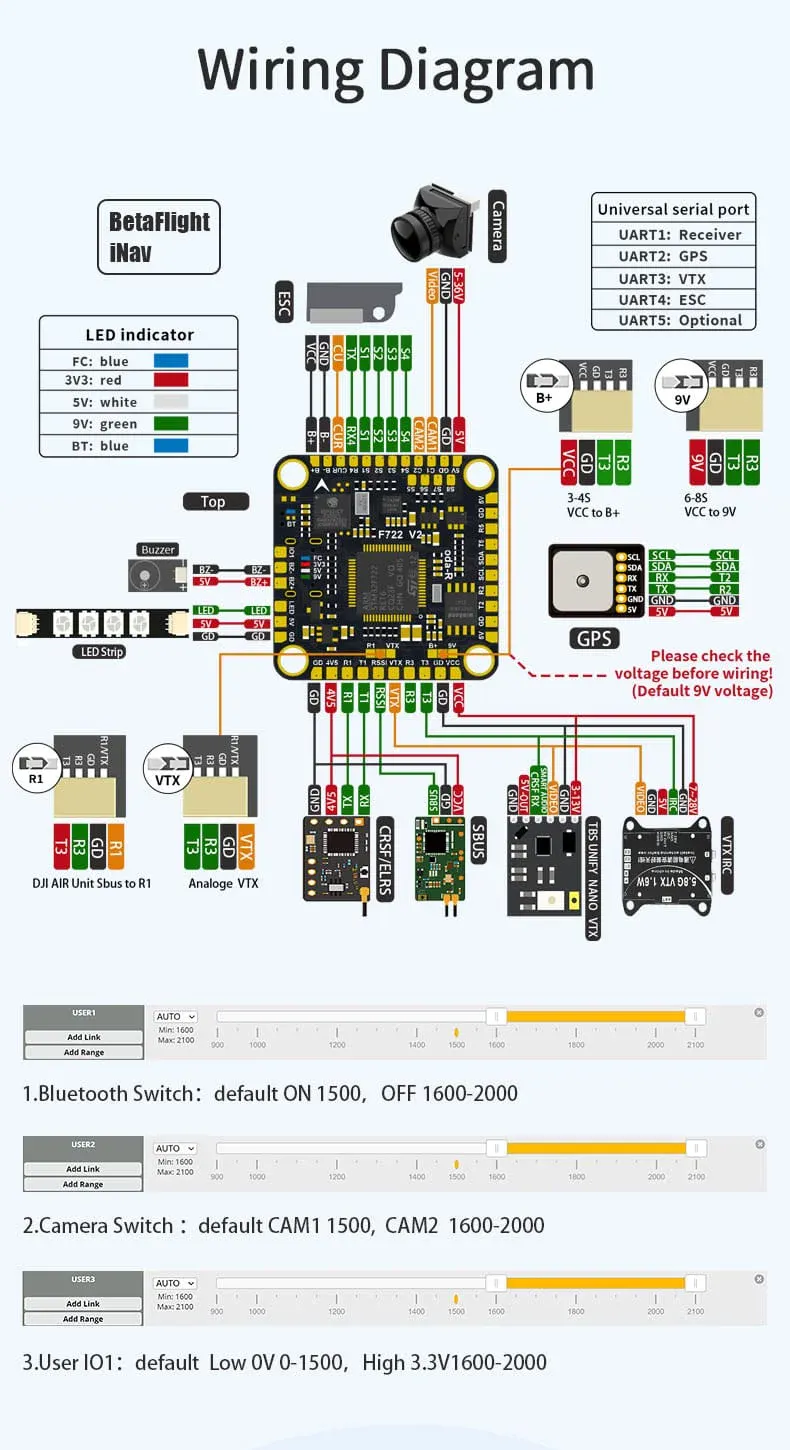
The D-F722 V2 steps up to an STM32F722RET6 while keeping the same ICM42688P gyro and adding a BMP280 barometer. It supports both BetaFlight and iNav — which matters if you race on one firmware and cruise long-range on the other.
Connectivity is the strong suit: five UARTs, eight motor outputs, and three BEC rails (4.5V/2A, 5V/2.5A, 9V/3A) power a full racing stack with room for peripherals. The board weighs 9.4g at 37×37mm, so it drops into any standard 30.5mm stack without a weight penalty.
The D-H743 is the flagship of the three. Its STM32H743VIH6 delivers the most processing headroom, and its 128MB BlackBox records far longer tuning sessions than the 16MB on the other two boards. For anyone serious about PID work, that difference is the whole story.
Sensor configuration is unique here: the standard MPU6000 can be joined by two optional BMI270 gyros, plus a choice of BMP280, DPS310, or MS5611 barometers — the only board of the three set up for gyro redundancy. With 3–6S direct input (12V–25.2V), it targets heavier long-range and precision builds.
Here is the decision rule we give integrators:
- 3–5 inch freestyle or cinewhoop, digital FPV convenience → D-F405 V3
- X8 racing frames, BetaFlight + iNav, heavy peripheral loads → D-F722 V2
- 6S long-range, gyro redundancy, deep BlackBox tuning → D-H743
If your build sits between two rules, pick the cheaper board first — the shared 30.5mm mounting means upgrading later costs you one afternoon, not a new frame.
Firmware TargetsEach board has its own firmware target name, so confirm it before you flash:
# Firmware targets (Betaflight Configurator → Firmware Target)
D-F405 V3  ->  RCF405V3 / RCF405V3SD
D-F722 V2  ->  RCF722V2
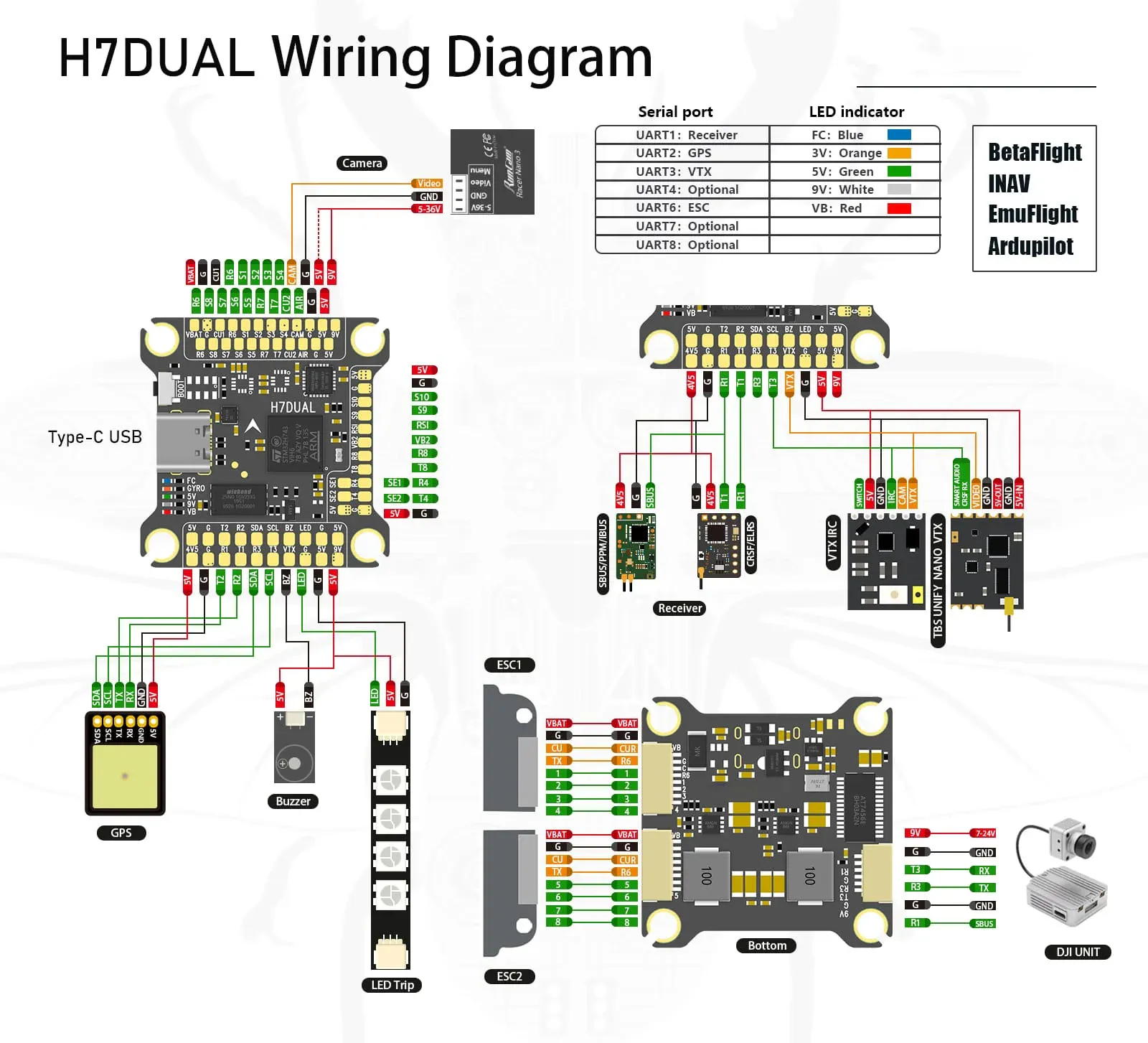
D-H743 -> RCH7DUALWe deliberately don't publish loop-rate benchmarks or BlackBox traces here — those numbers shift with every firmware release and every wiring choice, and we'd rather not publish data we can't stand behind. This project compares what is printed on the datasheets. If you want the continuously updated version with wiring notes, we keep it in our full F405 vs F722 vs H743 guide.
- We are bench-running the three boards on identical frames, and we will add build photos and logs to this project as they come in — follow it if you want the updates.
- Questions about a specific frame? Ask in the comments. We answer all of them.
Kui Wong — DADA Technology
D-F722 V2 Wiring Diagram


Comments