

Overview
Arduino and Qualcomm kick off Hackster’s first competition of 2026! We’re teaming up with Edge Impulse, Foundries, and an incredible lineup of ecosystem partners HuggingFace, SparkFun, Seeed Studio, Farnell, and STMicroelectronics to bring to life the year’s greatest contest for developers everywhere.
And here’s the best part: We’re giving away 300 UNO Q boards to help you bring your ideas to life!
This is your chance to push boundaries, create something extraordinary, and inspire the future of connected intelligence. Whether you’re into AI, IoT, edge computing, or just love building cool stuff, this contest is for you.
Top 5 Reasons to Get Excited About UNO Q + App Lab1. Dual-brain power: UNO Q combines a Qualcomm Dragonwing™ QRB2210MPU running Linux with an STM32 MCU for real-time control perfect for AI, IoT, and robotics.
2. Hybrid development made simple: Use AppLab to seamlessly mix Arduino sketches, Python scripts, and AI models in one workflow. Program the MCU with Arduino IDE and the MPU with Linux tools.
3. AI and edge computing ready: Built for machine learning at the edge, with native integration for Edge Impulse and support for computer vision, audio ML, and HuggingFace models.
4. Rich connectivity & expansion: Enjoy Wi-Fi 5, Bluetooth 5.1, HDMI, USB-C, camera/display connectors, plus classic Arduino headers and Qwiic for sensors.
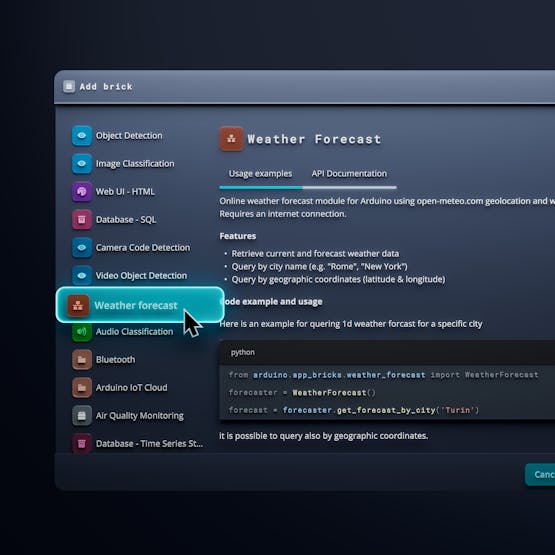
5. Rapid prototyping with Bricks: AppLab’s modular “Bricks” lets you add AI, web UIs, and APIs fast accelerating your path from idea to working prototype.
Ready to make your mark? Join us and let’s build the next big thing together!

We’re giving away 300 Arduino UNO Q (4GB) boards to help you kickstart your vision or grab one now and get a head start!
We’re on the hunt for groundbreaking solutions that harness the power of Arduino UNO Q to tackle real-world challenges in robotics, home automation, gaming, industrial IoT, and social impact. There are no limits—we want to see your most innovative ideas, powered by AI, come to life.
What’s in it for you?
- Global spotlight for your project
- Generous cash prizes
- Best in Show: a paid trip to Maker Faire Rome 2026 to show & share
This is your platform to showcase creativity, technical mastery, and problem-solving skills. Ready to make your mark? Join the contest and build the future!
Your Arduino UNO Q project could be addressing any of these scenarios:
Industrial IoT
- Smart Predictive Maintenance System: Monitors vibration, temperature, and motor current in industrial machines using sensors connected to UNO Q. Use AI models (via Edge Impulse) to predict failures before they happen, reducing downtime and saving costs. Add a dashboard in App Lab for real-time alerts and analytics and even connect with AWS Greengrass for extra points.
- AI-Powered Energy Optimization: Tracks energy consumption across factory equipment and uses machine learning to optimize usage during peak hours. Combines IoT sensors with AI to cut energy bills and reduce carbon footprint. Integrate with cloud services (AWS or Arduino Cloud) for remote monitoring.
- Autonomous Quality Control Station: Uses a camera module with UNO Q to inspect products on a conveyor belt for defects using computer vision. Brings AI-driven quality assurance to small-scale manufacturing without expensive hardware. Display results on an HDMI screen and log data to AppLab for analysis.
Home Automation
- AI-Powered Smart Security Hub: Use a camera and motion sensors to detect people, pets, or packages at your door. AI models classify events and send alerts to your phone. Combine computer vision with real-time control for lights or alarms. Integrates with AppLab for a custom dashboard. Add voice control via HuggingFace models for natural interaction.
- Intelligent Energy Management System: Monitors energy usage of appliances and optimizes schedules based on patterns and peak hours. Use ML to predict consumption and reduce costs. Can integrate with AWS or Arduino Cloud for remote control. Add a web UI in AppLab for live stats and control.
- Adaptive Climate Control: Track temperature, humidity, and occupancy to adjust HVAC systems dynamically. Use AI to learn user preferences and environmental conditions for maximum comfort and efficiency. Add predictive maintenance for HVAC units using Edge Impulse models.
Robotics
- Autonomous Delivery Robot: Navigate indoor or outdoor environments using cameras and sensors, powered by UNO Q’s AI capabilities. Combine computer vision for obstacle detection with real-time motor control for smooth navigation. Use App Lab for remote monitoring and route planning via a web dashboard.
- AI-Powered Robotic Arm: Performs pick-and-place tasks with precision, learning from user input and optimizing movements using ML. Great for industrial automation or maker projects—integrates Edge Impulse for gesture recognition or object classification. Add HDMI output for a live control interface and cloud connectivity for remote operation.
- Social Assistance Robot: Interacts with users using voice and vision, recognizing faces and responding to commands. Use HuggingFace models for natural language processing and UNO Q’s dual-core architecture for real-time responses. Use AppLab to build a custom UI for managing interactions and logging data.
Gaming
- AI-Powered Retro Gaming Console: Turn UNO Q into a mini console running classic games with AI enhancements, like adaptive difficulty or voice-controlled menus. Combine Linux-based emulation with Arduino hardware for custom controllers and LED effects. Use AppLab to build a game launcher UI and integrate cloud leaderboards.
- Smart Multiplayer Arcade Cabinet: Create a connected arcade experience where players can compete remotely. UNO Q handles game logic and real-time networking. Add IoT features like score syncing, live chat, and AI-driven matchmaking. Include HDMI output for big-screen play and Bluetooth for wireless controllers.
- Mixed-Reality Gaming Robot: A robot that interacts with players in physical space while syncing with a digital game. Think laser tag meets AR. Use computer vision for tracking and AI for dynamic gameplay, blending physical and virtual worlds. Harness AppLab to host the game dashboard and manage multiplayer sessions.
Social Impact
- AI-Powered Wildlife Monitoring System: Deploys cameras and acoustic sensors in natural habitats to detect and classify species using Edge Impulse ML models. Help conservationists track endangered species and prevent poaching in real time. Use AppLab to build a dashboard for live data visualization and alerts.
- Smart Climate Data Logger: Collect temperature, humidity, and air quality data from remote areas and upload it to the cloud for analysis. Support climate research and disaster prediction with low-cost, scalable IoT nodes. Integrate predictive analytics to forecast environmental changes.
- Community Water Quality Monitor: Measures pH, turbidity, and contaminants in local water sources, sending alerts when unsafe levels are detected. Empower communities to take action on clean water access and health. Use AI to predict contamination trends and integrate with mobile apps for easy reporting.
Additional Considerations
- Sustainability: Projects that focus on sustainable solutions, such as reducing energy consumption or minimizing waste, will be highly regarded.
- User Experience: Pay attention to the user experience. How intuitive and user-friendly is your solution? Can it be easily integrated into existing systems or workflows?
- Scalability: Consider the scalability of your project. How can it be expanded to serve a larger audience or be applied in different contexts?
We encourage you to think outside the box and explore the full potential of the Arduino UNO Q. Whether you’re a seasoned developer or a newcomer to the field, this challenge is your opportunity to make a meaningful contribution and be recognized for your efforts.
Prizes
Best in Show


- Paid Trip to Maker Faire Rome 2026 ($3,000)
- Samsung XR device (up to $2,000)
- Public Showcase of Your Project
- Feature Blog on Arduino.cc
- Qualcomm Dragonwing Swag
- Be one of the first people to get access to Arduino's newest product: Arduino VENTUNO Q!
- Total Value: $5,000+
Best in Robotics

- $3,000 Cash Prize
- Feature Blog on Arduino.cc
- Qualcomm Dragonwing Swag
- Be one of the first people to get access to Arduino's newest product: Arduino VENTUNO Q!
Best in Industrial IoT

- $3,000 Cash Prize
- Feature Blog on Arduino.cc
- Qualcomm Dragonwing Swag
- Be one of the first people to get access to Arduino's newest product: Arduino VENTUNO Q!
Best in Gaming

- $3,000 Cash Prize
- Feature Blog on Arduino.cc
- Qualcomm Dragonwing Swag
- Be one of the first people to get access to Arduino's newest product: Arduino VENTUNO Q!
Best in Home Automation

- $3,000 Cash Prize
- Feature Blog on Arduino.cc
- Qualcomm Dragonwing Swag
- Be one of the first people to get access to Arduino's newest product: Arduino VENTUNO Q!
Best Social Impact

- $3,000 Cash Prize
- Feature Blog on Arduino.cc
- Qualcomm Dragonwing Swag
- Be one of the first people to get access to Arduino's newest product: Arduino VENTUNO Q!
Resources
Arduino UNO Q: Your New Gateway to Edge AI Innovation
The Arduino® UNO Q is a single-board computer featuring a Qualcomm® Dragonwing™ QRB2210 MPU (quad-core Arm® Cortex®-A53 running Debian Linux) and an STMicroelectronics STM32U585 MCU (Arm® Cortex®-M33 running Arduino Core on Zephyr OS). The microcontroller and Linux system communicate via Bridge (Arduino’s RPC library), enabling sketches to access Linux services and Linux applications to interface with peripherals for real-time tasks.
UNO Q includes embedded eMMC storage (16 GB or 32 GB) and LPDDR4X SDRAM (4 GB) for smooth operation. It includes dual-band Wi-Fi 5 and Bluetooth 5.1 for wireless connectivity, a USB-C connector supporting power delivery input and video output, and Arduino-compatible headers that allow expansion with shields, carriers, and accessories.
UNO Q integrates seamlessly with Arduino App Lab, enabling developers to combine Arduino sketches, Linux applications, and AI models in one environment. App Lab can run directly on the board or from a connected PC, offering ready-to-use examples, and the flexibility to create custom apps tailored to your projects.

Key Features
Qualcomm Dragonwing™ QRB2210
Includes the powerful Qualcomm Dragonwing™ QRB2210 processor featuring:
- Quad-core Arm® Cortex®-A53 @ 2.0 GHz
- Adreno GPU 3D graphics accelerator
- 2x ISP (13 MP + 13 MP or 25 MP) @ 30 fps
STM32U585 Arm® Cortex®-M33 32-bit MCU
The UNO Q integrates the STM32U585 microcontroller featuring:
- Arm® Cortex®-M33 up to 160 MHz
- 2 MB flash memory
- 786 kB SRAM
Single-Board Computer
You can use the UNO Q as a standalone single-board computer leveraging its built-in Debian Linux environment. By using a USB-C dongle with external power delivery connected to the UNO Q USB-C port, you can connect:
- HDMI display
- Mouse and keyboard
- USB camera, USB drive, USB microphone, USB headphones
- Ethernet cable
- microSD card
Debian Linux OS
The Arduino UNO Q features a built-in Debian Linux environment with upstream support powered by its high-performance application processor, allowing you to develop in a familiar Linux environment without additional hardware.
Compatibility and Ease of Use
UNO Q is designed with interfaces that are compatible with a variety of embedded development board peripherals, reducing the implementation difficulty and cost. This means you can focus on your core project without worrying about the logistics of integrating additional components.
Easily Expandable
Take the UNO Q even further with its expandability leveraging the following features:
- Qwiic connector for seamless compatibility with Modulino nodes
- Traditional UNO headers allowing you to stack official or custom shields on top of the UNO Q
- New bottom high-speed connectors for using carriers to connect MIPI-CSI cameras, MIPI-DSI displays, analog audio, and much more
Multiple IDE Compatibility
The UNO Q is designed for flexible development, with first-class support for the Arduino App Lab and compatibility with the latest Arduino IDE 2.0+.
- Arduino App Lab – Develop for both the onboard MPU and MCU with ease. Recommended for a full development experience.
- Arduino IDE 2.0+ – Program only the MCU using the beloved Arduino IDE.
Contest Status
Timeline
Registration opens
February 19, 2026 at 12:30 PM PST
Competition begins
March 3, 2026 at 12:00 PM PST
Applications for hardware close
April 5, 2026 at 11:59 PM PDT
Hardware recipients announced
May 6, 2026 at 5:00 PM PDT
Submissions close
August 30, 2026 at 11:59 PM PDT
Winners announced by
Sep 25, 2026